Protest rally of disabled people in Iran coincides with International Day of Persons with Disabilities; What do the protesters want?
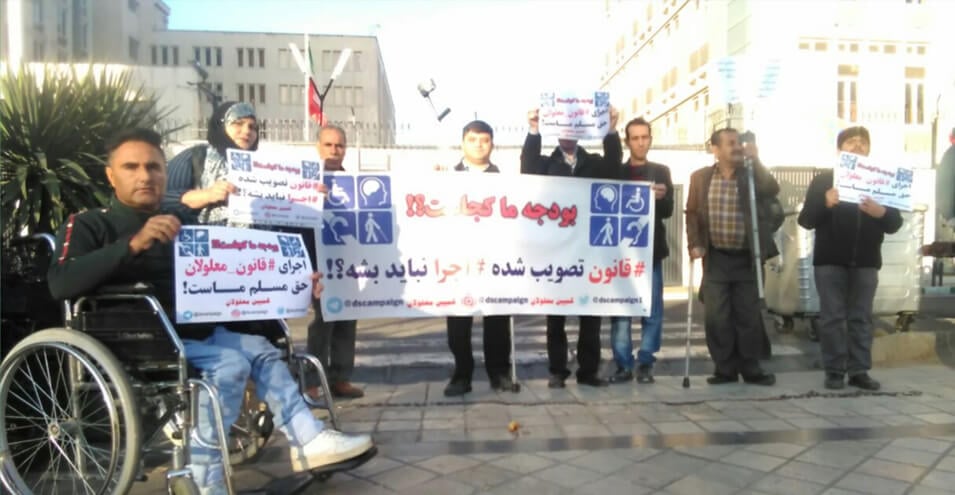
Coinciding with the International Day of Persons with Disabilities, a number of disabled people held a protest rally regarding the lack of funding allocated to the "Protection of Persons with Disabilities" law.
People with disabilities in Iran gathered in front of the Planning and Budget Organization on Monday, December 1, coinciding with the International Day of Persons with Disabilities, to protest the lack of provision and allocation of funds for the implementation of the "Law on the Protection of the Rights of Persons with Disabilities" in next year's budget bill.
These people held a protest rally in front of the Planning and Budget Organization while chanting slogans such as "The law has been passed, shouldn't it be implemented?!", "They blinded the disabled, they beheaded the law," and "If the law is not implemented, the protests will increase."
The need to pass a law to protect the rights of the disabled was raised in the 1980s, and after years of follow-up, it was finally passed in the Islamic Consultative Assembly in May of this year. However, contrary to expectations, the necessary funds for the implementation of this law were not foreseen in the 2019 budget.
Also, organizations and groups related to the disabled issued a statement in early December of this year in protest against the lack of budget provision for this law, stating: "If the budget required for the Law on the Protection of the Rights of the Disabled is not considered and provided, we reserve the right to nationwide protests in accordance with the Constitution of the Islamic Republic and the current laws of the country."
Negin Hosseini, a disability rights activist, explained the law passed by the Voice of America, titled "Supporting the Disabled in Iran," stating: "The disabled were not counted in the last census conducted in Iran. This shows that there is a single mindset that does not take into account people with disabilities. In such circumstances, one would expect such a consequence to occur and no budget would be allocated to them."
He emphasized: "Despite the fact that people with disabilities have achieved great progress through the efforts of their families and many supporting groups and organizations, the government, legislative, and executive sectors have failed to move forward with these advances."
The lack of allocation of the necessary funds for the law to protect the disabled comes at a time when, according to a member of the parliamentary faction for the protection of the rights of the disabled, 12 to 14 percent of Iranians have disabilities, and Iran is among the top ten countries in the world in this regard.
Previously, Mohammad Shariatmadari, Minister of Labor and Social Welfare, had announced that 25,000 disabled people are added to the Iranian population annually and 240,000 children have been identified, 150,000 of whom are studying in special schools.
However, it does not seem that the Islamic Republic's authorities, despite the passage of the law, have taken the issue of "supporting the disabled" seriously; as Behrouz Maroti, director of the campaign to pursue the rights of people with disabilities, told Jahan Sanat newspaper: "From the beginning, there was no budget for the disabled, which is now being eliminated."
According to Mr. Maroti, the Welfare Organization quickly conducted the necessary validations to determine the necessary funds for the disabled and allocated 12 billion for this issue. However, this issue was not taken into account and, as in previous years and without considering the validation, 12 percent was added to the welfare budget like every year.
He emphasized: "With these conditions, the disabled returned to the situation they were 14 years ago, and all the efforts we made in the past few years were in vain."
However, the lack of support for the disabled community in Iran is in a situation where, according to the Constitution of the Islamic Republic, based on the structure of the comprehensive welfare and social security system, the Comprehensive Law on the Protection of the Rights of Persons with Disabilities, the Universal Convention on the Rights of Persons with Disabilities, and other documents, attention to the rights of this segment of society has been emphasized.
Source: Voice of America