New sanctions on Iran for supporting terrorism and human rights violations approved in the US Senate
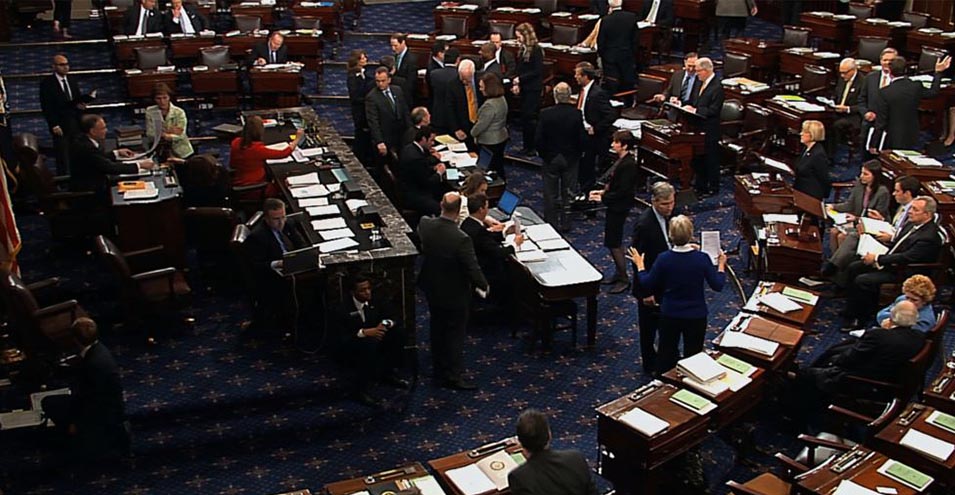
On Thursday, the majority of the US Senate voted to amend the new sanctions bill on the Islamic Republic of Iran, known as the "Countering Iran's Destabilizing Actions" bill.
In a vote that required 51 votes, an overwhelming majority of senators voted in favor of the new Iran sanctions amendments. 98 senators voted in favor and only two senators opposed it.
Thus, the Senate bill becomes law after being introduced in the House of Representatives and signed by the President.
The “Countering Iran’s Destabilizing Actions” bill was introduced to the committee by Republican Senator Bob Corker, chairman of the Foreign Relations Committee, on March 23. The bill was temporarily shelved during the Iranian presidential election, but on June 24, it passed by an 18-3 vote and was presented to the Senate floor for final approval.
The plan to "counter Iran's destabilizing actions" targets the Islamic Revolutionary Guard Corps terrorist network, the production chain of Iran's missile program, and domestic repression in Iran.
In his first reaction to the passage of this bill in the Senate Foreign Relations Committee, Bob Corker said, "We will not limit ourselves to the Iran nuclear deal in confrontation with Iran. This passage showed that we will finally hold Iran accountable for its destabilizing non-nuclear actions."
What are the details of this plan?
According to this plan, if approved in the Senate, the US government must approve new sanctions against individuals and entities active in the development of Iran's missile programs within 90 days.
Another plan would also directly sanction the Islamic Revolutionary Guard Corps (IRGC). If approved, this would be the first time the IRGC has been sanctioned. The US had previously sanctioned the IRGC's Quds Force in 2007.
The plan to "counter Iran's destabilizing actions" has three axes:
Ballistic Missile Sanctions: Under this plan, it targets individuals associated with Iran's ballistic missile program and those who do business with them.
New terrorism sanctions: For the first time, the US is imposing sanctions on Iran's Islamic Revolutionary Guard Corps for allegedly supporting terrorism.
Enforcing an arms embargo: If this bill becomes law, all individuals involved in the sale, supply of parts, repair, and transfer of tanks, armored vehicles, high-caliber weapons, combat aircraft, attack helicopters, ships, missiles, and missile systems to Iran will be sanctioned by the President and their assets will be frozen.
Sanctioning human rights violators: According to this plan, any person identified by the US State Department as a human rights violator in Iran will be placed on the sanctions list.
Part of this plan, which must be approved by Donald Trump, states that the US President can use his authority to temporarily suspend the imposition of certain sanctions under certain circumstances.
Former US Secretary of State John Kerry previously urged US lawmakers in a series of tweets to refrain from imposing any further sanctions on Iran. Mr. Kerry warned that passing further sanctions against Iran could violate the JCPOA.
On Wednesday, June 14, the U.S. Senate added Russia sanctions to the new Iran sanctions bill. Senators said they agreed to new sanctions against Moscow in response to Russia's interference in last year's presidential election as well as its aggressive actions in various parts of the world.
The White House had previously said that it was not yet ready to announce the president's position on sanctions against Moscow or Tehran, and that more information would be announced later.
Source: Voice of America