Removal of art and foreign language majors from some Iranian universities
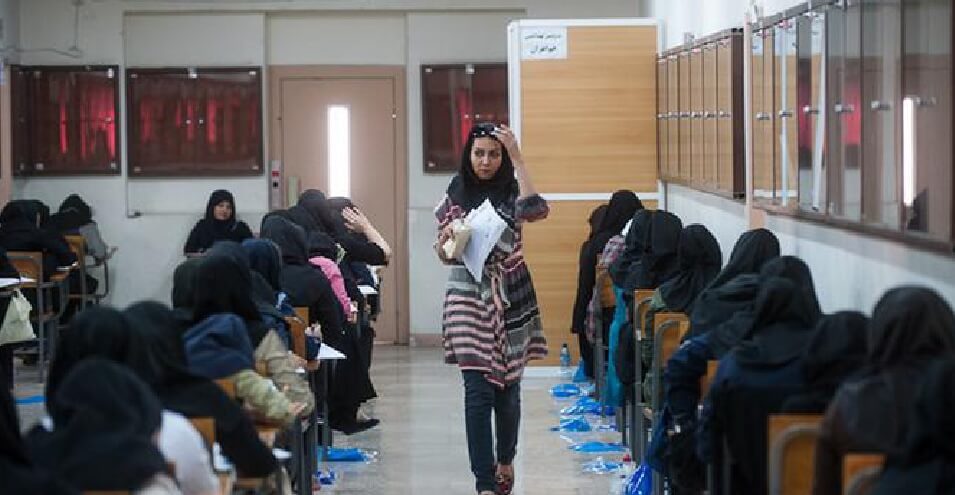
This year, there has been a significant reduction in the capacity of some academic fields in Iranian universities, including Persian literature, art, foreign languages, archaeology, directing, and many others. The curriculum of 100 fields has also been changed.
According to a report published by Hamshahri, in this year's entrance exam, about 60 percent of universities that offer Persian language and literature at the undergraduate level have reduced their admission capacity by 30 percent. The capacity of Arabic language and literature has also been reduced.
The report says: "In some universities, such as the University of Mazandaran, this field has faced a 40 percent decline."
This reduction includes various fields in universities across Iran, and the list is very long: geography, art and foreign languages, archaeology, university writing and painting, dramatic literature and English language teaching, restoration of historical monuments, television directing, and painting and handicrafts.
The report states: "Some universities, such as Shiraz University of Art, have announced that, unlike last year, they do not have dormitories for new admissions; according to the university's announcement, in fields such as dramatic literature, visual communication, archaeology, and museums, which previously had no gender restrictions in their admissions, this year the admission capacity will be divided equally between male and female candidates."
Changing the content of 100 courses
Another issue that students in 100 academic fields will face is the change in their curricula. This change will affect the humanities and engineering fields the most.
Mohammad Reza Ahanchian, Director General of the Higher Education Planning Office, said: "In total, we have three thousand curricula in university fields, many of which date back to before or at the beginning of the Islamic Revolution. The Higher Education Planning Office has reviewed 360 curricula over the past four years."
About 100 curricula have been revised, and these changes "will be implemented in universities for the first time starting from the new academic year."
What is the cause?
Abdolreza Ohadi Hamedani, Director General of the Higher Education Development Office of the Ministry of Science, told Hamshahri that capacities should be "allocated based on the number and rank of faculty members of each university" and "therefore, this year we are facing a gradual decline in the capacity to accept some majors, both in public universities and in non-profit institutions and universities," because they "did not have enough faculty."
According to him, universities may increase or decrease the capacity of certain majors "based on market needs or market saturation."
Regarding the reason for removing some majors from this year's national entrance exam booklet, he said that this is also left to the discretion of the university itself, and "universities can even accept students in majors they are licensed to offer in one year at their own will and for any reason, and reduce their admission capacity to zero in one year. Also, one of the reasons for the zero admission of students in some majors is the accumulation of graduates in those majors."
Another reason, according to what he said, is that "a field becomes completely obsolete and, as a rule, no university can accept students in that field anymore."
Lack of demand in the labor market
The Director General of the Higher Education Development Office of the Ministry of Science has also cited "lack of demand or an inappropriate labor market" as one of the reasons for eliminating some majors.
Hamshahri quoted him as writing: "Among the various groups, we are witnessing a sharp decrease in applicants in the basic sciences group. When there is no suitable job for the applicant in society, the number of applicants for those fields decreases."
It is not clear what the purpose of eliminating many courses and changing the content of some courses is, and whether it is really to comply with global standards. The history of manipulations by the Islamic Republic's Ministry of Science does not provide a positive answer to this question.
For years, the Islamic Republic has sought to empty the humanities field of content that meets global standards and change the educational content of universities in this regard.
Last year, Sadeq Ziba Kalam, a professor of political science at the University of Tehran, announced on his Telegram channel the fundamental changes in the political science department at the University of Tehran and strongly criticized its new content. He wrote: “The number of courses specifically for the political science department has decreased, and 45 credits of Islamic courses have taken the place of the courses specifically for this department.”
Source: DW