The risk of civil war in Iran following the collapse of the Islamic government
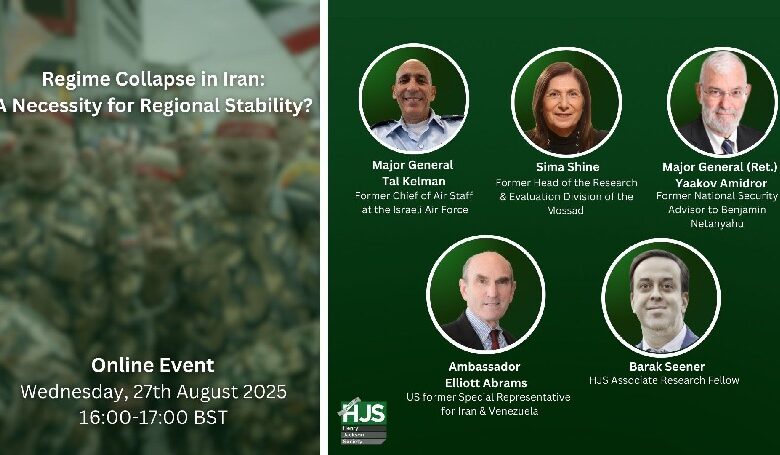
The Henry Jackson Institute, a think tank, held a meeting to examine the collapse of the Islamic Republic government and the risk of civil war.
Experts from the Henry Jackson Institute warned during a meeting: "The collapse of the Iranian government could lead to a civil war, the solution to which is the formation of a unified opposition and avoiding a power vacuum."
The UK-based think tank discussed the future of Iran after the possible collapse of the Islamic Republic's government during the online meeting. Researchers and political activists warned of the risk of a governance vacuum and subsequent civil war in Iran, and stressed that a Syria or Iraq scenario must be avoided at all costs for the Iranian people.
The participants in the meeting emphasized that the transition from the Islamic Republic must be swift and smooth, and that only by supporting and strengthening an effective opposition can civil war be prevented. They considered the possibility of the spontaneous collapse of the Iranian government to be very small and emphasized the need for coordinated strategic planning by the West.
Experts at the meeting, while referring to Iran's recent defeats in the region, said: "Israel's targeted attacks in April 2024 and June 2025 have weakened Iran's defense capabilities, the destruction of Iranian proxy groups such as Hamas and Hezbollah by Israel has also affected Tehran's regional influence, and the overthrow of Bashar al-Assad's government has also brought another defeat for Iran." However, the attendees predicted that Tehran will continue to seek to rebuild terrorist networks and continue its nuclear and missile programs.
According to them, the US and Israeli attacks have failed to completely halt Iran's nuclear program because Tehran had moved the enriched material before the attacks.
One of the central concerns of the meeting is the possibility of the IRGC gaining dominance after the fall of the government. Experts emphasized that the IRGC is not just a military force, but also operates as a huge economic consortium with energy, automotive, electronics, and construction industries in Iran, and will have the ability to reorganize the country.
However, some participants also warned that even if the IRGC does not fully seize power, there is a possibility of another repressive and anti-Western government emerging, whether in the form of Shiite ideology or relying on Iranian nationalism. They noted that Iranians’ historical memory of the 1953 coup and Western interference still keeps anti-Western views alive in a segment of society.
Dabbagh, one of the Iranian speakers at the meeting, warned about the sensitivity of Iranian society to military interventions, saying: “The feeling in society is one of despair and heartbreak. Yes! Many Iranians hold their government responsible for decades of corruption, repression, and international isolation, but that does not mean they accept or justify an Israeli military attack.” He added: “When cities like Tehran, Isfahan, or Tabriz are bombed and children are killed, it will be very difficult for people to see these actions as anything other than an illegal and disproportionate invasion.”
Dabbagh continued, “The Iranian people want change, but not through this kind of violence. These attacks complicate the democratic efforts of many Iranians. They (the government) portray dissenting voices as aligned with foreign enemies, while most of us only want accountability, freedom, and a future based on justice, not revenge.”
Participants in the meeting, referring to the fragmentation of the Iranian opposition, criticized the lack of coherent leadership and mutual trust, and noted that groups such as the National Council of Resistance of Iran and the People's Mojahedin Organization, although they want a non-nuclear and secular Iran, differ in tactics.
They believe that the best scenario is for a participatory democracy to emerge that builds on the cultural and educational background of the Iranian people. To achieve this, the West must invest in building a united opposition and pave the way for a new constitution that is both representative of the diverse ethnic groups and prevents separatism.
At the end of the meeting, experts from the Henry Jackson Institute warned that military intervention alone could backfire and unite the Iranian people around the current government. They suggested that an effective solution lies only in a combination of “external pressure and domestic reinforcement” – from sanctions and limited attacks to supporting the domestic opposition and promoting new messages about Iranian nationalism and Islamic identity.
According to their statements, only in this way can the risk of a power vacuum after the collapse of the Islamic Republic be reduced and a different future for Iran be created.
In analyzing the consequences of the possible collapse of the Islamic Republic, the situation of religious minorities, especially Christians in Iran, should not be overlooked. The experience of recent years has shown that during times of political and security crises, vulnerable groups are most at risk. Christians in Iran have repeatedly been subjected to pressure and discrimination in recent decades, from restrictions on church activities to security and social pressures.
If a power vacuum or civil war scenario were to occur in Iran, there is a serious risk that Christians and other minorities would become victims of violence, extremism, or lawlessness. In such a situation, Christian churches and communities may once again become centers of refuge and service for the affected people, as they have elsewhere in the Middle East, and this role would expose them to new threats.
From this perspective, Iran's political future is not simply a geopolitical issue, but also the human fate of thousands of Christians and followers of other religions. Defending religious freedom and guaranteeing the rights of minorities must be an integral part of any plan for Iran's future.