The People's Court's Prosecutor's Office accused 160 Islamic Republic officials of "crimes against humanity"
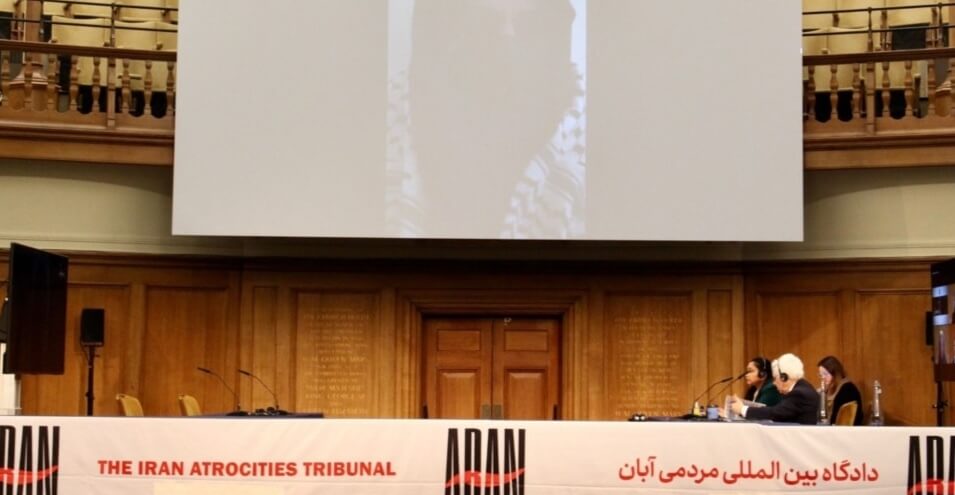
The Prosecutor's Office of the International People's Court published the names of 160 senior and provincial officials of the Islamic Republic of Iran, including Ali Khamenei, the Leader of the Islamic Republic, as defendants in the November 2019 massacre.
In addition to the heads of the three branches of government, the Secretary of the Supreme National Security Council, the Minister of Interior, and the senior commanders of the Revolutionary Guards, the police force, and the army, this list includes dozens of other senior officials, including Mahmoud Alavi, the then Minister of Information, and Mohammad Javad Azari Jahromi, the Minister of Communications and Information Technology in Hassan Rouhani's government.
Based on documents and evidence received by this court from 440 people, of whom 219 testimonies have been taken and verified, the prosecution of the International People's Court of Aban has accused these 160 people of committing "crimes against humanity" during the Aban protests of 2019.
The court asked all those who have additional evidence and documents in this regard to submit them to the court.
In the previous round of this trial, which was held in November of this year by the organizations "Justice for Iran", "Iranian Human Rights", and the international organization "Together Against the Death Penalty", 34 witnesses and six expert witnesses presented their documents and evidence.
The November 2019 protests, which were initially a reaction to the sudden increase in gasoline prices, quickly changed direction and targeted the Islamic Republic government. However, these protests were met with severe repression, resulting in hundreds of deaths.
The exact number of people killed in these crackdowns is not known, but Reuters, while announcing that at least 1,500 people were killed in the November 2019 protests, wrote, citing "three sources close to Khamenei's inner circle" and a fourth official, that the Leader of the Islamic Republic had told senior officials in the country to "do whatever is necessary to stop" the protests.
Witness accounts on the third day of the second round of the Aban International Tribunal
At the third session of the second round of the Aban International People's Tribunal on Sunday, February 7, which was held behind closed doors in London, a former senior member of the Islamic Revolutionary Guard Corps said that the number of people killed in the Aban crackdown on the second day of protests was 427 in Khuzestan and 417 in Tehran.
This witness, who appeared in court virtually on Sunday as witness number 600, introduced himself as one of the perpetrators of the arrest and killing of protesters and their interrogations, and now regrets his previous actions.
Witness number 600 also emphasized that the order to use maximum violence to suppress the November 2019 protesters was issued by the Leader of the Islamic Republic, and in order to carry it out, Lebanese and Syrian forces who were training in the IRGC barracks were also used.
He also confirmed that many Basij members, despite being young children, had weapons of war in these protests and fired shots in the air or at people to vent their excitement.
This witness also spoke about a large detention center on Takhti Street where hundreds of boys and girls were stripped naked and beaten.
He also spoke about the difficult conditions for handing over the bodies of the victims, saying that many families of the victims had kept their children's bodies hidden out of fear of consequences, so that they could bury them after, say, a month.
This witness cited one of the reasons for the increase in the number of deaths and violence during the November 2019 protests as "the lack of preparation and planning for the announcement of the gasoline price hike," and said that while even then-President Hassan Rouhani was not aware of the announcement, IRGC officials had begun preparations a week in advance and had told their forces, who were protesting the lack of time to prepare, to "just be ready for conflict."
According to witness number 600, the protesters did not carry any weapons, not even cold steel, during the protests and were only chanting slogans.
He also added that following the worsening situation for the regime on the second and third days of the protests and even the possibility of taking over the Iranian Broadcasting Corporation, they were asked to do everything they could to suppress the protesters.
The witness went on to name the "Sabreen" and "Imam Ali" units as units that suppressed the protesters and said that on the third day, the Basij was given the authority to use military weapons.
He added that "given this permission to the lowest military class of a country, the higher classes were certainly allowed to use more equipment."
He went on to describe the center as a "dreadful" organization that answers only to the Leader of the Islamic Republic.
This former senior member of the IRGC explained that special units that entered areas with armed conflict, such as Mahshahr, Shush Danial, and other parts of Khuzestan, Karaj, Mashhad, etc., have powers such as "5000 IRGC intelligence," meaning they are authorized to do anything and other forces must obey them.
The witness explained that members of this special unit undergo intense academic training, and even their "recreational camps" are in war-torn areas of Syria and Lebanon, where they are trained with heavy physical exercises for the "final confrontation."
Witness 600 said that where other forces are unable to control the situation, special units, including the "Sabirin Unit" and the "Imam Ali Unit," are brought into the scene as the "last straw of the system," and they will not be held accountable for any killings they commit.
Witness number 600 named the three provinces of Lorestan, Khuzestan, and Alborz as the three regions with the most clashes and deaths, adding that Alborz is the "weak point of the system" and requested that a specific decision be made about Alborz province later.
Maryam Foumani, a researcher for the prosecution of the International People's Tribunal of Aban, explained in an exclusive interview with Radio Farda that a thorough investigation and verification was conducted on this former senior member of the Islamic Revolutionary Guard Corps, and then he was introduced to the People's Tribunal as witness number 600.
"Vahid Haqqaniyan"
This witness named a person named Khalafi, who is in charge of the ceremonial duties of the Supreme Leader's House, as well as Vahid Haqqaniyan, the deputy for "Special Affairs" in the office of the Supreme Leader of the Islamic Republic, as the main factors in suppressing the November 2019 protests, and said that Haqqaniyan was the first person after Ali Khamenei, the Supreme Leader of the Islamic Republic, to convey orders to the commanders of the IRGC, and that these two people had told the commanders of the IRGC to "put the case together."
Witness number 600 went on to call Vahid Haqqaniyan "Khamenei in the shadow" and said that he is very close to the leader of the Islamic Republic and even checks the transcripts of his speeches.
Regarding the extent of Vahid Haqqani's power and influence, he said that all the commanders of the army and the IRGC are extremely afraid of him. He has extensive and unlimited authority and has dismissed commanders who have asked for a softer approach.
This witness reported the arrest of approximately 7,000 to 8,000 people in Tehran and said that on the second day of the protests, 427 people were killed in Khuzestan and 417 in Tehran.
He named the "Panj Hezar" detention center as a detention center for holding dual nationals and those who are to be tortured, and said that this detention center is controlled by the IRGC's intelligence and they do whatever they want to people there without regard to the law.
"Widespread dissatisfaction within the IRGC and the Ministry of Intelligence"
This former senior member of the IRGC said that there are people in the IRGC and these units who "enjoy these killings and torture, love this work, and believe in it very much, and believe me, they even put their own families under the pressure of torture."
He added, however, that the majority of people in the Ministry of Intelligence and the IRGC's intelligence body "are dissatisfied, and if international organizations pressure Iran to hold a referendum, not even one percent will vote for the regime."
Witness 600 added that "with the IRGC's spider web of intelligence in organizations, no one dares to criticize the regime's behavior. If anyone opposes, it will create many problems for themselves and their families."
He said his intelligence friends express their dissatisfaction with the Islamic Republic's government in private meetings.
Witness 418: "Security officers were looking for a head for their noose"
In the third session of the second round of the Aban court on Sunday, witness number 418, who introduced himself as a member of the police force, also said that from 2:00 PM on Saturday, November 15, the police force went on full alert and the forces were asked to play the role of the "Second War" organization, an organization that takes action in times of crisis.
The witness went on to report that thousands of bullets were fired that day, but said that Naja did not have the order to fire and was shooting in the air to intimidate people, and that only the Basij and the IRGC were allowed to shoot.
Witness number 418 also said that he did not recognize the bullets that were found, noting that the Naja organizational weapon was a Kalashnikov.
According to this witness, on the first day of protests in the city where he was assigned, at least 15 people were killed by plainclothes Basij and IRGC forces.
Referring to the large number of detainees, the witness continued, saying that the IRGC forces were forced to hand over about 50 people, all of whom were handcuffed and blindfolded, to us. This was despite some of the detainees saying that they had not been on the streets during rush hour and that security officers were looking for their heads for the nooses.
Witnesses 422 and 427
In the third session of the second round of the November trial, two sisters, numbers 422 and 427, testified about the situation of the protests in Sanandaj.
According to witness number 427, on the second day, their nephew, who was under 18 years old, was arrested, and those who were looking for him witnessed security forces firing tear gas into the narrow alleys.
He also reported the simultaneous presence of hundreds of motorcycles on the streets, the firing of tear gas, and the sound of gunfire in the city of Sanandaj. During the escape, a citizen took refuge in his house and discovered a bullet wound after returning home.
Pressure from security forces during the handover of the bodies of the deceased
During the trial, witness number 499, a man from Sanandaj, spoke about the destruction of people's property by security forces, including breaking the windows of cars and shops, and called the people's demonstrations "peaceful."
He added that during the Aban crackdown, the Islamic Republic's security forces, including the Basij and the IRGC, even targeted elderly people and children with direct gunfire.
He also spoke about the arrest of one of his friends, Kaveh Visani, whose body was found by his family near a village in the region after 18 days.
According to Witness 499, security forces had asked Kaveh Visani’s family to attribute their son’s death to “Kurdish parties opposed to the Islamic Republic,” including Komala and the Democratic Party, but they refused. He added that Kaveh Visani had one child and his wife was pregnant at the time of his arrest.
Verification of People's Court Witnesses
Maryam Foumani, a researcher for the International People's Court's prosecution team, explained to Radio Farda about the sources of these statistics and reports, saying that these sources include "one of the senior IRGC commanders in Tehran," "one of the high-ranking IRGC commanders," several members of the "IRGC and Basij security forces," and "three former students."
Maryam Foumani said that one of the senior commanders of the IRGC in Tehran called us yesterday to testify, and we quickly conducted a detailed interview so that we could hear his testimony and requested that he send his documents for verification. We were busy verifying his statements before the trial, and this verification was carried out with the same protocols we have for other witnesses, and he presented his testimony today.
Ms. Fomani added that another high-ranking IRGC commander contacted the court's investigators with shocking information, and the investigators were able to verify part of this information, which is the part that will be presented in court.
The investigator for the Aban International People's Tribunal's prosecution team then explained that "during both rounds of the trial, we had 12 members of the IRGC and Basij security forces who contacted the prosecution unit and asked to give their testimony. We had two of these individuals in court in the first round, both of whom were from the security forces. In the second trial, we had one person yesterday who was a member of the Imam Ali Battalion and we had one today who was witness number 600 and a senior IRGC commander. We will have another security force officer today and we may have another witness from those 12 today."
Since the start of the second round of hearings at the International People's Court in November, more than 40 new witnesses have contacted the prosecution via WhatsApp and requested to provide testimony, several of whom are officials and agents of the Revolutionary Guard, the police force, and the Basij.
Source: Radio Farda