Farvardin 58 and the reverse referendum
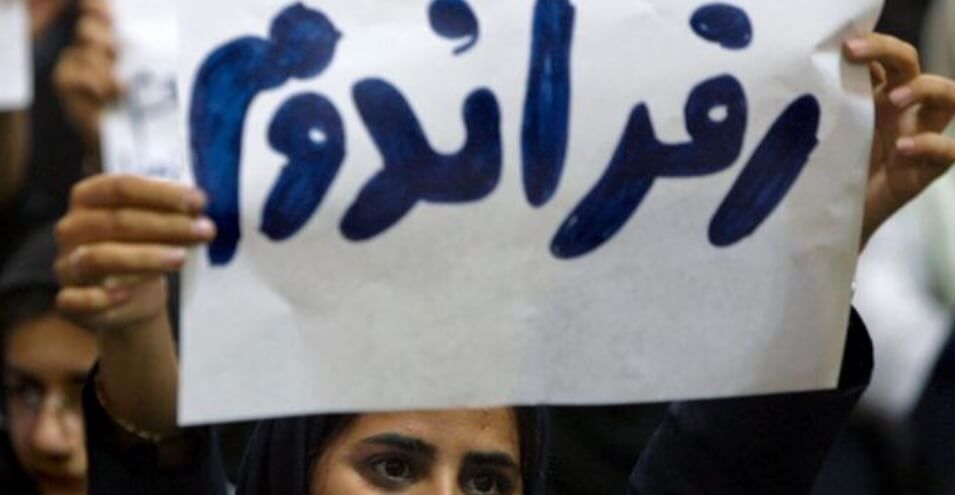
The 42nd anniversary of the Islamic Republic's referendum is more than a historical event or a ritual occasion for the regime, it is a reflection of the system's failure and the growing demand for a new referendum on the continuation or change of the political system. Analysis by Ali Afshari
After holding an undemocratic referendum that violated the standards of free and fair elections by reconstructing the traditional concept of “allegiance,” the Islamic Republic has only used direct popular vote in approving the initial and revised versions of the constitution, effectively closing the case for this decision-making method. The government has not been willing to hold referendums even at lower policymaking levels. In the past two decades, the demand for referendums has grown significantly to put the principle of survival or fundamental transformation of the system to the people’s vote.
Forty-two years ago, Ayatollah Khomeini, through illegal, arbitrary and willful intervention, limited the voting options to yes or no to the Islamic Republic of Iran, while this system had neither a precedent in Iran's past nor a clear definition. It would not be wrong to say that the majority of those who voted for the Islamic Republic of Iran trusted Ayatollah Khomeini's words and promises, which soon turned out to be unfounded and based on deception. The decline in votes in subsequent elections and referendums is evidence of this claim that some voters later realized their mistake in optimism.
Ayatollah Khomeini called the opponents of the Islamic Republic and the defenders of the national or democratic republic “opponents of Islam” and “owners of poisoned pens.” With these words of Ayatollah Khomeini and the mobilization of all government institutions and resources to promote the Islamic Republic, the referendum became meaningless. In fact, the election had already taken place and the founder of the Islamic Republic had already draped the mantle of the Islamic Republic over the country of Iran. From his perspective, the referendum meant allegiance. He did not expect the people to choose, but rather asked them to confirm his will and decision. It was natural that when there was a revolution and the people had risen against the rulers of the previous regime, the defenders of the republic-oriented alternative to the Islamic Republic would also be called “traitors and owners of poisoned pens,” and the elections would become a confrontation between Islam and infidelity. There would be no room for choice, and the Islamic Republic option would emerge from the ballot box with a high number of votes.
Therefore, this referendum did not meet the requirements for a legitimate election. Even though the fate of the monarchy was to be determined in the referendum, the ballot papers instead of “No” stated: “Former regime”!! This point itself indicated the theatrical and ceremonial nature of the aforementioned referendum.
Now, after 42 years, the channels of political participation have not been realized, contrary to the spirit of the Bahman Revolution and its anti-authoritarian orientation, and the authoritarian political system has been formed and consolidated with more interventions in the public sphere. In addition, the structural blockage has engulfed the country in major super-crises. The current situation and conventional mechanisms are not responsive to solving the problems; even a part of the government has realized a deadlock. Hassan Rouhani has repeatedly proposed a referendum at a limited level and governance policies, which have been met with a negative response from the hard core of power and the institution of Velayat-e-Faqih. Of course, Rouhani himself has also raised the issue of a referendum as a slogan and has not had a serious will to move forward with it.
The country's mega-challenges can be divided into smaller levels that include numerous crises such as unemployment, economic prosperity, center-periphery, efficiency, high liquidity, water shortage, authority, crisis management, foreign relations, outflow of human capital, trust, government-nation gap, women's dissatisfaction, widespread class differences, cultural confrontation, inefficient education system, systematic corruption, closed circuit power circulation, disruption of the information system, loyalty (lack of meritocracy), parallel institutions, marginalization, nihilism, intensification of violence in social behaviors, high energy consumption, increasing poverty and deprivation, spread of drug addiction, presence of the military in politics, vulnerability to earthquakes, soil erosion, aging development infrastructure, boom in money laundering, and lack of transparency.
The Islamic Republic is incapable of containing and treating these super-challenges. The main basis of these crises is the system’s prevention of political openings and opening the scope of political participation. More precisely, the self-created crisis of the system is the desire and will of the institution of Velayat-e-Faqih, the main support for the problems, which assesses the existence of a level of controlled crisis as necessary for its survival and supremacy. This will is the intersection of the interventionist Supreme Leader and the carrying and active forces in the Velayat-e-Faqih institution and its subsidiaries. Under normal conditions, the bureaucracy and modern institutions perform their specific tasks and gradually stabilize, and there is no longer room for the intervention of the Supreme Leader and the army of his representatives. Inadequacies and shortcomings are also identified, and it becomes difficult to blame the incompetence on a foreign enemy. The crisis and critical conditions, which seem to be a great danger lurking, necessitate the Supreme Leader’s call to his followers to “continue the revolution.” In this paradigm, law, custom, and rule have no value and are easily violated. The Velayat-e-Faqih army is allowed to act as a lone wolf and “revolutionary groups” and not allow the political and administrative organization of the country to be managed based on normal, rational, and established procedures and processes, which, from the perspective of the hard core of power, ultimately leads to “compromise with the West.”
The structural bottlenecks that have led election-oriented approaches in strategic and tactical areas to a dead end have inclined public opinion towards structurally disruptive strategies. Saving the country requires resorting to public votes to determine the fate of the macro-power structure. Within the framework of the Islamic Republic system, there is no possibility of continuous and sustainable improvements.
The output of the Islamic Republic's system of government is internal tension, and part of its power is spent on resolving frictions and controlling elected institutions in the direction desired by the Supreme Leader and the groups under his supervision. This duality, which is based on the conflict between the two dimensions of "republic" and "wilayah", has various dimensions, but perhaps its most tangible aspect is the stability or influence of societal developments for the survival of the institution of the Supreme Leader and maintaining its dominant position in the power structure.
“Province” and “republic” belong to two completely different spheres and their ultimate purpose is different. The two cannot be directly combined in the modern era; therefore, the above conflict has persisted in the context of power of the Islamic Republic and has imposed a permanent crisis on it. This crisis has no solution and the conflict must be resolved in favor of one of the two institutions by eliminating the other.
The negative experience of the 2019 referendum is not a reason to generalize it to the principle of a referendum. A referendum is a principled method and procedure for decision-making based on direct and public participation and does not have a populist characteristic per se. Therefore, a new referendum this time on the permanence or change of the Islamic Republic is an effective and workable approach to addressing the country's numerous super-challenges and breaking the structural blockage.
Source: DW