"Like other children"; only one in 10 disabled children goes to school
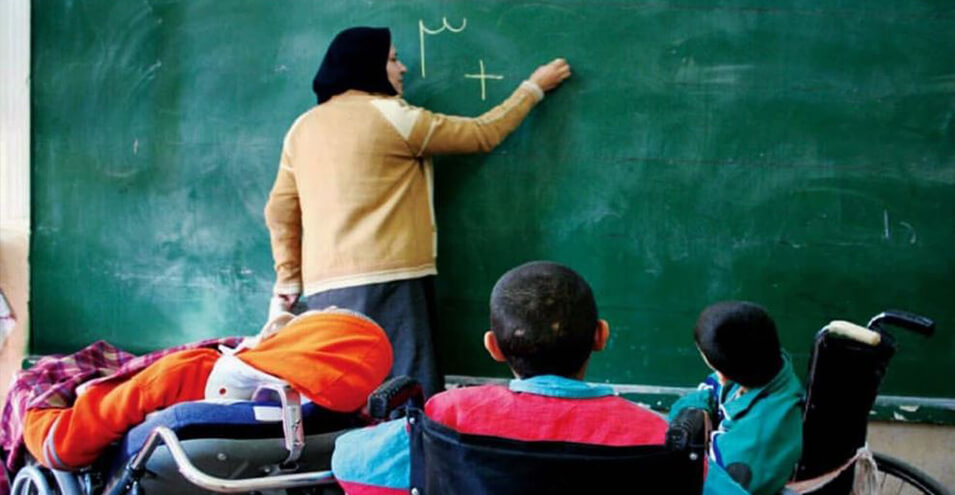
“Like Other Children” is the title of a joint report by Human Rights Watch and the Campaign for Human Rights in Iran, released on Wednesday. The report examines the education situation of children with disabilities in Iran and criticizes the lack of facilities in this area.
The report states that for many children with disabilities in Iran, going to school is an unattainable dream, a dream that should be part of their daily lives.
Tara Sepehrifar, Iran researcher at Human Rights Watch, says about this report:
"This report discusses the lack of adequate facilities in Iranian schools for the education of children with disabilities, such as physical access to buildings, the availability of up-to-date books in Braille, assistance with hearing aids, and other facilities. It also points to the lack of resources and insufficient training for teachers to effectively assist students with disabilities in Iran."
“The lack of physical adaptation of schools for children with disabilities, the lack of appropriate teaching methods, and the shortage of teachers and trained human resources to help children with disabilities” are some of the problems these children face in Iran. This is what Maryam, the mother of Alireza, a 12-year-old visually impaired child in Kurdistan Province, says:
"My son has low vision, meaning he can see up to one meter with one eye and up to half a meter with the other. We have had problems with education and school since the first grade. Unfortunately, wherever we go, they pass us on to someone else. No proper classroom, no teacher, no suitable place, no entertainment; these are four people who have been together since the first grade until now, and they spend all their time in the same classroom, except for recess and sports, meaning they are only in the same classroom from morning to noon. At the special school, they were given one classroom, then they told us that if you are unhappy, take your child to a regular school. When we go to a regular school, they tell us that we do not accept such conditions at all and that we do not accept responsibility for anything that happens to your child."
Human rights advocates say that no child should be considered uneducable and that under international law all children should have access to appropriate and adequate education. But children with disabilities in Iran face “numerous obstacles,” says Arash, a longtime teacher of children with disabilities in Tehran:
"I work mostly with children with physical and motor disabilities. There are transportation problems, and unfortunately, families cannot afford it. The facilities are very poor, and if there is no public assistance, the school does not have many facilities. One of the biggest problems for these children is using the bathroom. In schools, there are usually three or four toilets for 140 students with disabilities."
Problems that, in addition to the educational environment, also encompass the sports, cultural, and artistic activities of children with disabilities. Children for whom art and sports are essential for their growth, health, and prosperity, but who are deprived of them due to deficiencies.
Fatemeh, a sports teacher for students with disabilities, says about these problems:
"There are no facilities in Iran. We do not have access to equipment for disabled children in Iran, and even if it does reach Iran, it is very expensive. For example, families cannot afford to buy smart white canes for their blind children. Other educational aids are also very expensive. There are really no facilities or care, and in this economic situation, families do not know whether to provide food for their children or their educational aids."
Human Rights Watch and the Human Rights Campaign in Iran estimate the number of children with disabilities of school age in Iran at around one and a half million, but they say that only 150,000 of these children were enrolled in schools last school year, and the rest were excluded from education. Hadi Ghaemi, director of the Human Rights Campaign in Iran, says about these statistics:
“Unfortunately, the Iranian government does not publish statistics on children with disabilities or the reasons for their exclusion from education. However, according to our estimates, in the last school year, only one in 10 children with disabilities in Iran went to school, and the majority of these children went to special schools. Children with disabilities have the right to an inclusive education under the Convention on the Rights of Persons with Disabilities. Inclusive education means that children with disabilities should be able to study in schools close to their homes and alongside other children.”
In Iran, "disability is the most common reason why children are not able to attend school," Human Rights Watch and the Campaign for Human Rights in Iran have stated, calling on Iranian authorities to end what they call discrimination against children with disabilities.
The report states that there are 1,570 special schools in Iran, schools that operate on the basis of separating students with disabilities from other students, an issue that Human Rights Watch and the Human Rights Campaign in Iran have criticized. Tara Sepehrifar says that separating children with disabilities has long-term consequences in their lives:
"The most important issue that this report points out is the need to change the overall approach to the education of children with disabilities. In Iran, steps have been taken to provide access to education for these children, but these steps have been within the framework of separating children with disabilities from regular schools and placing them in special schools. If these children are separated from society at the beginning of their entry into society, it will have dire consequences in their lives."
Human Rights Watch and the Human Rights Campaign in Iran say that in recent years the Iranian government has increased the budget for the education of children with disabilities, however, the two organizations have emphasized in their reports that if the education system, teaching methods, and school environment for children with disabilities in Iran are not reformed, thousands of children will be deprived of education. Hadi Ghaemi says that according to Iranian law, all children have the right to free education:
"The justification that the Iranian government uses for not meeting the needs of children with disabilities is the lack of sufficient funds and facilities. This is despite the fact that the Constitution of the Islamic Republic recognizes free education for all members of society up to secondary school. Therefore, the Iranian government cannot ignore the rights of 10 percent of children on the grounds of lack of funds and facilities. In some border and deprived areas of Iran, up to 90 percent of blind and disabled children have never seen the color of school."
A year ago, Human Rights Watch and the Human Rights Campaign in Iran examined the situation of people with disabilities in Iran in a report titled "I am as human as you" and emphasized that Iran, based on its international obligations, must provide all the facilities for a decent life for these people. Obligations that Iran is obliged to implement within the framework of the International Convention on the Rights of Persons with Disabilities. A convention that Iran joined a decade ago. Tara Sepehrifar says that inclusive education is one of the principles of this global convention:
"This means that all students with disabilities should have the opportunity to receive quality education while meeting their needs for equal access to education alongside other students, and in fact, within the country's mainstream education system."
An education that may be able to solve some of the problems of thousands of children with disabilities in Iran, children who, according to human rights defenders, have a long way to go to access a standard and efficient education.
Children who have the right to an adequate education and a happy, childlike world, a right equal to all children in the world.
Source: Voice of America