Depriving political and ideological prisoners of medical services is a deliberate government move to eliminate dissent.
The deteriorating health of Bektash Abtin, a poet and filmmaker imprisoned in Evin Prison, is a direct and obvious result of the illegal and discriminatory treatment of political and ideological prisoners by judicial authorities in Iran, who use the most inhumane methods to deal with critics and opponents and place no value on the lives and health of prisoners. Preventing prisoners from accessing medical and treatment facilities and obstructing the treatment process for prisoners has become commonplace, and instead of stopping this inhumane and human rights-violating process, the government uses it to advance its goals of suppressing the voices of critics.
Hadi Ghaemi, director of the Human Rights Campaign in Iran, expressed concern about the health condition of Bektash Abtin, a member of the Iranian Writers' Association, saying: "The indifference of the responsible authorities towards the physical health of prisoners and the continuation of inhumane treatment of them is the most cruel possible form of torture and violence against those who have been imprisoned solely for expressing their opinions."
According to Hadi Ghaemi, "By engaging in such behavior, the government is not only seeking to eliminate critical and opposition figures, but is also trying to create fear and terror among other activists and critics of the government, and this has increased concerns about the government's gambling with the lives of prisoners."
The Human Rights Campaign in Iran considers the continuation and repetition of illegal and inhumane behavior by prison authorities towards political and ideological prisoners as a continuation of the regime’s systematic and violent approach to opposing and critical ideas and voices, which have been suppressed in various ways and forms in the past years, violating human rights. The dark record of the authorities of the Islamic Republic of Iran’s judiciary in protecting the lives and health of political and ideological prisoners and the regime’s lack of accountability for the severe physical and mental harm inflicted on prisoners during their imprisonment, which in many cases has led to the death of prisoners, is a clear indication of the regime’s discriminatory view of political and ideological prisoners and civil activists. The Human Rights Campaign in Iran, while calling for the immediate and unconditional release of all those imprisoned solely for expressing their opinions, considers the behavior of Iranian judicial and prison authorities in making it difficult for prisoners to receive medical treatment and care as a clear and public example of human rights violations and an inhumane tactic to eliminate critics and opponents that has become a normal practice for the government. A practice that begins with filing cases against critics and issuing heavy sentences and continues with inhumane and illegal behavior by prison authorities with prisoners.
Death of political and ideological prisoners due to the negligence of judicial and prison authorities
In recent years, a large number of political and ideological prisoners have died in Iranian prisons, either due to lack of medical care, hunger strikes, or suspicious reasons. Sasan Niknafs, Behnam Mahjoubi, Sattar Beheshti, Vahid Sayadi, Alireza Shirmohammadi, and Kavoos Seyed Emami are some of the people who died in Iranian prisons in the 1990s alone. However, in none of these cases have the judicial and prison authorities refused to accept responsibility, and no one has been tried in this regard. The death of Adel Kianpour, a political prisoner imprisoned in Sheiban Prison in Ahvaz following his hunger strike, is the latest example of the recurring tragedy of political prisoner deaths in Iran, for which the Islamic Republic of Iran’s judiciary is directly responsible. In addition to these individuals, there are other prisoners who have been in very poor physical conditions in prisons for a long time, and despite protests and hunger strikes, no one has listened to their pain. Khaled Pirzad, a political prisoner imprisoned in Sheiban Prison in Ahvaz who has repeatedly gone on hunger strike to protest the lack of attention to his physical condition, or Kamal Jafari Yazdi, a chemical weapons veteran and signatories of a letter calling for the resignation of the Leader of the Islamic Republic of Iran, who has been denied the right to access medical services despite the order of the forensic doctor.
The United Nations has repeatedly expressed its serious concerns about the continued denial of access to health facilities and the lack of medical care for detainees.
In Iranian criminal law, the omission of an act by individuals who are responsible for others, if it results in death, can be considered a crime of “murder.” Article 295 of the Islamic Penal Code states in this regard: “Whenever someone neglects an act that they have undertaken to perform or a specific duty that the law has placed on them, and a crime is committed as a result, if they have the ability to perform that act, the resulting crime is documented against them and, depending on the case, it is intentional, quasi-intentional, or a pure mistake; such as a mother or nanny who has undertaken to breastfeed does not breastfeed the child, or a doctor or nurse neglects their legal duty.” The regulations of the Iranian Prisons Organization also explicitly mention the right of prisoners to receive medical treatment. Article 118 of the Regulations of the Iranian Prisons and Security and Educational Measures Organization states that “the examination and, if necessary, treatment of sick convicts is the responsibility of the prison administration or vocational training and employment centers.”
Given the allegorical nature of the cases mentioned in Article 295 of the Islamic Penal Code, it can be said that prison officials and judges, including prison supervisors and judges executing criminal sentences, can be prosecuted on charges of murder if they abandon their legal duties in dealing with the medical affairs of sick convicts and cause the death of the prisoner.
However, the prisoners' narratives and the repeated behavior of judicial officials completely violate this part of the laws and regulations, and despite the numerous physical and mental injuries suffered by prisoners and sometimes their deaths in prisons, none of the responsible officials in the Islamic Republic of Iran have been tried or punished for this.
Concerns about the physical condition of Bektash Abtin
On Sunday, January 2, the Iranian Writers’ Association announced that Bektash Abtin, the former secretary of the association, had fallen into an induced coma. “His four days of wandering in Evin Prison between prison and hospital without receiving treatment, his transfer at night to Taleghani Hospital and chaining him to a hospital bed, keeping his family and fellow prisoners unaware of his condition, and wasting Abtin and his family’s vital days and moments in an attempt to get leave are part of the conscious and deliberate actions of the government and its prison guards in endangering Abtin’s life,” the association said in a statement.
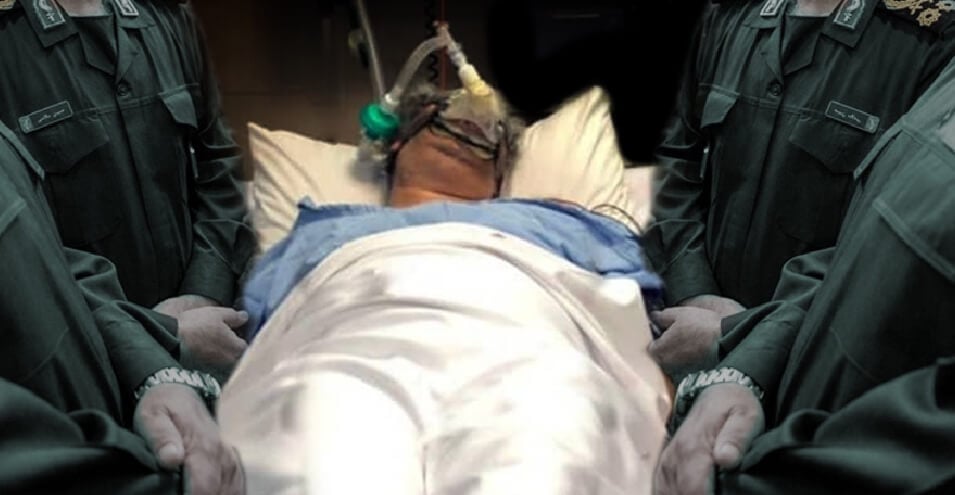
The history of underlying diseases of Bektash Abtin, a member of the Iranian Writers' Association, had led to increased concerns about his health among his family. Bektash Abtin contracted COVID-19 twice during his imprisonment and was hospitalized for a period of time in July of this year due to medical problems. The publication of pictures of him in the hospital wearing prison clothes and tied to a bed with handcuffs sparked widespread reactions.
Bektash Abtin, along with Reza Khandan (Mahabadi) and Keyvan Bajan, three members of the Writers' Association of Iran, were sentenced to six years in prison in 2018 on charges of "publishing the internal newsletter of the Writers' Association", "preparing a research book on the fifty-year history of the Writers' Association", and "attending the graves of the victims of the serial political murders of Jafar Poyandeh and Mohammad Mokhtari and participating in the annual ceremony of Ahmad Shamloo". Their sentences were enforced in October 2020. At that time, Nasser Zarafshan, a lawyer for the Writers' Association of Iran, told the Campaign for Human Rights in Iran, referring to the charges against the writers, that none of these charges had any legal or judicial basis and that there were many contradictions regarding the issuance of these sentences and the announced punishments.
In November of this year, Arash Ganji, the secretary of the Iranian Writers' Association, was sent to prison to serve a five-year prison sentence. In recent years, many Iranian writers and poets have faced security and judicial clashes in different cities of the country. Alireza Nouri, Nima Ghasemi, Khosrow Boroujerdi Sadeghi, Akbar Azad, Nasser Hemmati, Marjan Davari, and others are some of the writers and poets who have faced judicial clashes simply for expressing their opinions.
Hadi Ghaemi, director of the Human Rights Campaign in Iran, referred to the government's unstoppable trend in dealing with opposing and critical ideas, and said: "Hearing and broadcasting critical and opposition voices within Iran in a situation where all-out repression has cast a shadow over their lives and work is a fundamental and important duty of human rights organizations and the international community, so that perhaps in this way the shadow of the government's repression can be slightly reduced."
Source: Iran Human Rights Campaign