Khamenei's top advisor: The country would be better governed if there was no government
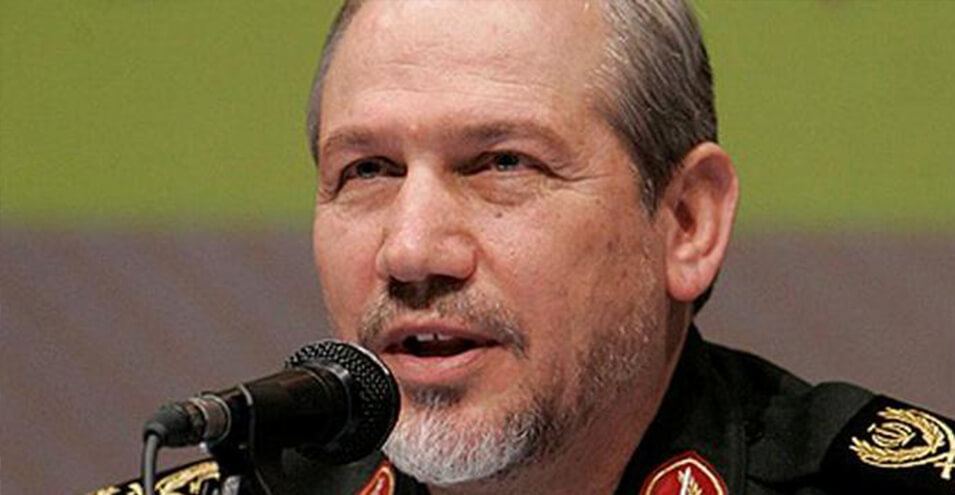
While praising the Revolutionary Guards, Yahya Rahim Safavi has said, “Sometimes it seems that the country would be better governed if there were no government.” A conservative MP had previously said that “a military president” would solve the country’s problems.
Yahya Rahim Safavi, assistant and senior advisor to the Leader of the Islamic Republic, said during a speech that was mainly dedicated to Iran's "power and influence" in the region and the role of the Revolutionary Guard Corps in it: "Sometimes it seems that the country would be better governed if there was no government."
In his speech on Sunday (June 24), Supreme Advisor Ali Khamenei first said in response to a question regarding Saudi Arabia's threat to attack Iran: "Iran is a great power, and if they want to make a mistake, on the very first day, 1,000 missiles will be fired at them and their palaces in Riyadh, but of course, I think it is unlikely that they will do such a foolish thing."
Rahim Safavi then called the Islamic Republic “the leading power in the region,” whose power, he said, “has reached the shores of the Mediterranean,” and without its presence, “no issue” will be resolved. He also referred to the “influence” of the thoughts of the founder and leader of the Islamic Republic in “all corners of the world,” and mentioned the existence of “80,000 missiles” in the hands of Hezbollah in Lebanon as a “permanent threat” against Israel.
The former IRGC commander went on to address the “domestic situation of the country and existing problems,” and in response to a question about why the Leader of the Islamic Republic did not “directly intervene” in the JCPOA issue, he called Ali Khamenei a “law-abiding” individual and said: “The Supreme Leader was not optimistic about negotiations with America from the very beginning and announced this issue, but due to the same adherence to the country’s constitution, they allowed the government to enter into the JCPOA negotiations; now if the government has gone the wrong way, what is His Highness’s fault? Well, this government was the people’s choice.”
The assistant and senior advisor to the Leader of the Islamic Republic then added, noting that “we have a problem with state-building,” “Sometimes it seems that if there is no state, the country will be better governed.” According to Major General Rahim Safavi, “People go to departments, organizations, and municipalities and their problems are not resolved, and these issues create dissatisfaction, and the counter-revolution immediately exploits it and makes people appear dissatisfied, and part of this dissatisfaction is due to the inefficiency of officials.”
The Supreme Leader’s fierce attack on the government has coincided with his full-throated defense of the Iranian Revolutionary Guard Corps as a military institution whose power, he said, “grounded America in Syria.” Rahim Safavi has said, “Those who are hostile to the IRGC have a disease in their souls, because if it weren’t for the IRGC, the Basij, and the army, they would have been eliminated overnight.”
Khamenei's top advisor also referred to the "automotive industry mafia" in Iran, in response to a request from an audience member for the presence of the IRGC in this industry, calling the automotive industry an "octopus" that "does not allow the IRGC into its body at all."
Questionable statements
Khamenei's implicit reference to the government's redundancy in Iran, along with his praise of the Revolutionary Guards, comes during one of the most difficult periods in the Islamic Republic's life; a period when, according to the Jahan Sanat newspaper, "Iran's economy is on the verge of explosion."
The previous context for this type of attack on the government makes Rahim Safavi’s statements even more questionable. Mohammad Ali Pourmukhtar, a former IRGC commander and current conservative member of parliament, had said in March of last year (2017) that “if a military man becomes president, he will definitely be able to save the country from its problems.” At the same time as these remarks, reports were circulating that the rumor of a “military president” was gaining momentum among conservatives.
Meanwhile, even Houshang Amirahmadi, a political activist living in the United States and a disqualified candidate for various presidential terms in Iran, had proposed forming a military-revolutionary government in early April of this year to "show off" against the Trump administration.
In addition, the possibility of a "Coup d'état" by the IRGC in Iran, which was mainly raised by circles outside the government and opponents of the Islamic Republic, adds to the sensitivity of Khamenei's Supreme Advisor's statements.
Some analysts, especially looking at the “interferences of the IRGC” in the 2009 presidential election, consider this military institution to be Iran’s “shadow government”; an institution that, if it one day does not see the “election outcome” aligned with its political, economic, and ideological projects, will have the power and will to act against the existing government. Others, however, consider the issue of the “IRGC coup” to be a tool for Iranian reformists and moderates to mobilize their supporters.
Brigadier General Hassan Rastegarpanah, head of the National Security Research Institute of the General Staff of the Iranian Armed Forces, said in an interview in May 2015 on the occasion of the official anniversary of the establishment of the Revolutionary Guards: "Some say that the IRGC wants to stage a coup, and this is not true, because the IRGC has its own place in the government and does not need these discussions."
Source: DW