Netblocks warns of public safety following internet outage
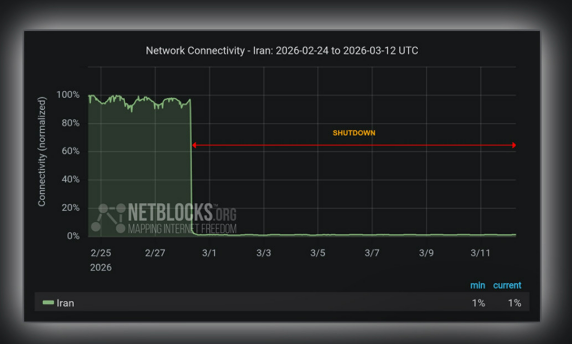
Netblocks warned about the thirteenth day of internet outage in Iran, describing it as a threat to the health and security of the Iranian people.
The widespread internet shutdown in Iran, which has been in effect for the 13th consecutive day, has once again drawn the attention of international organizations and human rights defenders. The shutdown not only undermines freedom of expression, but also threatens people’s right to access information vital to survival, contact emergency services, and personal security.
Netblocks, a global internet monitoring organization, has announced in its latest update that the widespread internet outage in Iran has entered its 13th consecutive day, and that this situation "poses a direct threat to the safety, health, and security of citizens" and fundamentally violates the right to access vital information that is essential for survival.
The organization emphasizes in its report that: "By repeating similar policies in recent months, the Islamic Republic of Iran has repeatedly cut off access to the global internet for millions of people, seeking to silence the news, limit public communication, and control the flow of information in the interest of repression and maintaining political power."
Netblocks analysis shows that this is the third time that the Iranian government has extensively shut down public access to the internet. The first occurred during the 12-day war between Iran and Israel last year (2025), and the second time was on Thursday, January 8, coinciding with the start of domestic protests known as the “Iranian National Revolution,” and now the internet shutdown has continued for the second week in a row.
According to Netblocks assessments, Iran has already spent about a quarter of 2026 without access to the global internet, an unprecedented statistic that shows that internet shutdowns have become a recurring tool in the policy of repression.
Digital rights experts and freedom of information advocates say that these military and political measures, rather than responding to security threats, are putting pressure on civil society, silencing dissent, and cutting people off from the outside world, an action that could have serious human and social consequences.
Internet shutdowns go beyond restricting access to social media or media. These restrictions can jeopardize people’s right to life, especially when access to information and communications is essential for emergency services.
For example, under normal circumstances, people use the internet to contact medical services, call for an ambulance, receive security alerts, or communicate with family and friends, which poses physical and psychological risks when the internet is down. Doctors, activists, and ordinary users have repeatedly stressed on social media that the internet shutdown threatens not only freedom of expression but also the fundamental right to life.
Human rights and freedom of expression organizations, including Netblocks, Reporters Without Borders, and the UN Human Rights Division, have repeatedly warned against the policies of internet shutdowns in Iran. They emphasize that internet access should be recognized as an essential tool for social participation, access to information, and the defense of human rights, not a tool that governments can shut down in times of crisis.
In published statements, human rights experts have described the internet shutdown as a form of "collective restriction" that can cause irreparable harm to people and civil society, especially at a time when people need access to information and free communication more than ever.
While Iranian authorities often justify internet shutdowns on security grounds, analysts and social media users see the policy as a repressive tool that not only violates fundamental freedoms but also poses direct risks to people's health, security, and right to life.
The right to access the internet and vital information that can save lives (from contacting emergency services to receiving breaking news) should not be sacrificed to repressive policies.
In the midst of political and social crises, the question remains: Is the Internet shutdown in Iran a legitimate tool for security control, or a serious and unjustifiable violation of people's fundamental rights?