The first day of the second round of teachers' sit-in in Iran
A large number of teachers across the country refused to attend classes at the invitation of the “Coordination Council of Teachers’ Unions.” It does not seem that the government will be able to solve the problems of teachers in the near future.
The second round of Iranian teachers' sit-in began on Tuesday, November 13, with a large protest rally by teachers. The sit-in, which was called by the "Coordination Council of Teachers' Unions," will last two days.
In its call, the council announced the goals of this protest movement as providing and guaranteeing a fair budget for the implementation of the Civil Service Management Law, eliminating discrimination against working and retired educators, implementing Article 30 of the Constitution, free education, implementing the second phase of the ranking, stopping the full-time teacher plan, and stopping the process of filing cases and suppressing teachers, as well as releasing imprisoned teachers.
The council hopes that with the second round of the sit-in, "the rulers will be forced to fulfill their constitutional duties towards students and provide free, quality, and fair education, and not further attack the livelihood and dignity of teachers."
Positive response to protests in various provinces
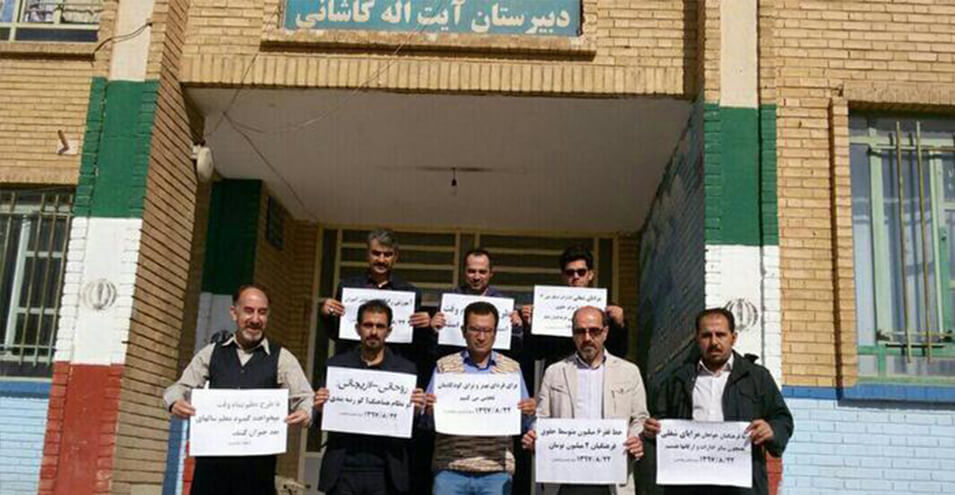
According to HRANA News Agency, on Tuesday, many teachers in various provinces, including East Azerbaijan, Ardabil, Isfahan, Alborz, Bushehr, Tehran, Chaharmahal and Bakhtiari, Khuzestan, Fars, Qazvin, Kurdistan, Kermanshah, Gilan, Mazandaran, Hamedan, and Yazd, refused to attend classes.
The HRANA report states that the protesting teachers had written slogans on their placards such as “We protest the educational situation,” “We protest the livelihood situation,” “No to discrimination,” “Poverty line 6 million Tomans, teachers’ salaries 2 million Tomans,” “Rouhani-Larijani, no coordinated system,” “No to the full-time teacher plan,” “Abolish class differences,” “Improve the status and livelihood of teachers,” “No to private education,” “Free education is the right of Iranian children,” “Mother tongue education,” “Free imprisoned teachers,” “Make schools safe,” and “Stop filing cases against union activists.”
Narges Mohammadi, the deputy head of the Human Rights Defenders Center, who is in prison, has supported the sit-in. Ms. Mohammadi’s solidarity message states: “The children of this land learn ‘freedom’ from their teachers, and the freedom of teachers depends on the realization of their freedom of expression and thought. The children of this land learn ‘peace’ and ‘happiness’ from their teachers, and the happiness of teachers lies in the realization of their human life.”
Iranian teachers also staged a two-day sit-in in October of this year.
"Inherent deficit" in the education budget
Teachers' protests are not a new phenomenon, and it does not seem that the government will be able to find a solution to the education problems in the near future.
Ali Allahyar Turkman, Deputy Director of Management Development and Support at the Ministry of Education, addressed the problems of teachers in a group of reporters at the beginning of this solar year, saying: "The education budget has an inherent deficit, and the government has also approved it, and we have asked representatives to specifically consider projects that have a financial burden, especially recruitment, in 2018, and to help the Ministry of Education manage the budget."
This government official also stated about the supplementary insurance for educators: "Because the Ministry of Education does not have the credit for welfare assistance, we were forced to implement it in the form of a fund, which is not effective for the educational community in the long run. We are talking to insurance companies to consider a specific tariff for us. More than one million people use insurance in this ministry, and insurance companies should consider a special package for us."
The Deputy Minister of Management and Support Development of the Ministry of Education had stated: "We have a 100 billion tomans of transferred claims in 2018, a 300 billion tomans inherent budget deficit, and a 3.7 billion tomans deficit for severance pay, which is intended for severance pay and payment of claims from one percent of the companies' budget, which we hope the Ministry of Economy and Finance will take action to pay."
Interestingly, Ali Allahyar Turkman had said in the same press conference that a large number of state-owned companies are loss-making and that the Ministry of Education is concerned about "how this figure will be met in 2018, given the performance of 2017, because the five trillion tomans budget must be met in this way."
Source: DW