Iran News

Water Transfer Projects in Iran: From Environmental Consequences to Economic Efficiency
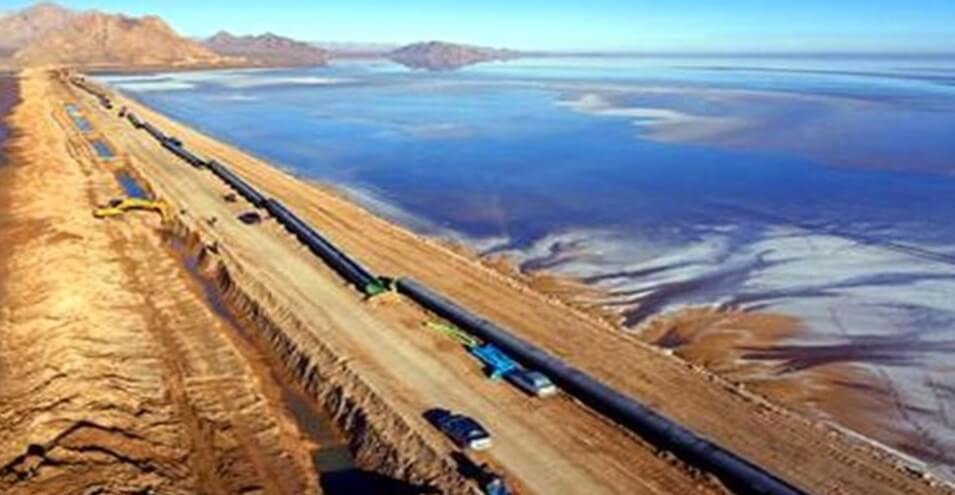
Fars News Agency, in an article titled "Analysis of the Water Transfer Project," points out that the project to transfer water from the Sea of ​​Oman to Mashhad costs the equivalent of one year of the country's entire development budget and has no economic justification.

  • Water transfer idea

Although the idea of ​​transferring water from the Persian Gulf to central Iran dates back to the time of Hashemi Rafsanjani's presidency after the revolution, Mahmoud Ahmadinejad first officially announced in 2012: "Studies have been conducted for the project of transferring water from the Persian Gulf and it has been concluded that this issue has been initiated for the provinces of Kerman and Yazd, and we are also seeking its implementation for Isfahan."

He then announced a plan to transfer Caspian Sea water to the desert plain and central desert of Iran.

On November 5, 2020, the first phase of the water transfer project to the Sirjan region of Kerman Province was inaugurated by then-President Hassan Rouhani.

At that time, Fereydoun Hemmati, the then governor of Hormozgan, estimated the total cost of desalination and the water transmission line to Sirjan at 163 billion rials.

And then on March 14, 2020, the National Water Transfer Project to the Central and Eastern Plateau of the country was inaugurated by Hassan Rouhani via video conference. Regarding the general outline of this project, it was stated that this project will deliver water from the Persian Gulf and the Sea of ​​Oman to seven provinces, including Hormozgan, Kerman, South Khorasan, Khorasan Razavi, Yazd, Isfahan, and Sistan and Baluchestan, through a pipeline spanning 3,700 kilometers.

  • Water transfer is destructive and economically unjustified.

Dr. Mehrdad Filizadeh, associate professor of the Faculty of Chemical, Oil and Gas Engineering at Shiraz University, said in a specialized seminar on dealing with the water crisis: "The final cost of desalination and transferring each cubic meter of fresh water to Shiraz is at least 30,500 Tomans, which is 22 times the urban water tariff. If conventional agricultural products are grown with it, the cost of water consumption is much higher than the price of the product."

Dariush Mokhtari, a senior expert in water resources management, told ISNA: "Fortunately, the implementation of this project has many opponents among various experts. Apart from the debate about whether it is possible or impossible to desalinate one billion cubic meters of water sustainably, the lack of the slightest financial and economic justification for this action is very dangerous and unsustainable." He added: "With these projects that have no technical or economic justification, not only will the country's water problem not be solved, but it will also put Iran's geography in a great misery, danger, and obstacle."

Nasser Hajian, a faculty member at Azad University, said: "With the mismanagement of the water crisis that has arisen in the country, we now want to transfer water that has no economic justification for any of its uses, whether for drinking, industry, or agriculture. We should abandon the implementation of such projects."

Filizadeh said: "Desalination of seawater and its transfer to the central regions of the country will have various destructive environmental effects, such as increasing the salinity of seawater, the entry of heavy metals and chemicals into the sea, changing the ecosystem, destroying the lives of some aquatic animals, and increasing air pollution."

  • Silence and ambiguity in the project

Donya Eqtesad wrote: The Persian Gulf Water Supply and Transmission Company, which was in charge of the first line of this project, published a book titled "Founders and Supporters of the Water Supply and Transmission Plan," but it has not provided any answers to the many questions raised. Questions such as, to what extent was the first line successful? To what extent did it affect the cost price of each consumer's products? To what extent was it successful compared to a similar project implemented in the Persian Gulf countries? What was the actual cost and investment of this project?

Mohammad Darwish, head of the Environment Committee at UNESCO, told Mehr News Agency: “There are far more economical and less costly methods than transporting water in the country. The central plateau of Iran is facing water shortages and water waste, while there is no phenomenon called “water recycling” in these local Arab regions. No efforts are made to treat waste and sewage.”

On the other hand, Fars, while pointing out the shortcomings of the tender held for the implementation of this project, added that the insistence on implementing this project is despite the fact that the amount of water transferred in the form of these projects is not proportional to the amount of water needed in the three sectors of drinking, industrial and agricultural of the target areas. By spending less than these costs, other solutions can be found to solve the water crisis. And he concluded that "it seems that the benefit of certain individuals from this project is the reason for the pressure on the use of this tool in solving the country's water problem."


Source: Voice of America

Similar posts

Back to top button