The "Hijab, No Hijab" campaign became widespread on the government's "Hijab and Chastity" Day.
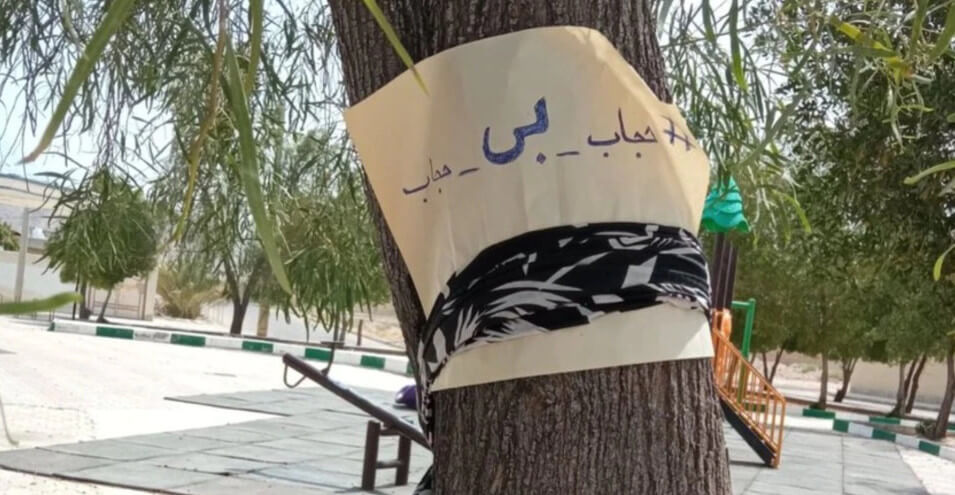
Coinciding with the government's "Chastity and Hijab" day in Iran, the hashtag "Hijab, No Hijab" became widespread on Persian-language social networks, and a field campaign with the same name has also been launched in some public places in the country.
July 11 is called "Hijab and Chastity Day" in the Islamic Republic's calendar, and government institutions and agencies are scheduled to promote this issue for a week.
On this occasion, a video of a ceremony in this regard was broadcast on Iranian state television, which has been the subject of much satire on social media and has been met with ridicule from users.
A number of women's rights activists and civil and human rights activists had called on Iranian citizens, both men and women, to show their opposition to the mandatory hijab in the country on this day.
Following this call, many videos and images have been shared on social media since the morning of Tuesday, July 11, showing some women and girls appearing on the streets, on public transportation, and in stores without a hijab.
In some videos, men, alongside the women in their families, oppose the mandatory hijab and even abandon and throw away scarves and shawls on the street.
Many female users have also written on social media about their personal experiences in this regard or shared their observations of this field campaign with others.
This campaign was launched after Ali Khamenei, in a meeting with the head and staff of the judiciary on July 27, said: "The God of the year 1401 is the same as the God of the year 1360, and we must strive to make ourselves an example of divine traditions so that the result will be progress and victory."
His statements were accompanied by various speculations, one of which was the government's decision to increase pressure on citizens, especially women, in the style of the 1960s, by violently confronting those who wear clothing that is different from the Islamic Republic's intended clothing.
It was after these statements that not only did repression and arrests increase in Iran, but also, as the hot season arrived and many women began to wear clothing appropriate for the season, the number of Ershad patrols on the streets increased.
While numerous reports on social media indicate that detained women are being beaten by Ershad patrol officers on the streets or in detention centers, official officials of the Islamic Republic are trying to emphasize in their statements the necessity of observing the law by officers and commanders.
Among them, Mohammad Baqer Qalibaf, the Speaker of the Islamic Consultative Assembly, said in a public session of the parliament on Tuesday morning, July 11: "In the field of hijab, the speech of all executives and officials must be to observe the law and ensure the fundamental rights of the people according to the constitution. Any action contrary to the provisions of the law, in any form, will be against the principle of the goal of promoting hijab and chastity."
His statements came at a time when other officials had previously spoken about the need for positive rather than negative action in combating what is called "improper veiling." Statements that are not taken into account in the practice of the officers in charge of enjoining good and forbidding evil in dealing with the public.
Meanwhile, Hossein Jalali, a representative from Rafsanjan in the parliament, has denied any "harsh" treatment of women by the Ershad patrol and said: "Where have the Ershad patrols you mention been in the past ten years? Tell me if you know of any place in the world that is more liberated and naked than Iran. Where is the Ershad patrol?"
While reports from social media users indicate the presence of numerous Ershad patrol officers on the streets of various cities in Iran, the representative added: "Maybe even a thousandth is a problem. Behind the peak of Qaf, in a country of 80 million, one person has given a warning to another person. You have come to abandon 99.9 percent, clinging to a thousandth of the issue?"
Mr. Jalali also claimed: "Westerners come here and say, 'We think we're walking in Europe. Nudity has taken over society.'"
His admission of the futility of imposed policies against women's clothing comes at a time when the Islamic Republic has spent huge amounts of money in this area for years and has tried to greatly increase the cost of ignoring the hijab for citizens.
Iranian courts, for example, sentenced women known as the "Girls of Revolution Street" to long prison terms for publicly opposing the mandatory hijab.
Source: Radio Farda