Iran Under the Shadow of Bullets; “Issa Jalali Hoot” Killed by Military Forces’ Fire
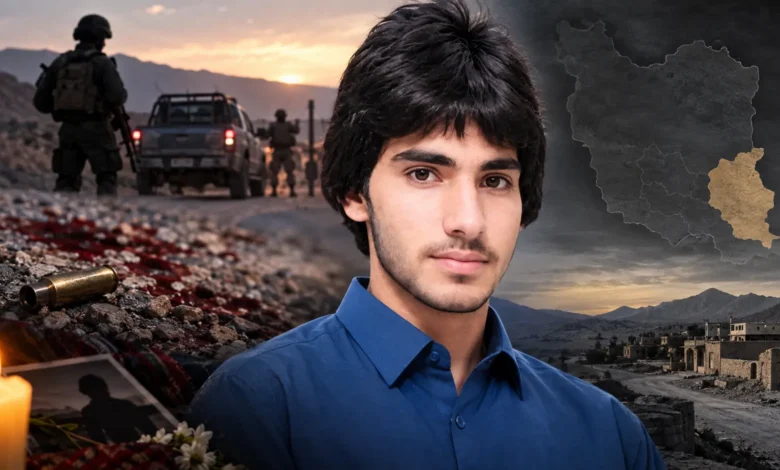
“Issa Jalali Hoot,” a 22-year-old Baloch youth from Dalgan, was severely wounded by gunshot fire on the evening of September 19 during a pursuit by military forces in the vicinity of Chah-Dazu village and subsequently died. According to human rights reports, the reason for initiating the pursuit and the identity of other vehicle occupants remain unclear, and official authorities have provided no explanation to date. This case once again highlights concerns about the safety of citizens’ lives in Iran, from Kurdistan and Baluchestan to Khuzestan and other regions of the country.
According to recent reports published by human rights organizations, Issa Jalali Hoot, 22 years old and a resident of Pang village, a subdivision of Jazmourian district in Dalgan city, became the target of military forces’ gunfire on the evening of Saturday, September 28, 1405, and lost his life.
According to the Halesh news agency, the young man was traveling in a Peugeot vehicle around 7:30 PM in the vicinity of Pang village when he was pursued by military forces stationed in a civilian car and a military Hilux vehicle.
The pursuit continued to the vicinity of Chah-Dazu village, and during the gunfire, a bullet struck Issa Jalali Hoot in the kidney area. The severity of his injuries was such that he died.
One of the most significant ambiguities in this case is the reason for initiating the pursuit. As of the time of preparing this report, official institutions have provided no explanation as to why the military forces pursued this vehicle. Furthermore, no information has been released regarding the identity or possible status of other vehicle occupants.
Therefore, one cannot judge the reason for the shooting or possible charges against the occupants. However, the absence of official information makes it even more necessary to clarify the dimensions of the incident and provide accountability regarding the use of weapons.
Behind the name Issa Jalali Hoot, there is the life of a 22-year-old young man and a family who now face his death.
In the deprived areas of Sistan and Baluchestan, many families have struggled for years with economic problems, lack of employment opportunities, and weak access to public services. In such circumstances, the death of a young man during armed forces’ gunfire is not merely a brief news item, but brings permanent grief to a family.
However, one of the fundamental problems is that many such cases, particularly in border and deprived areas, remain without transparent investigations and without clear answers from responsible institutions.
Issa Jalali Hoot’s death should not be viewed solely within the framework of the Baluchestan issue. In recent years, numerous reports of shootings by security and military forces against citizens in various parts of Iran have been published; from Kurdish kolbars on western borders to Baloch fuel smugglers in the southeast, protesters in different cities, and citizens who became targets of bullets during security incidents.
Alongside shootings and street killings, widespread arrests, torture, issuance of severe sentences, and executions have also been part of ongoing human rights concerns about Iran.
Accordingly, the issue cannot be limited to one ethnicity, religion, or region. Iranian citizens, whether Baloch, Kurdish, Arab, Turkish, Lur, Persian, or belonging to any other ethnicity and community, should be equally protected in terms of the right to life and human dignity.
What matters in Issa Jalali Hoot’s case is placing it within a broader picture of the human rights situation in Iran.
In one part of the country, a youth may lose his life during armed forces’ gunfire; in another place, a citizen may be arrested for civil activity; another prisoner may face an execution sentence for participation in protests; and another citizen may become a target of bullets in border areas.
These cases are not necessarily identical cases, and the motivation and circumstances of each incident must be examined separately; however, their common feature is concern about the widespread use of security and criminal instruments in dealing with citizens.
In such circumstances, the fundamental question is: what position do human lives occupy in the governmental structure of the Islamic Republic?
One serious problem in such cases is the absence of independent and transparent information. Issa Jalali Hoot’s case is now facing multiple unanswered questions: Why was the pursuit initiated? Did military forces issue warnings? Was the use of weapons necessary? Will an independent investigation be conducted regarding this young man’s death?
Answering these questions is the right of his family and the public. Security is not built by frightening people, and no society can achieve lasting security through shootings, arrests, and executions.
If the government resorts to the widespread use of armed forces to maintain security, it must simultaneously have clear and independent mechanisms to review the performance of its forces. The use of weapons, particularly when it results in someone’s death, should not remain outside the scope of accountability.
Before Issa Jalali Hoot was a name in a human rights report, he was a human being and a 22-year-old youth; a person who is now no longer among his family and loved ones.
In today’s Iran, reports of shootings, arrests, torture, execution sentences, and suppression are published from various parts of the country. The victims of these suppressions do not belong to one ethnicity or one specific region.
For this reason, defending the rights of Baluchestan’s people does not mean ignoring the rights of Kurdistan’s, Khuzestan’s, Azerbaijan’s, or other regions’ people. On the contrary, defending the rights of a Baloch is defending the same human principle that should also protect a Kurd, Arab, Turk, Lur, Persian, and every other citizen.
Issa Jalali Hoot’s case, like many similar cases, requires clear answers and transparent investigation; because when a human being loses his life to a bullet, silence and lack of information cannot replace justice.