Life in the Grave
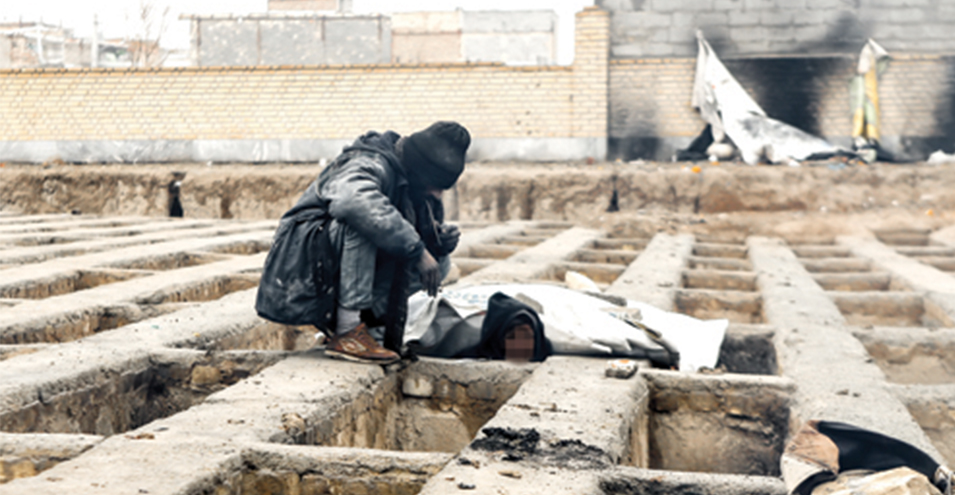
50 women, men and children sleep in graves at night, with 1 to 4 people living in each grave
Maryam Roustaii| The grave dwellers have returned. Each one heads into a grave. In the darkness, or occupied with substances, or thinking about something—we don’t know. The silence of the cemetery is heavy and the air is cold. One by one, torn banners, pieces of worn blankets and half-burned wooden boards are stretched over the graves. They are living death.
When the air gets very cold, they search for wood to make fire and warm themselves in graves that are the end of life for everyone, but for these people have become a beginning and a shelter. Woman, man and child; cardboard dwellers sleeping sitting in a grave.
“There’s no more wood here to burn,” says one of the uninvited guests of these dark and narrow rooms.
It’s been a month since the cold drove the cardboard dwellers to settle around and inside the large Nasirabad Baghestan cemetery in the suburbs of Sharivar. Some live inside the cemetery in pre-prepared graves and several families live in tents around the cemetery, in the stone-breaking area and under the canal. Inside the cemetery, there are 300 pre-prepared graves, with at least 50 cardboard dwellers occupying 20 graves. One to sometimes three or four people live in each grave.
These graves are generally used for sleeping and during the day, when people collect waste or beg to get money for substances and food, they are empty; but they have to watch their graves because from the other side the cardboard dwellers are robbed. They don’t spare torn blankets and old clothes either.
Burned firewood, disposable food containers, plastic and pieces of cloth in some of the graves that now have no roof show that they were previously used by another group.
The pre-prepared graves on the left side of the cemetery face graves where burials have been conducted and are at a short distance from the path of people’s passage.
Someone out of curiosity moves aside a corner of the blanket stretched over one of the graves to see what’s inside; suddenly encounters cardboard dwellers sleeping in the grave. Hassan is upset that his afternoon nap has been disturbed, sticks his head out of the grave and tries with a hand gesture to move the curious person away. Arman is another cardboard dweller walking nearby and upon seeing this scene quickly returns toward the graves. He comes to move the stranger away from their living place. A verbal fight breaks out between them, drawing the attention of more people who came to the cemetery to say prayers. Their argument escalates, several people are busy taking photos with their phones. Arman: “Don’t take a photo, sir, don’t take a photo. Does misery even get photographed?”
A white banner stretched over another grave is moved aside and a man quickly pulls himself up. He barely looks 30 years old. The cold has taken the skin off his nose and turned it into a large wound. He gets cold, pulls the edges of his black knitted hat down over his ears. He looks around and says: “It’s okay, no news.” He bends down to help the thin woman behind him get out of the grave.
From a few graves further away comes a voice: “Shahrnaz, Shahrnaz” but there’s no answer. A passerby hears it and calls out loud: “Who’s Shahrnaz? They’re calling her.”
The same woman who just moments ago was inside the grave up to her shoulders, now pulls herself up, wipes her clenched fists with the back of her long brown robe and says with a drawl: “Haaaa? I’m coming now.”
Abd stands next to Shahrnaz, shouting: “Say her name louder so everyone understands,” they are afraid to tell their names to strangers. Keeping their names secret is part of their identity.
They have no desire to talk. When you look at them, they turn their gaze away. After a few questions about their situation, what they’re doing here and why they chose this place, Shahrnaz says: “I came here five days ago to get substances because I heard they’re cheaper here, someone gave me a swallow. I saw a few people sitting on top of the graves, I gave them some of that swallow, I saw they were like me, I decided to stay. My husband is supposed to come here too.”
Are you married? Do you have children?
Yes, I have 3 sons. My oldest son is 18 and I have 16-year-old twins.
Where are you from?
I came to Tehran 20 years ago from the provinces.
Where is your family? Do they know about you?
My parents and 7 brothers are in the provinces, they have no news of my fate. I can’t go back, if I go back, because I’m addicted they will definitely kill me.
How long have you been addicted?
Five years.
How did you become addicted?
Five years ago I was the best cook; I cooked for an Armenian company with 100 staff. My husband didn’t go to work, he was at home and was always using substances. I didn’t know I would inhale and became addicted. In the mornings it was hard to wake up from sleep and I would doze off at work. I bought a packet of Nescafé to wake me up, my husband saw it and said shame on you, what did you buy? Come, I have your cure, I’ll give you something that will completely keep sleep off your head, he gave me crystal. After that I couldn’t sleep for a week. I had become obsessive about working. I said damn you, man, take me to a doctor, I can’t sleep. He gave me something else and said if you do this you’ll sleep, it was heroin, when I did it I slept for two days, as if I was dead. To calm down, I was forced to do it again and gradually lost my job.”
Large drops of tears roll down her sunken cheeks, she takes a deep breath and seems to have gone back five years. Now she has more desire to talk about herself.
How long have you been a cardboard dweller?
“We’ve been cardboard dwellers for three years now.
Where are your sons?
My sons went to their uncle’s house, they’re studying, I call them, they just cry, my oldest son goes to work; but three times so far he’s wanted to commit suicide, he says uncle and aunty are very good but I can no longer sit at their table.
She wants to swallow her sob; she laughs with difficulty. She has no teeth. Only three rotten teeth and this is also the result of addiction. A group of men and women in black clothes 100 meters away have buried a dear one. The sound of lament and a religious song comes. Shahrnaz shakes her head slowly and with regret. So that her voice reaches voices, she raises it higher.
“I want to quit, I beg you, I beg your religion, help me quit, I’m tired, I’m tired of begging every day in the suburbs. I used to come to the cemetery, I felt sick, the first time they dragged me down into the grave I was sick for three days and couldn’t sleep, but well, I have no choice, I have nowhere to go.”
Why don’t you go to the camp?
“I went a few times, but they beat me there, they pull my hair. They shave my head, they tie a hose and beat us with the knotted hose, I still have marks of the beatings I received on my body, I don’t have the life left to be beaten.”
In the midst of her words, someone comes with two green and white plastic bags. He brought her clothes and belongings. Shahrnaz thanks him: “May God ease your pain.”
Now a larger crowd has gathered, men have come to the edges of the graves, but women stand at a little distance on the hills around these ready graves. Someone from the crowd says you should quit and get a job!
Arman says: “Our problem is homelessness. Even if we quit, we have to come back here again. Next to the others who are addicted. We become addicted again.”
“I know one of these,” says a man who owns an industrial workshop.
“One of these cardboard dwellers named Farshideh worked in my workshop 2 years ago. At that time she was engaged. She got involved with drugs and couldn’t work anymore, her life fell apart. She’s here now.”
He points with his hand to the ruins behind the cemetery. “She’s collecting waste over there now. How can we help her? Words won’t work. Everyone has to take a step.”
The sky is dusk and fog, people disperse. The ceremony of that bereaved family has ended. A little further away, people indifferent to the grave dwellers are at the graves of their own dead and sharing their charity with each other.
The call to prayer echoes in the cemetery. As darkness falls, the heads of the remaining cardboard dwellers gradually appear. Tired from daily wandering, with bent posture and twisted heads, they drag a bag with them and go into the crowd to see if they can earn something here too. Most of them are women. Especially women with a child’s hand in theirs. They reach out. They swear by their child’s life and say: “Give me money for some bread.” Most pass by without responding. One of the men says: “I have no money but the bakery is nearby. Come, let’s go get you some bread.”
The gate keeper of the cemetery has things to say about the days and nights he spends with these grave dwellers:
“It’s been a month now that the cardboard dwellers, especially at night, spend the night in some of these graves until morning. In the beginning when they came here, we drove them out but they are many in number and have nowhere else to go. The cemetery wall is short, even if we drive them out they come over the wall. When law enforcement comes, they disperse. We’ve caught some of them and taken them to camps. Many of them escape from camps and come back.”
Are they all addicted?
“Almost all of them are addicted. There are also two women and an 8-year-old child who are also addicted. Across from the cemetery, a few hundred meters away in the ‘stone-breaking’ area, an old woman lives with 2 sons, a daughter-in-law and her grandchildren in a tent. The old woman herself and one of her sons are addicted. Again, there are a woman and a man a bit further away under the canal who have come from the provinces. They also live in a tent but are not addicted.”
How do people treat them?
“This is a poor neighborhood. People have seen these cardboard dwellers so much that it’s as if they’ve been vaccinated and are indifferent. But some come to help, like Yashar Tabriz’s group who brought food and fruit on Yalda night for the grave residents and tent dwellers around the cemetery, but the cardboard dwellers didn’t come.”
A woman with a green headscarf, one of the cardboard dwellers who just returned from outside to the cemetery, heard the gate keeper’s words and said: “Yes, a few nights ago they brought food. They want to trick us and take us to camps. I was so scared that I was in the surrounding wilderness until 3 in the morning. Who wants to help us? When people see us they harass us. They throw stones at us. Are we strangers? We are the same people who were at each other’s tables just a few years ago.”
Yashar Tabriz, the manager of the group that shaped the Yalda night campaign, says: “We intend to continue our work.”
Where did the campaign start?
Our work started on virtual pages. 20 days ago I found out about the presence of cardboard dwellers in the cemetery and with the help of friends we didn’t know each other but who trusted me, I collected funds and provided some food and fruit for Yalda night. Unfortunately, many cardboard dwellers out of fear didn’t come, or came, took the food and left.
What is your purpose in continuing this work?
Our goal is to create cooperation and collaboration between charities to help these homeless people. Among these cardboard dwellers there are women, there are children. Many of them are not addicted and have taken refuge in the cemetery from poverty.
A child among the cardboard dwellers?
Yes, Ali is eight years old and addicted. He spends some nights in the cemetery. To make contact with him and create motivation, with the help of friends we bought him some warm clothes. He himself wants to quit. We want to support him for this to happen.
What are your plans?
We have negotiated with several charitable organizations and organizations like Imam Ali (AS) Society, Mehran Institute of Zanjan, Kosha Children’s House and also the Ministry of Education agreed to support us.
Once again the cemetery crowd is left behind and darkness has engulfed everything, like every night. Torn banners, pieces of worn blankets and half-burned wooden boards are picked up. The ceiling of two-story rooms that are 1.5 meters high. Their floor is cardboard scraps and their bed is hard, cold ground. No lights, no equipment. Just blankets and old clothes. That’s it.
Source: Shahrvand Newspaper