Marriage rates in Iran have dropped by 40 percent over the past decade.
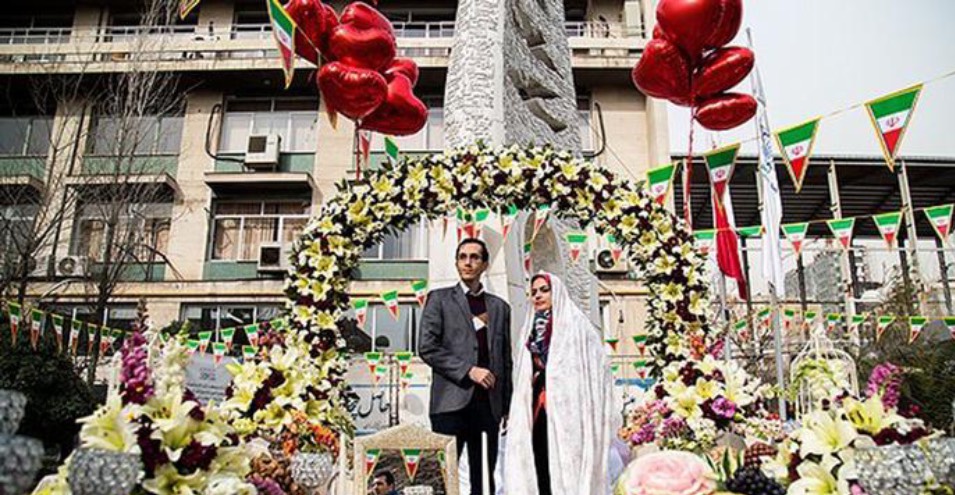
A senior health ministry official confirmed recent reports of a sharp decline in marriages and an increase in divorces in Iran, saying that one divorce is registered for every three marriages, and half of the separations occur within the first five years.
According to the Director General of the Population and Family Health Office of the Ministry of Health, in 2008, the number of registered marriages was 890,000, and this number decreased by 40 percent to 500,000 last year.
According to IRNA, Hamed Barakati presented these statistics on Wednesday, November 10, at a marriage counseling training conference in Kerman, adding that the number of registered marriages in this province has also decreased by 30 percent compared to the average for the whole of Iran.
Barakati also reported a 20 percent increase in Iran's elderly population in recent years, saying that slightly more than 9 percent of Iranian citizens are over the age of 65.
The Director General of the Ministry of Health referred to the decline in fertility and childbearing in Iran in another part of his speech. According to him, in the 1960s and 1970s, an average of 2 million babies were born in Iran each year, and this figure dropped to about 1.6 million babies in the 1990s.
Fertility decline despite Khamenei's recommendations
The decline in marriage and childbearing has occurred despite the increase in the population, even though the Leader of the Islamic Republic, Ali Khamenei, has repeatedly warned about the aging population for several years and called for programs to increase the population.
The Director General of the Population and Family Health Office of the Ministry of Health says that to maintain the composition of the country's population, on average, every woman of reproductive age should give birth to at least 2 children, but the average fertility index in Iran has reached less than 9.1 percent.
Referring to the continuing decline in marriage and childbearing, he said: "We were unable to work well in these two areas, and looking at population growth and childbearing policies in the early days of the Islamic Revolution, there was a growth of three and a half percent, but now this figure has reached 1.2 percent."
This trend is exacerbated by the increase in divorce and the shortening of the period of cohabitation. According to Barakati, currently, one divorce is registered for every three marriages, and 50 percent of divorces occur in the first five years of cohabitation.
The consequence of this situation is the slowdown in Iran's population growth rate, which was about 46.2 percent in 2016 and decreased to 24.1 percent in 2016.
Childbirth rate lower than previous statistics
Concurrently with these remarks, Health Minister Saeed Namaki told reporters on the sidelines of Wednesday's cabinet meeting that after joining the ministry, he had assigned a team to prepare statistics on childbearing and fertility, whose findings differed from previous statistics.
According to ISNA news agency, the health minister says that there was either a mistake in the previous statistics or that there was "malicious intent" in their preparation and announcement. It is also possible that previous officials published manipulated statistics to please Khamenei or to pretend to advance his desired programs.
Saeed Namaki, referring to the slower fertility rate compared to previously announced statistics, said: "There are concerns about population growth becoming negative in the future."
Source: DW