Is religious propaganda other than the official religion a criminal act in Iran?
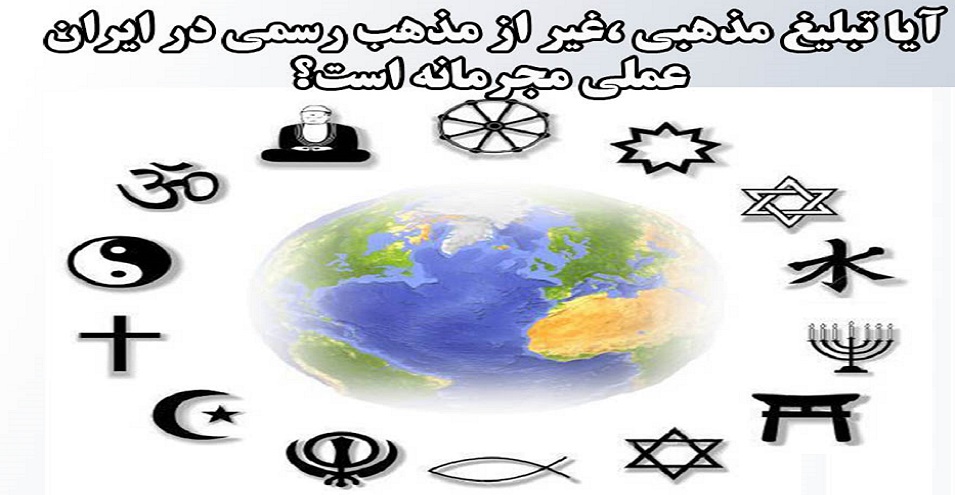
This is a brief article about a topic that needs to be clarified and clarified a little so that misunderstandings about it can be reduced and addressed without prejudice or hatred.
The premise of this issue, or rather, the question in principle, is whether, according to the laws enacted in our country, it is permissible to propagate a religion other than the official religion of the country, or is it considered a criminal act?
To address this question, some preliminary questions must be raised:
1- According to Article 2 of the Islamic Penal Code, any act or omission for which a penalty is prescribed in law is a criminal act and is considered a crime. According to this article of law, which is called the principle of legality of a crime, whenever the legislator has prescribed a penalty for doing something or failing to do something, it can be said that this act or omission is criminal and against the law. Therefore, if an official of an office or the head of an organization, or even an investigator of the prosecution, or even the prosecutor or the attorney general, or even the head of a power, disregards the principle of legality of a crime and calls it illegal and against the law based only on his personal opinion of the act, is that act or omission really considered criminal and against the law? The answer is no. Only an act or omission is a crime that the law has specified.
2 - Article 37 of the Constitution of the Islamic Republic of Iran states that the principle of innocence is that no one is considered guilty by law unless his guilt is proven in a competent court.
According to this basic principle, the only authority and place that can consider an act or omission to be criminal is the official courts of the country, and the legislator has not considered other individuals and persons, regardless of their position, rank, or rank, authorized to express an opinion about criminal acts. If such an opinion were to be expressed, it would not be considered valid and would not provide those individuals with the power to do so.
3 – Article 166 of the Civil Procedure Code states that court rulings must be well-reasoned and based on legal provisions, and Article 167 of the Civil Procedure Code states that the judge is required to find the ruling for each case in the codified laws, and whenever the ruling for a case is not specified in the law, the judge must refer to valid fatwas and issue the ruling for the case.
So we see that Article 166 and the beginning of Article 167 of the Criminal Procedure Code and the last part of Article 37 of the Criminal Procedure Code and Article 2 of the Criminal Procedure Code are in the same direction, and the judge of the court is also obliged to consider the legal provisions in the case and in issuing sentences must specify the violation of the legal provision by the accused and cannot issue a sentence based on the personal opinion and interpretation of individuals and officials.
We know that in our judicial system, an expert's opinion is not necessarily evidence for the judge. This means that these expert opinions can only be used as evidence to assist the judge in the investigation and cannot, on their own, be conclusive evidence and legal text for the judge to issue rulings.
4 – According to Article 167 of the Islamic Jurisprudence, a judge has the right to refer to the fatwas of authorities when the legislator has not determined a ruling on that issue and, in principle, it can be said that the law is silent on this matter.
Therefore, is it relevant to refer to the fatwas of religious authorities regarding an issue that the law has discussed and the text exists?
According to this principle of Q. A. C. A. A., one should doubt the validity of this practice, even though there is a clear text, referring to a fatwa, which is sometimes different, will cause differences in the opinions issued by the courts and may lead to injustice in the sense of not giving the right to the rightful owner. For example, some respected authorities consider banking operations in the banking system of our country as usury and forbidden, and some do not, some of them consider broadcasting some radio and television programs as forbidden, and some do not, and so on.
Therefore, it seems that the criteria and scope of validity for declaring an act or omission to be a crime and declaring it illegal are
It should be found in the explicit text of the law and also that the responsible for investigating the actions of the accused are the judges of the judiciary and competent courts, not other officials and officials of government and governmental departments. (Article 36 of the Criminal Procedure Code)
Now, let's address the question posed in the research premise: Is it a crime to propagate a religion other than the official religion of a country?
It seems that we do not have a clear text in the laws of any country on this matter, a text that explicitly considers, for example, the propagation of Buddhism, Brahmanism, Zoroastrianism, Baha'iism, Christianity, or... as criminal in Iran, calls it a crime, and deems the perpetrator to be subject to punishment.
What should be done now? Should we refer to the fatwas of the authorities, which, as mentioned, are sometimes different and the right may not be granted to the rightful owner?
But do we really have no law on this? And can't we find anything in the laws passed by the country?
According to Article 9 of the Iranian Civil Code, the provisions of treaties concluded between the Iranian government and other states in accordance with the Constitution have the force of law. In fact, Article 9 of the Civil Code states that in addition to what has been explicitly ratified by the Iranian Legislative Assembly, all international treaties that the country of Iran has accepted and the correct procedure for ratification and approval has been followed in Iran have the force of domestic laws and must be observed.
Therefore, the scope of applicable laws in this regard, in addition to laws approved by the legislator, also includes international treaties and commitments, although it should be noted that these treaties and commitments are usually first signed and ratified by the government.
It seems that it must also be approved and ratified by the legislature, and in fact, in a sense, the legislature enacts it through it.
The intention of this reference is that according to the International Covenant on Civil and Political Rights of 1966 of the United Nations General Assembly and its Article 18, everyone has the right to freedom of thought, conscience and religion. This right includes freedom to have or adopt a religion or belief, and freedom, either alone or in community with others and in public or private, to manifest his religion or belief. And Article 19 of it also explicitly states in its second paragraph the right to receive and impart information and ideas of all kinds.
Therefore, individuals can adopt any religion, belief, or belief, and this means that they can change their religion, belief, or belief or express and spread it without these actions being considered punishable.
Although Articles 18 and 19 of the Universal Declaration of Human Rights adopted in 1948 were the model for this Covenant, perhaps its reference could have been objected to, since it is commonly accepted among jurists that declarations are not binding, but according to the explicit text of Article 9 of the ICCPR, treaties are valid and have the force of domestic law, and Article 2 of the aforementioned Covenant also guarantees and undertakes to observe the articles of this Covenant by the States Parties to the Covenant.
Here it may be argued that according to the fatwas of respected religious authorities, imitating other religions and customs is forbidden in Iran or that it is not permissible and should not be done. However, it should be noted that from the beginning, the intention was to address this issue from the perspective of legal texts. On the other hand, according to Article 167 of the Islamic Jurisprudence, it is permissible to refer to the fatwas of religious authorities when the judge does not find the ruling on the case in the legal articles, not that it is in the texts and articles and refers to the fatwa without paying attention to those legal articles. (As for the use of fatwas, there is also the perception among many jurists that the application and use of this principle is permissible only in legal matters and will not be applicable in criminal matters.)
Furthermore, according to Article 4 of the Islamic Jurisprudence, the jurists of the Guardian Council are authorized to determine and declare which legal articles are against Islamic law. According to current practice, they are even asked about legal articles left over from before the revolution, and they declare their opinion on this matter. Sometimes, we even see this citation of the opinion of the jurists of the Guardian Council in the rulings of the general panels of the Supreme Court of the country or the general panels of the Administrative Court of Justice, and even in the courts of justice.
However, so far, the jurists of the Guardian Council have not declared that the Convention on Civil and Political Rights, which the Iranian government accepted and was ratified by the Shura Council on 13 Aban 1351 and also by the Senate on 17 Ordibehesht 1354, is against Islamic law, or that they have indicated that a certain article of this convention and declaration is against Islamic law and should not be considered or acted upon.
Therefore, the reference to this convention is valid and the respected judges of the courts should pay attention to it, observe it, and take it into account in issuing rulings.
In addition, as mentioned in Article 2 of the Covenant on Civil and Political Rights, the States Parties and signatories have undertaken to implement and guarantee the rights envisaged in this Covenant.
In reference to the Covenant on Civil and Political Rights, it may be doubted that the subject of this discussion can be covered by the restrictions contained in paragraph 3 of Articles 18 and 19. That is, restrictions that are lawfully imposed in a democratic society and in order to protect national security and interests, or public order and safety, or public health and morals. The response states that what can be effective as a restriction on the application and enforcement of Articles 18 and 19 is the "existence of a legal provision" in this regard, while it was pointed out that in the laws approved by the Islamic Republic of Iran, there is no law on the restriction of belief or the expression and dissemination of thoughts and beliefs, especially religion. Also, according to Article 4 of the Covenant on Civil and Political Rights, states can only adopt measures outside the requirements set forth in this Covenant in cases of public and exceptional and extraordinary danger that threaten the existence of a nation, and on the condition that they immediately notify the United Nations and the States Parties to the Covenant. In other words, they can ignore and violate these provisions. However, throughout all the years since During the period of the Islamic Republic of Iran, the government has never declared extraordinary and exceptional circumstances that threaten the existence of the Iranian nation, which could be considered grounds for imposing certain restrictions on human rights and non-implementation of the Convention on Civil and Political Rights. Finally, it should be noted that according to paragraph 2 of Article 4 of this Convention, assuming that emergency conditions are fulfilled, the application of Article 3 should not create restrictions on the implementation of any articles of this Convention, including Article 18.
Summary of the article:
Is the propagation of a religion other than the official religion of the country in Iran against the law and a criminal act according to the codified and approved laws?
In response, it should be said that given that the law is silent on this matter and there is no explicit provision on the criminality of this act, it cannot be said that this act is illegal and criminal, even with reference to Article 18 of the Convention on Civil and Political Rights adopted by the United Nations General Assembly in 1968, and with regard to the validity of these covenants according to Article 9 of the Covenant, and with reference to the fact that the jurists of the Guardian Council have not declared this convention and its articles to be contrary to Islamic law, and also with regard to Article 2 of this Covenant, the observance and implementation of which is a commitment and guarantee by the member states, the propagation of religions and beliefs other than the official religion of a country is free in Iran and cannot be considered a crime and the perpetrators of it should be punished.