Testimony of Dobrina Bet Tamraz at the U.S. Department of State
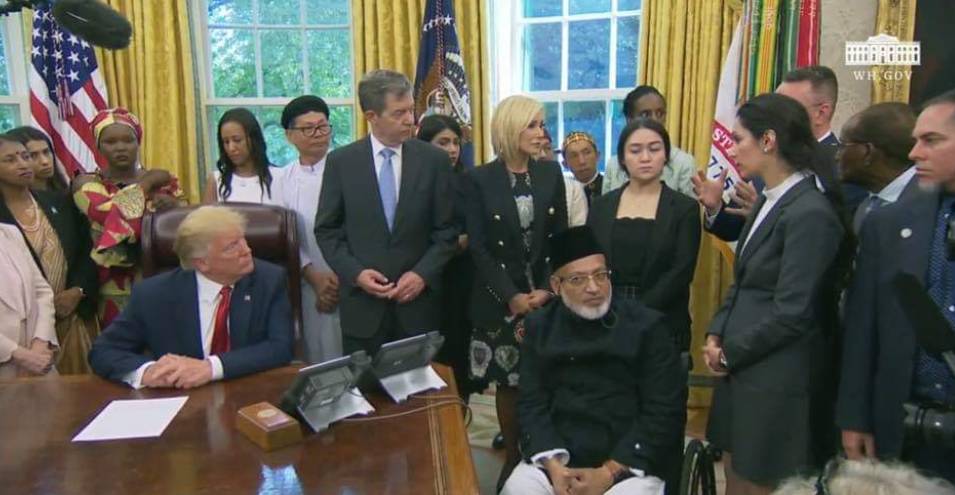
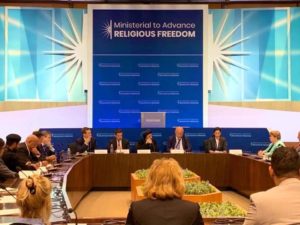
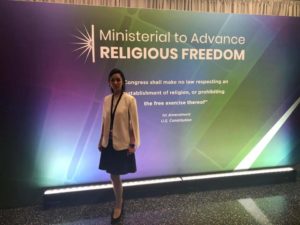
Assyrian priest and human rights activist Dobrina Bet Tamraz participated in a panel discussion titled “Challenges to Religious Freedom in the Middle East” at the second anniversary of the U.S. Department of State-hosted Forum on Advancing Religious Freedom in Washington, D.C., on July 17, 2019. She spoke about the challenges facing Christian minorities in Iran.
He made the following statements:
“I would like to sincerely thank the United States Department of State, especially Secretary of State Pompeo, Ambassador Brownback, and Special Counsel Knox Thames, for organizing such an important event and for giving me the opportunity to share my story with you.
Terrorists, Zionists, and spies are a threat to national security: this is how evangelical Christians are called in the country where I have lived, Iran. Many Christians have been sentenced to long prison terms for such wrongful convictions related to the practice of their religion, and their sentences have been upheld by appeals courts. Most of the cases mentioned involve Muslim Christians, but there are also many other cases where members of the Armenian and Assyrian Christian minorities have been imprisoned or sentenced to prison for their religious activities. My parents and only brother, as well as myself, have been subject to such sentences.
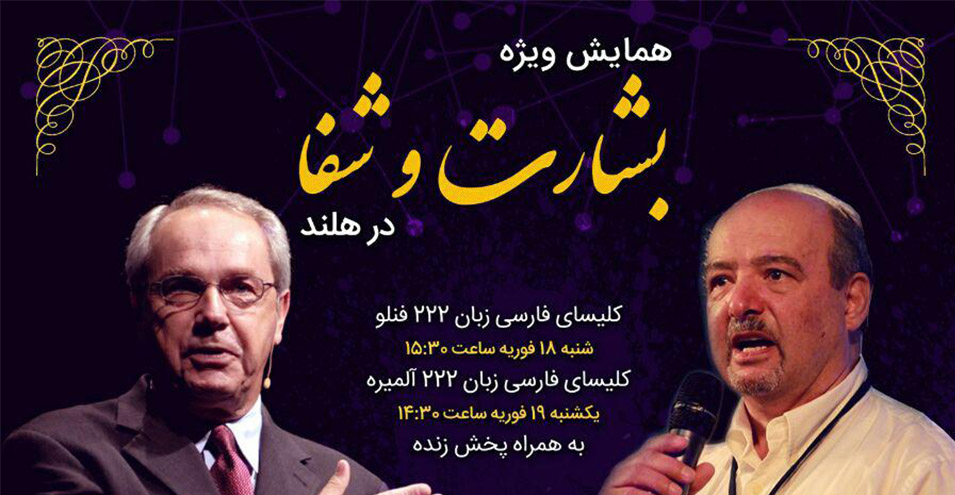
My father, Rev. Victor Bet Tamraz, was a pastor officially recognized by the Iranian government. He led the Assyrian Pentecostal Church for over 40 years, holding services in both Persian and Assyrian. Our church was closed by the Iranian Ministry of Interior in March 2009. For as long as I can remember, my family has been the target of repeated threats from Iranian authorities. Everything changed on December 26, 2014, when uniformed security officers stormed our home while we were celebrating Christmas and arrested everyone present. The officers separated the men and women and began body searching them, confiscating all our Bibles and personal belongings such as cell phones, laptops, and identification documents. Everyone at the party was interrogated on camera and forced to sign forms pledging never to get together again.
My father was taken straight to prison. They beat him. They shaved his head to humiliate and mock him. They treated him like a criminal and a terrorist. He was kept in solitary confinement for 65 days, sometimes spending 10 days in these cells without anyone else present. He was convicted of “organizing evangelistic meetings” and “illegal house church activities,” along with other charges that were considered “activities against national security.” Currently, my father, Pastor Victor Bet Tamraz, is serving a ten-year sentence.
Following my father’s arrest, my brother Ramil and four other Christians were arrested at a picnic in Tehran. We had no information at all about their whereabouts. The next day, we received a brief phone call from my brother who told us that he was being held in Evin Prison in Tehran. We had no news of him for a month. They had been interrogated and denied access to their lawyers the entire time they were held. They were also charged with “acting against national security” and “planning and establishing house churches.” The matter did not end there. Shortly after their arrest, the wives of two of the prisoners were dismissed from their jobs by order of the Iranian authorities.
In 2017, my mother, Shamiran Issavi, was summoned to meet with intelligence officers and the National Security Agency. She was interrogated for long hours and forced to provide information about our church members and religious activities. My mother was subsequently sentenced to five years in prison for “membership in a group that endangers national security” and another five years for “gathering and conspiring to commit crimes against national security.” She is due to appear in the Court of Appeal in September of this year.
I had a similar experience before leaving Iran. I was held in a men’s detention center without any female officers present. Eventually, I was forced to cooperate with the authorities and provide them with the names of our church leaders along with information about their activities. I was then forced to sign documents confessing to the crimes of my family and other priests.
The Iranian Christian community, along with other religious minorities, is denied the right to freedom of religion and belief. This violation of human rights threatens the security of these communities. The ongoing persecution of Christians by the authorities is often accompanied by threats that take various forms.
The end of 2018 saw a sustained wave of crackdowns on private home gatherings, leading to a large number of arrests. In 2018 alone, 171 Christian converts were arrested and convicted on similar baseless charges. They are currently either awaiting trial or serving lengthy prison sentences.
At least 37 Christian converts have been arrested this year. These innocent people are not religious leaders or priests. They are not politicians or even some kind of political activist. They are simply believers who attend gatherings and prayer and worship services. But in the eyes of Iranian officials, any non-Islamic religious gathering is a threat to the regime.
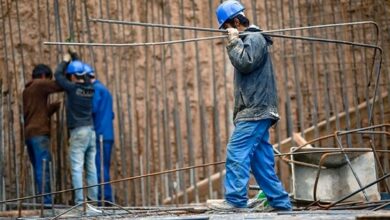
Today, known church facilities for the native Persian-speaking Christians, as well as the Armenian and Assyrian Evangelical minorities, are closed. In some cases, church property has even been seized by state officials. A few months ago, in May, Iranian state officials raided the historic Assyrian Evangelical Church in the city of Tabriz. They ordered the church guard to leave, then changed the locks, pulled down the cross on the church tower, and installed surveillance equipment.
I myself am a native Assyrian Christian. My people are the descendants of our ancestors who have lived in this land for thousands of years, but unfortunately many of them have left our homeland in recent years.
According to 1976 statistics, there were 200,000 Assyrian Christians living in Iran. Now, less than a quarter of that number remain. I ask myself why?
Religious persecution was the only reason I left Iran. I was able to escape, but I cannot forget those I left behind, my family and all the innocent people who are suffering harsh sentences simply for the peaceful activities of their faith. Everyone has the right to live in safety and peace, with respect and dignity. The Iranian government is committed to respecting, preserving and implementing the right to freedom of religion and belief under international law.
I invite the respected officials of the country of Iran to:
- Immediately and unconditionally release Christians arrested on false charges related to their religious activities and the practice of their faith; and
- The right to freedom of religion and belief shall be granted to every citizen, regardless of their dialect or indigenous group, which shall include any form of religious conversion.
I call on the United States and the international community to hold Iran accountable for its mistreatment of religious minorities, and to hold Iranian authorities accountable for their commitments to grant freedom of religion or belief to all its citizens, and to mention these principles in their negotiations with or about Iran.
In closing, I turn to the congregation in this room and humbly ask that you help us raise awareness and awaken public opinion about the ongoing persecution of Christians and religious minorities in Iran. I thank you for taking the time and for granting me the right to share my family's story with you.