Government Spokesperson’s Belated Admission of Failure and Defeat of Mandatory Hijab Policy
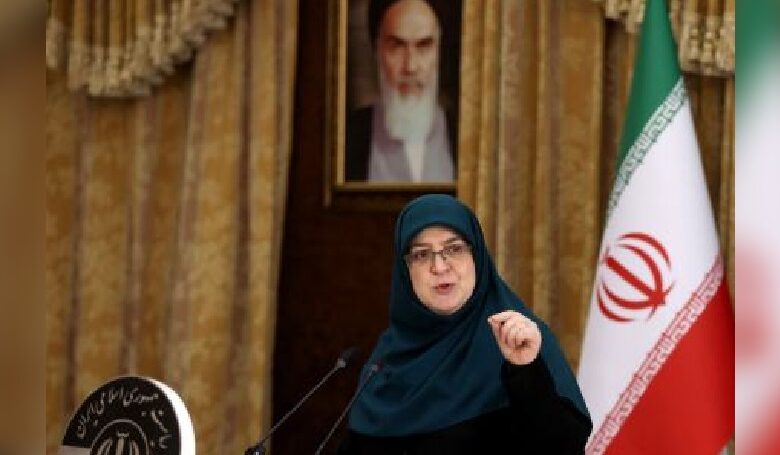
The Islamic Republic’s government spokesperson has acknowledged the failure and ineffectiveness of the mandatory hijab policy in recent statements.
“Fatemeh Mohajerani,” the Islamic Republic’s government spokesperson, made an unprecedented statement acknowledging that “we cannot force hijab back on people through coercion,” while simultaneously defending the continuation of surveillance and the use of religious institutions for social control.
In the latest official statements regarding Iran’s mandatory hijab policy, Fatemeh Mohajerani, the government spokesperson, referred to the experience of “forced hijab” as “a failed experiment”—remarks that observers have interpreted as one of the most explicit government admissions of failure in four decades of policy suppressing women’s dress code.
In a weekly press conference on Tuesday, October 21, Mohajerani stated: “Certainly, we cannot force hijab back on people through coercion; this was a failed experiment.” She simultaneously emphasized that the Masoud Pezeshkian government still considers itself obligated to comply with the decisions of the Supreme National Security Council and stressed that any cultural initiative must be implemented while considering society’s cultural attitudes.
Mohajerani added that the government intends to use a “neighborhood-centered approach” to leverage the capacity of mosques to promote respect for laws—a position that critics view as a continuation of control through soft and religious means.
These statements came days after “Rouhollah Momayyednasab,” the head of Tehran’s Enjoining Good and Forbidding Evil headquarters, announced the formation of a “Modesty and Hijab Situation Room” and the mobilization of over 80,000 enforcers of virtue to implement the mandatory hijab law.
In recent years, numerous reports have documented clashes between citizens and morality police, closure of businesses, and the arrest of women for their manner of dress. Despite widespread protests and civil campaigns, strict policies against women continue to be enforced.
According to the government spokesperson, no special budget has been allocated for such work, and the government is attempting to prevent unofficial actions in the hijab enforcement sphere through budgetary discipline. However, local reports indicate that shop closures, cafes, and restaurants continue to be sealed in various cities.
In another part of her remarks, Mohajerani warned: “Because we are a Muslim society, we must be careful not to create polarization within society.”
Nevertheless, social experts believe that deep polarization has formed between the youth generation and the political structure. In today’s Iranian society, a large segment of women, particularly following the 2022 protests, view the hijab as a symbol of government coercion and have rejected it as a tool for controlling their bodies and identity.
Based on independent research, including a report by the “Gamaan” institute, over 70 percent of Iranian women in 2025 stated they oppose forced hijab and believe it should be a personal decision. These findings demonstrate that the mandatory hijab policy no longer has social acceptance or political efficacy.
From the perspective of international observers, while the government spokesperson’s admission of policy failure is noteworthy, it cannot be regarded as evidence of genuine change as long as forces known as “virtue enforcers” and repressive legal structures remain active.
Meanwhile, human rights organizations, including Article 18 and Christian Solidarity Worldwide, have repeatedly warned about violations of religious, cultural, and individual freedoms in Iran. They argue that the imposition of mandatory hijab and harsh treatment of opponents constitute part of broader suppression of religious and civil liberties in Iran.
Although Fatemeh Mohajerani’s statements may represent a window of realism in Iran’s official discourse, the continued control over women’s lives demonstrates that the state still fears “freedom as a threat.” For the international community and human rights-defending Christian organizations, this admission serves as a reminder that the struggle for human dignity and freedom of conscience in Iran continues, with Iranian women standing at the forefront of this struggle today.