Transfer of Evin Prison Prisoners to Fashafoyeh; Uncertain Fate of Evin Prison and Prisoners
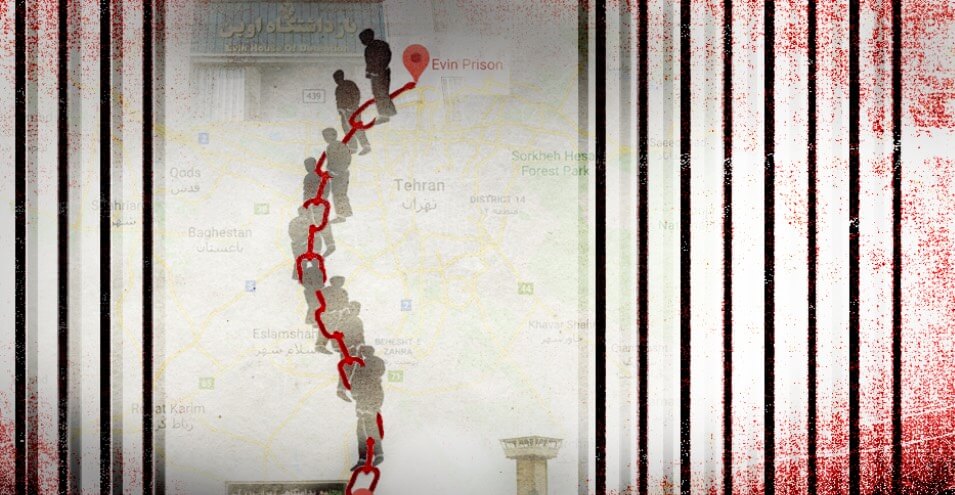
The transfer of a large number of prisoners from Evin Prison to Fashafoyeh Prison has raised concerns about the fate and current situation of these prisoners, as well as Evin Prison. An informed source told the Campaign for Human Rights in Iran that, apart from the security detention centers and two general wards, other prisoners from various wards of Evin Prison have been transferred to Greater Tehran Prison (Fashafoyeh) without any explanation.
According to this informed source, “Evidence suggests that Evin Prison is being prepared for possible protests, and as some officials had previously said, it seems that they want to turn Evin Prison into a large detention center that will have room for detainees in times such as public protests when the number of detainees becomes very large. In a way, the November protests and the large number of detainees who were forced to release some due to the lack of detention centers and holding areas have been an experience for them, and they are raising the possibility of more and wider protests, and from now on they are preparing the ground (prison) for the detained protesters.”
Mostafa Pourmohammadi, former Minister of Justice in Hassan Rouhani's government, said on July 27, 2017, that "there is a need for a large detention center for temporary detention in Tehran because it is not possible to constantly transfer offenders from a distance of 40 kilometers to these complexes while the case is being reviewed in the prosecutor's office or court." Although he had said that a final decision had not yet been made, now that more than two years have passed and prisoners from Evin Prison have been transferred to other prisons, judicial and security officials have not given any explanation about these transfers.
An informed source told the campaign: “They started transferring prisoners ten days ago, and now only a limited number of prisoners remain in Ward 2, Hall 7, Ward 8, and Hall 12, Ward 7, most of whom are political, ideological, and security prisoners. They have closed and locked the other wards, and it is not clear what their specific plans are.”
Saeed Malekpour, a former political prisoner who was imprisoned in Evin Prison for more than eleven years, announced on his personal Facebook that “all the trees in the air vents of Wards 7 and 8 have been cut down. The large, sturdy trees that were the only source of joy for the prisoners in the air vents. The Andorzgah 8 club has been closed and prisoners are not allowed to exercise in the club. The empty halls are being built and for the first time since the 1960s, they are installing metal doors for the rooms.”
According to Mr. Malekpour, “All evidence shows that Evin Prison is becoming a high-security detention center like Ward 2A and Ward 209. They have replaced all the cameras and increased the number of cameras. They have made the walls higher and installed barbed wire and electric fences everywhere.”
Ward 209 is a security ward belonging to the Ministry of Intelligence, and Ward 2A is a security ward belonging to the Revolutionary Guard Corps. A source familiar with the changes and developments related to Ward 2A of the IRGC told the Campaign: “After the protests of 2009, Ward 2A of the IRGC was the main detention facility belonging to the IRGC, where detainees were interrogated and tortured by the IRGC. However, since last year, another detention facility has been established by the IRGC outside Evin Prison, and at the same time, a number of detainees have been transferred to that detention facility, using Ward 2A of the IRGC.”
The source told the campaign that “this new detention center, according to some detainees, appears to be newly built. But it is not yet clear where it is and it is a kind of secret detention center.”
In Evin Prison, in addition to the security detention centers of the Revolutionary Guard and the Ministry of Intelligence, Ward 240, which is under the protection of the Judiciary, is also a security ward. In addition to these wards, female political prisoners are also held in the women's ward of Evin Prison. Female non-political prisoners have previously been transferred to Qarchak Prison in Varamin.
An informed source told the campaign that the changes and developments in Evin Prison are not unrelated to Gholamreza Ziaei’s leadership of the prison: “Almost since Ziaei came to Evin from Rajai Shahr and became the head of Evin Prison, changes and developments have begun in Evin Prison, and they say that the plan to transfer prisoners and prepare Evin for detained protesters is Ziaei’s plan that is being implemented.”
Gholamreza Ziaei, who was appointed as the head of Evin Prison in early August of this year by the order of the Director General of Tehran Province Prisons, has played a significant role in increasing pressure and imposing illegal restrictions on prisoners in this prison. Ziaei previously headed Rajai Shahr Prison in Karaj, which is known for its poor conditions for prisoners. He was also the head of this detention center in 2009, at the time of the Kahrizak crimes that led to the murder of several protesters against the election results.
However, according to sources from the campaign, the conditions of the prisoners from Evin Prison who have been transferred to the Greater Tehran Prison (Fashafoyeh) are not good. The prison does not have the capacity to accommodate the number of prisoners in this prison, and the prisoners who have been transferred from Evin after quarantine are spread out in different wards of this prison, even though there is not even a place to sleep.
Hassan Khalilabadi, the head of the Islamic Council of Rey, announced during the transfer of detainees from the November protests to Fashafoyeh Prison that Fashafoyeh Prison does not have the necessary facilities and that it is difficult to accommodate this number of detainees in this place, and Fashafoyeh Prison is not capable of handling this volume of detainees.
One of the former prisoners of this prison told the campaign: “Fashafoyeh prison is really terrible. There is no drinking water or tap water there at all. It is officially salty and cannot be eaten. Prisoners have to buy water, which is also in short supply, and it even leads to water smuggling. The segregation of crimes has no meaning at all, and it is a very remote place in the middle of the desert, which is very difficult for prisoners’ families to get around. The hygiene is very poor. The quality of the food is really low. There is even rat droppings in the food. Meat and fruit in this prison are a joke. In the regular wards, prisoners have to pay for everything they want to do, from sleeping to calling their families. It is in a way that there are many times the capacity of the prison hall, and each prisoner finds a place according to the amount of money they have and can afford, and some prisoners sleep in front of the toilets due to lack of space. At the same time, drugs are officially traded and are so common that some prisoners exchange drugs instead of paying money, for example, to get a phone card. In general, this prison is prone to disaster, and if this continues, "If this continues, anything is possible in this prison."
Nader Fatorechi, a journalist who was arrested on Sunday, August 19, following a complaint by the producer of the TV series "Shahrzad" and spent a day in Fashafoyeh Prison, published a critical article describing the conditions in this prison as "inhumane and anti-human," nothing less than "hell."
Source: Human Rights Campaign