Transfer of 3,000-year-old Iranian treasure to China and failure to return and hold officials accountable
Iran's three-thousand-year-old treasure has not yet been returned after being transferred to China, and officials are refusing to provide a transparent response.
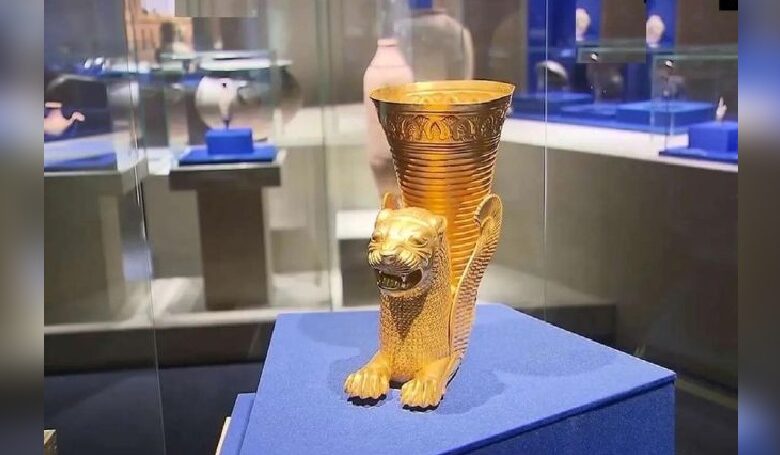
In recent years, Iran has hosted events that have put the country’s historical and cultural heritage at risk. One of the most important of these events was the transfer of a number of valuable Iranian antiquities, including the Achaemenid Golden Cup and a collection of 3,000-year-old objects, to China under the title of “Exhibition of the Splendor of Ancient Iran in China” in 1402. Two years after this transfer, these artifacts have not yet returned to Iran, and the silence of the country’s official and cultural institutions has raised serious questions and widespread concerns among experts and cultural heritage enthusiasts.
In late 1402, a collection of Iranian antiquities, including pieces from the Median, Achaemenid, Parthian, and Sasanian periods, was transferred to one of the national museums in China for an exhibition titled “The Splendor of Ancient Iran.” At the forefront of the collection was the Achaemenid Golden Cup, a unique work of ancient Iranian metalwork of unparalleled historical and artistic value.
The resolution to export Iranian historical monuments to China was approved and announced by the Cabinet of Ministers, citing Article 138 of the Constitution of the Islamic Republic of Iran and signed by Mohammad Mokhbar, First Deputy Prime Minister of Ebrahim Raisi. Based on this authorization, the Ministry of Cultural Heritage, Tourism and Handicrafts, in an official action, transferred 211 historical monuments, along with five recreated works, to this country for display in the exhibition "The Splendor of Ancient Iran in China".
According to the initial announcement by the Cultural Heritage Organization, these works were initially supposed to be returned to the country within a maximum of three months, but it was then extended for six months. In June 1403, the contract was extended again for another six months. However, now, about two years after the transfer of these works to China, no report has been published on the return of these works, and follow-up by the media and cultural activists has also been met with vague and non-transparent responses from the authorities.
Cultural heritage experts have warned of the possibility of these artifacts being retained or handed over to Chinese institutions. Some unofficial sources have spoken of the possibility of these artifacts being traded for economic or political benefits in bilateral relations, a claim that has not yet been denied or confirmed by officials.
Dr. Nasser Kaviani, an Iranian archaeologist and researcher, stated in an interview with the media: "Transferring such a treasure without transparency, monitoring, and guaranteeing its return is against the principles of protecting cultural heritage and national interests. Silence on this issue could lead to the loss of an important part of our historical identity."
Social media users have also called for clarity on the fate of these artifacts. So far, no official institution, including the Ministry of Cultural Heritage, the Ministry of Foreign Affairs, or the Islamic Republic's Customs, has provided accurate information. Given the importance of these artifacts as part of the world heritage and belonging to the Iranian people, and the plundering of many Iranian cultural properties and heritage by the Islamic Republic's regime, demanding their immediate and unconditional return should become a national priority.