Celebration of blood, presence of representatives of religious minorities in Jamkaran, in the shadow of repression and killing
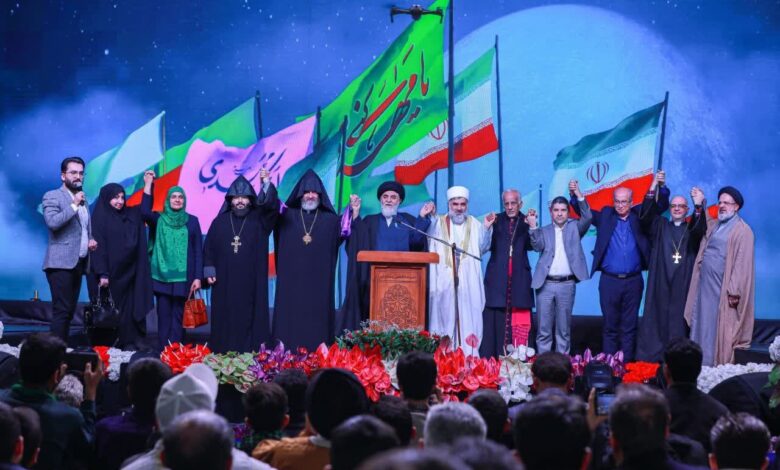
Representatives and leaders of Iran's religious minorities participated in the government celebration of the Mid-Sha'ban holiday at Jamkaran Mosque, less than a month after one of the Islamic Republic's bloodiest crackdowns.
While Iran is still in shock and mourning over one of the bloodiest government crackdowns, with a staggering and catastrophic death toll in recent history, images and reports have emerged showing representatives of religious minority communities attending a government-sanctioned religious celebration, a ceremony that is not only unrelated to the pain and suffering of ordinary Iranians, but also stands in stark contrast to it in an unprecedented and questionable way.
بر اساس گزارشهای متعدد نهادهای حقوق بشری و رسانههای مستقل، اعتراضات مردمی در ایران از سه ماه اخیر سال ۱۴۰۴ آغاز و با خشونت، سرکوب شدهاند و شمار کشتهشدگان در این موج سرکوب، حتی بیش از 30 هزار نفر برآورد میشود، در حالی که دولت جمهوری اسلامی خود رقم رسمی حدود ۳ هزار نفر اعلام کرده است.
These heavy casualties come at a time when many independent sources and human rights organizations, including Human Rights Watch and the United Nations, have warned of continued widespread human rights violations and a new wave of executions, mass arrests, torture, and suppression of protests.
In this atmosphere of bloodshed and sorrow, the holding of the large religious celebration of “Nimeh Sha’ban” at the Jamkaran Mosque in Qom, attended by representatives of minority communities, has sparked a wave of criticism, anger, and despair among activists, observers, and the Christian, Jewish, Zoroastrian, and other religious minority communities themselves. The celebration took place while there has been no satisfactory response to the families of the tens of thousands of dead and wounded, or any real accountability from the government for the recent events.
Criticism has focused not only on the timing of the ceremony, but also on the nature and implicit messages of the presence of such figures at a government event; a question that is repeated in social circles and independent media is: "How can those who are supposed to represent religious minorities and protect their rights and dignity participate in a ceremony whose legitimacy is questioned in the shadow of the blood of thousands of Iranian citizens?"
The presence of these religious representatives, especially Christian representatives, at the government celebration comes at a time when Alireza Panahian, spokesman for Ayatollah Ali Khamenei, called Christianity a "nonsense religion" in a speech last week, causing a strong reaction from Christian representatives in the parliament.
However, the Islamic Republic government continues to use the presence and participation of minorities in official events and elections as a tool to appear to have no problem with minorities. However, historical experience and numerous reports show that at other times, these same minorities have been severely repressed and harsh sentences have been issued against them, and this contradictory behavior raises serious questions about the good faith and moral responsibility of the government and minority representatives.
Furthermore, criticism has gone beyond this issue and has extended to the role of these representatives in legitimizing government policies and the apparent disregard for recent tragedies in the official reception of government institutions.
While even Iranian civil society itself, including Christians and Jews, has been among the victims of repression, the prominent presence of representatives of religious minorities in a government gathering highlights the question of whether these individuals are truly independent or are in the clutches of the same structures that ignore the blood of the people? Does their representation, in the true sense of the word, “defending the rights, dignity, and security of their community” pave the way for participation in government projects? The answer from many analysts and critics is clearly negative.
This bitter event once again exposed the fresh wounds of Iranian society and reminded us that until the true voice of the people, justice, and accountability are achieved at the government level, any official presence or participation of representatives in government programs is more like a symbol of compromise, silence, and inaction than a sign of unity and true support for the rights of religious minorities and all Iranian people.