The Islamic Republic of Iran Has Denied Unofficial Religious Minorities the Ability to Obtain National ID Cards
Unofficial religious minorities must either lie or give up to obtain national ID cards
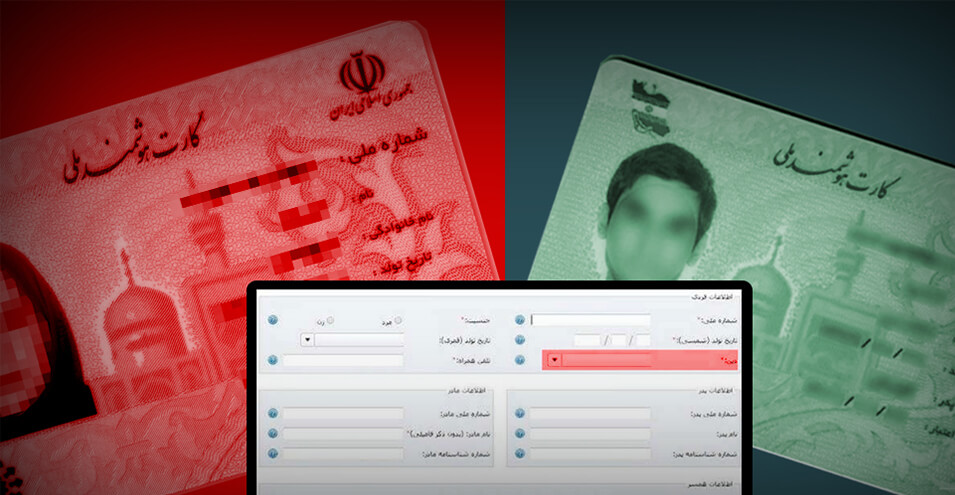
For Bahá’ís and other unofficial religious minorities, the new national ID application form is problematic
January 27, 2020 — In a new measure that severely discriminates against unofficial religious minorities in Iran, national ID cards, which are required for most government and private transactions, are now issued only to citizens who believe in officially recognized religions.
Due to the removal of the “other religions” option in the new national ID application form, followers of unofficial religions must falsely select one of the officially recognized religions (Islam, Christianity, Judaism, or Zoroastrianism) or they will not be issued ID cards.
According to Hadi Ghaemi, director of the Human Rights Campaign in Iran: “In practice, the Iranian government’s new procedure tramples on the basic rights of religious minorities and deprives them of access to essential civic services.”
Ghaemi added: “This action should be strongly condemned by the international community because it openly discriminates against religious minorities and violates domestic and international laws.”
Not having a national ID makes it impossible for unofficial religious minorities, such as Bahá’ís, who with a population of around 300,000 to 350,000 are the largest religious minority in Iran, to access many services and carry out daily tasks, such as banking transactions.
New form following criticism by parliamentary representative
In the previous national ID issuance form, when registering the applicant’s religion, in addition to religions officially recognized in the constitution, an “other religions” option was also listed.
However, in January 2019, Javad Abtahi, a principlist parliamentary representative from Khomeini Shahr in Isfahan Province, submitted a written notice to Abdolreza Rahmani Fazli requesting the removal of the “other religions” option. According to this representative, the Interior Ministry, by including this option, had granted “legitimacy” to “deviant” sects, including Bahá’ís.
On January 22, 2020, Bahareh Hedayat, a civil activist who has served several years in prison for her peaceful activities, reposted the response of the Civil Registration Organization to a Bahá’í citizen on her Twitter page. In this response, it stated: “Dear citizen, wishing you good health, your chosen religion has not been recognized by law and no solution has been considered. If possible, please complete the registration under the current conditions.”
New procedure intensifies discrimination against religious minorities
A parliamentary representative’s involvement in the national ID issue and his reference to Bahá’ís is the latest sign of the Islamic Republic’s hostility toward the country’s Bahá’í community, which has a long history. While all official and unofficial religious minorities have experienced various forms of discrimination, the Islamic Republic’s persecution of Bahá’ís has been more severe than that of other minorities.
In 2014, Mohammad Javad Larijani, former head of Iran’s Supreme Human Rights Council, in response to a United Nations report on mistreatment of Bahá’ís, said: “Bahá’ís… enjoy all the privileges of other citizens.” However, the Iranian government has imprisoned leaders and followers of this religion, prevented their university education, shut down their businesses, and confiscated their lands.
Despite the “Citizen Rights Charter” emphasizing “the principle of non-discrimination and equality of all individuals and groups before the law without any consideration such as gender, ethnicity, religion, and political-social orientations…,” President Hassan Rouhani has remained silent on the violation of the rights of unofficial religious minorities by the Interior Minister regarding the issuance of national ID cards.
Hassan Rouhani’s Interior Ministry’s new procedure violates domestic and international laws
The issuance of national ID cards is governed by regulations set by the Interior Ministry of Hassan Rouhani’s government, and applicants can visit www.ncr.ir to complete the electronic form. However, the section related to religious registration violates the principles of the Islamic Republic of Iran’s constitution and the international treaties approved by this country.
According to Article 19 of the Constitution: “The people of Iran, regardless of their ethnicity or tribe, enjoy equal rights, and color, race, language, and similar factors shall not be cause for privilege.”
Also, according to Article 20: “All individuals of the nation, both men and women, are equally protected by law and enjoy all human rights—political, economic, social, and cultural—in accordance with Islamic principles.”
Article 23 also states: “Inquisition of beliefs is forbidden, and no one may be molested or taken to task simply for holding a particular belief.”
Furthermore, Article 18 of the Universal Declaration of Human Rights and Article 18 of the International Covenant on Civil and Political Rights explicitly state that no one has the right to deprive individuals of religious freedom or force them to accept other religions.
The use of the new national ID application form applies to both new applicants and those requesting replacement cards.
Source: Human Rights Campaign