California on the Brink of Recognizing Islamic Holidays, Sparking Fresh Debate Over Religious and Secular Identity in America
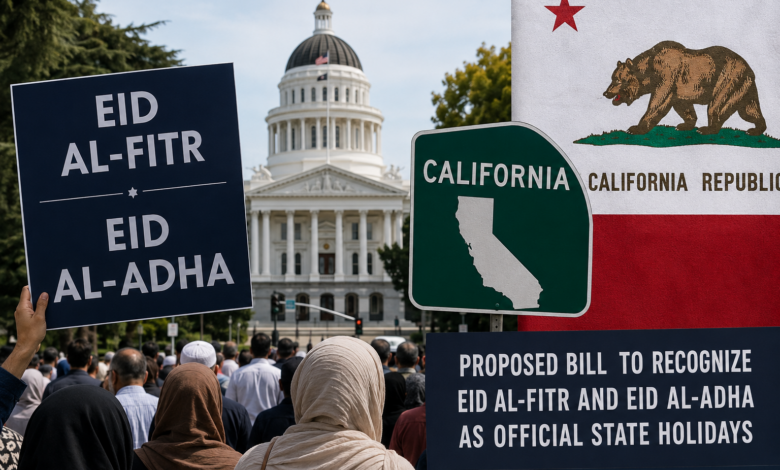
A bill in California’s state legislature to officially recognize Eid al-Fitr and Eid al-Adha as official state holidays has garnered support from Muslim activists and defenders of religious diversity, but critics warn that this measure could spark new debates about the place of different religions in the American public sphere.
California lawmakers are currently reviewing a proposal that, if passed, would place two major Islamic holidays—Eid al-Fitr and Eid al-Adha—among the official holidays of the state. This proposal, which enjoys support from several Democratic representatives, has sparked broad discussion about religious freedom, the status of religious minorities, and the limits of government involvement in matters of faith.
Supporters of the bill argue that Muslims should be able to observe their most important religious occasions without worrying about academic or employment consequences. Matt Herron, a California state assemblymember and sponsor of the bill, has defended it by saying: “No student or worker should be forced to choose between observing their faith and their educational or employment responsibilities.” He also emphasized that this measure sends a clear message to Muslim families that their beliefs, traditions, and religious celebrations matter to society.
Under the provisions of this bill, schools and educational institutions can create conditions allowing students to participate in these celebrations without worrying about being marked absent for attending religious ceremonies. Bill supporters view this measure as a step toward recognizing religious diversity in one of America’s most populous and multicultural states.
California State Senator Aisha Wahab has also voiced support for the bill, describing it as an action that should have been taken years ago. She stated: “It is shameful that taking such a step has been delayed this long.”
Conversely, critics argue that the bill raises serious questions about how the government treats different religions. Rabbi Michael Barkley is among the opponents of the measure, stating that California has not previously formally recognized major holidays of other religious communities in this manner. Pointing to the Christian and Jewish populations in the state, he has asked why occasions such as “Rosh Hashanah” or “Yom Kippur” do not enjoy similar status.
Barkley has described this measure as “a step beyond normal bounds” and said: “This move essentially amounts to a kind of capitulation to something resembling the implementation of Sharia law.” He has also claimed that political decision-makers are more focused on gaining support from certain voters than on the principle of equality among religions.
Continuing his criticism, the rabbi has drawn attention to Eid al-Adha due to its connection to the tradition of animal sacrifice and has expressed concern about the cultural implications of this matter. He has also warned about certain Islamist movements, stating that his perspective on these occasions cannot be evaluated solely within the framework of religious freedom.
This debate unfolds in California at a time when the role of religion in the American public sphere has become one of the most controversial topics in recent years. Protests related to the Gaza war on American campuses, disagreements over Israel, and increased political tensions between different groups have created an environment in which any decision related to religious matters is followed with greater sensitivity.
Some conservative analysts also believe that a kind of political alignment has formed between certain left-wing movements and Islamist activists. Danny Bermawi, a political analyst, has commented on this: “In the view of many radical left-wing forces, Islam is perceived as part of a collection of oppressed groups, and for this reason they support it, without paying attention to all dimensions of its intellectual and doctrinal aspects.”
Despite predictions about the likelihood of the bill passing through the state’s legislative process, it remains unclear whether Governor Gavin Newsom will sign the bill if it reaches his office. The final decision could affect not only California’s Muslim community but also how other American states respond to similar requests, potentially leading to broader discussions about the relationship between religious freedom, religious equality, and the government’s role in matters of faith.