Attack on Azadi Stadium and destruction of the 12,000-seat hall after it was converted into a base for repressive forces
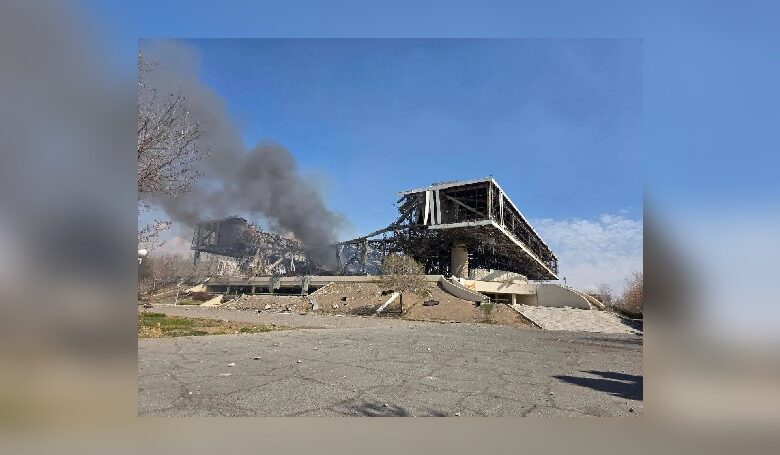
A revelation about the attack on Azadi Stadium shows that the complex's 12,000-seat hall, which in recent years was used to gather Basij forces and security equipment, was extensively destroyed during the recent attacks on Tehran.
Hours after reports of an explosion and attack in western Tehran were published, Iranian domestic media released images showing the extensive destruction of the 12,000-seat Azadi Sports Complex, one of the country's largest indoor sports arenas that has hosted major sporting and even political events for decades.
According to official Iranian news agencies, the stadium was targeted in a missile attack on the morning of Thursday, March 5, and suffered heavy damage. State media outlets explained the incident by writing: “In this morning’s missile attack by the US and Israel on the 12,000-seat Azadi Stadium in Tehran, all parts of the stadium and surrounding buildings were destroyed.”
Images released show large parts of the hall's structure and surrounding buildings severely damaged, with some parts completely collapsed. There have also been reports of the destruction of a dormitory complex associated with the cycling federation near the hall.
The 12,000-seat Azadi Hall, formerly known as the Ariyamehr Indoor Hall, was built in the 1970s, coinciding with the 1974 Asian Games in Tehran. Over the past decades, the complex has been one of the country's most important sports centers, hosting major competitions in disciplines such as volleyball, wrestling, basketball, futsal, and skating.
In addition to sports competitions, this hall has also been used for large gatherings, religious ceremonies, and political programs over the years. This multi-purpose nature has made it one of the symbols of Iran's sports infrastructure.
While official Iranian media refers to this place as a sports center, claims have been made on social media and in some media reports abroad that this complex has at times become a gathering place for Basij and security forces.
In some reports published on social media, the stadium has been described as a “hideout for repressive forces.” It is also said that in recent months, large sports halls have been used to store security equipment and deploy counter-riot forces.
Before the recent wave of attacks on Islamic Republic positions began, reports had been published indicating that some of the country's major stadiums had been turned into security force bases. According to these reports, the government was using the vast, covered spaces of stadiums to protect special forces vehicles and equipment.
For example, reports have been published about Isfahan’s Naqsh-e Jahan Stadium, which was used as a staging area for water cannons, special forces motorbikes, and suppression equipment in the days leading up to the attacks. There have also been reports in the past about the similar use of the Pas Qavamin Sports Complex for the deployment of security forces.
Military and international law experts say that using civilian infrastructure such as stadiums for military purposes can make them potential targets in conflict situations. According to the principles of international humanitarian law, converting public facilities into military bases can pose serious risks to civilians and public property.
Meanwhile, images and videos published in Iranian media show that the destruction of the 12,000-seat Azadi Hall was extensive, with parts of the historic sports complex virtually destroyed. There has been no official report yet on possible casualties or the number of people present at the time of the attack.
The Azadi Sports Complex has been one of Iran's most recognizable sporting icons for decades. Now, the demolition of one of its most important venues amid military tensions has once again drawn attention to the consequences of turning public infrastructure into security centers.
As fighting continues and counter-attacks increase in the region, it is unclear how many other public infrastructures may be at risk, raising new concerns about the security of civilian centers in Iran.