Bushehr Court of Appeals orders separation of Christian couple's 2-year-old adopted child
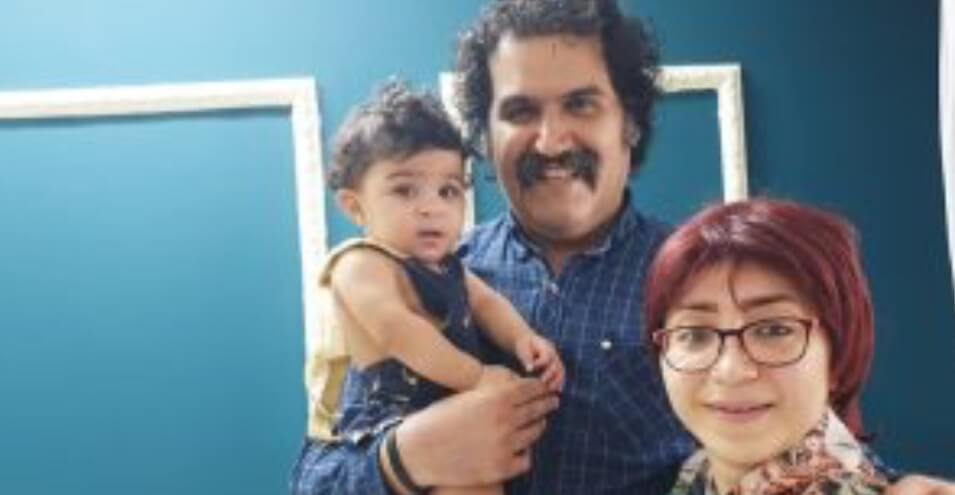
On Wednesday, October 2, the Bushehr Provincial Court of Appeal ruled to separate the 2-year-old adopted child of Maryam Fallahi and Sam Khosravi, a Christian couple who had been taking care of him since he was ten weeks old. The ruling states that because the child was born Muslim, the Christian family cannot take care of him.
According to HRANA News Agency, citing Article 18, on Wednesday, October 2, 2020, the Bushehr Provincial Court of Appeal issued a ruling to separate the 2-year-old adopted child of Maryam Fallahi and Sam Khosravi, a Christian couple who had been in charge of her since she was ten weeks old.
According to this report, the ruling states that because the child was born Muslim, a Christian family cannot take care of him.
This ruling was confirmed after the Bushehr Family Court judge issued a ruling on July 10, acknowledging that there was a "strong emotional relationship" between the child and the Christian couple, Maryam Fallahi and Sam Khosravi, and that with the sick child's return to the orphanage, an "unknown future" awaits her, and the likelihood that another family will adopt Lydia due to her illness is "zero."
The report states that the two-year-old child suffers from heart and digestive diseases, and the welfare department did not inform the Christian couple about Lydia's illness. However, they are doing their best to improve the child's condition without any objection. The welfare supervisor and the forensic doctor have also confirmed that during the period of custody, Maryam Fallahi, who has been a nurse at the Bushehr Heart Hospital for many years, and her husband have provided the best care for the child.
On the other hand, the lawyer in the case also announced: “The judge’s ruling to separate Lydia from the Christian couple is completely contrary to the fatwas of Makarem Shirazi and Yousef Sanei, two Shiite religious authorities. In response to the lawyer’s explanation and question, Nasser Makarem Shirazi had issued a fatwa that due to “necessity,” the child could stay in this family. Sanei also issued a fatwa that “his guardianship of the couple has no religious problems, and their non-Muslim status is not an obstacle, and the choice of religion is with the child after puberty. Also, issuing this ruling is not only contrary to international law but also to Iranian law.”
The lawyer added: “Article 3 of the Law on the Protection of Unaccompanied and Badly Cared Children and Adolescents states that all Iranian citizens residing in Iran can adopt children for guardianship, and no specific provision is made regarding religion. According to the Constitution, the clients are Iranian citizens and residents of Iran, and the Christian religion is recognized in the Islamic Republic of Iran. According to Article 6, paragraph 1, entrusting a child to religions accepted in the Constitution is permitted, and therefore, according to this law, there is no obstacle to the clients adopting a child.”
Maryam Fallahi and Sam Khosravi are among seven Christian converts who were arrested by Bushehr security officers on July 1, 2019, and tried in the Bushehr Revolutionary Court.
Based on the Revolutionary Court's verdict, Sam Khosravi was sentenced to one year of imprisonment and a two-year ban on residing in Bushehr, and Maryam Fallahi was sentenced to a fine of 80 million rials and permanent dismissal from government service.
It is worth noting that despite the fact that Christians are recognized as a religious minority by law, the security services follow the issue of Muslims converting to Christianity with particular sensitivity and deal with activists in this field with force.
The treatment of Christian converts in Iran is taking place despite the fact that, according to Article 18 of the Universal Declaration of Human Rights and Article 18 of the International Covenant on Civil and Political Rights, everyone has the right to freedom of religion and to change their religion with conviction, as well as the freedom to manifest it, individually or in community with others and in public or private.
Source: HRANA