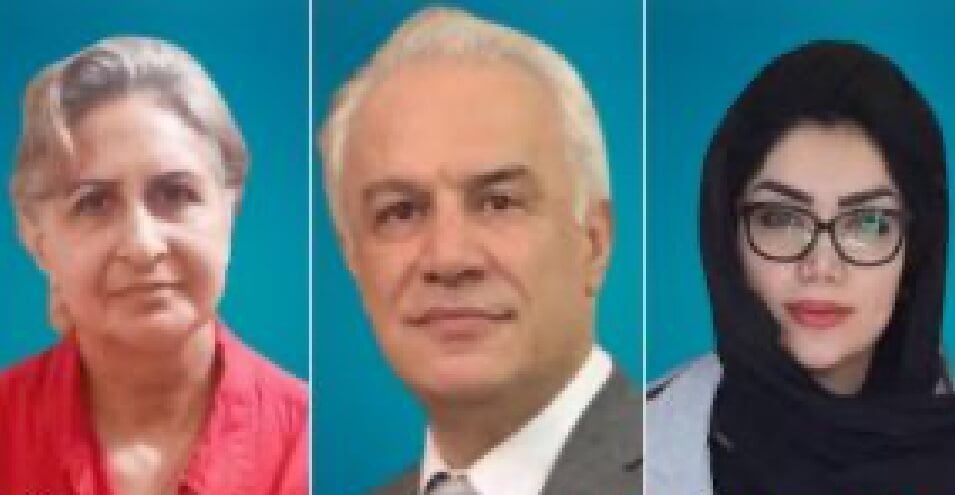
A Christian convert: The Islamic Republic seeks double persecution by issuing a deportation order

Ebrahim Firoozi, a Christian convert who is spending his exile in the city of Rask, a part of Sarbaz County, Sistan and Baluchestan Province, believes that the Islamic Republic of Iran's authorities' goal in issuing exile orders, which are considered supplementary punishments, is only to harass the citizens to whom these orders are issued, harassment that is presented as legal by the authorities.
Ebrahim Firoozi, a Christian convert in Iran, spoke to Voice of America on Thursday, July 25, regarding the situation in the city of Rask, a part of Sarbaz County, where he is spending his time in exile. He said that there are no medical facilities in the city of Rask, and that the city is deprived of having a hospital or even a health center. He cites the lack of medical facilities as one of his problems during his exile, saying that if he ever gets sick, the city does not even have a place to treat him, and there is only one pharmacy in the city of Rask, and the medicines there are also not complete.
This Christian convert describes the conditions of life in exile as follows: an exile is not allowed to leave the city limits, must report to the police station every 24 hours, and must sign a form called an attendance sheet.
In his interview with Voice of America, Ebrahim Firoozi announced the number of exiled citizens in the city of Rask as at least five, and said that the city of Rask is considered a city of exile and that the charges against the people who are exiled with him in this city are related to civil crimes, and none of them have ideological or political charges.
This Christian convert says that he has been sentenced to prison three times to date. He was first sentenced to 10 months in prison by the Revolutionary Court of Robat Karim in 2010 on charges of “propaganda of Christianity.” Mr. Firouzi was then sentenced again in August 2013 by the Revolutionary Court of Robat Karim on charges of “propaganda against the Islamic Republic system,” “establishing and leading a deviant Christian evangelical organization,” and “establishing a Christian website.” He was finally sentenced in April 2015, while serving his sentence in Rajai Shahr Prison, by Branch 28 of the Revolutionary Court, headed by Judge Moghiseh, in a separate case, to another five years in prison on charges of “forming a group with the intention of disrupting the security of the country.” That sentence was upheld by the Court of Appeal on January 15, 2016.
On November 29, 2019, Ebrahim Firouzi was released from Rajai Shahr Prison in Karaj after serving his sentence. On Tuesday, November 12, he went to Sarbaz County, Sistan and Baluchestan Province, to serve his two-year exile sentence, and presented himself to the Rask Public and Revolutionary Prosecutor's Office.
Mr. Firoozi told VOA that although he had previously been sentenced to two years in exile by the Revolutionary Court of Robat Karim, authorities sentenced him to an additional eight months in exile. The Christian convert also said that although he began his exile two weeks after his release by traveling to Sarbaz County in Sistan and Baluchestan Province and being introduced to the Rask Public and Revolutionary Prosecutor’s Office, judicial authorities have given the date of his exile as April of this year.
Previously, some human rights media outlets had announced that in April 2020, the 2-year exile sentence of Ebrahim Firouzi in a new case due to his absence for one day to serve the period of exile was increased to two years and 8 months by the Revolutionary Court of Robat Karim; also, judicial officials in Robat Karim and the prosecutor's office in Sarbaz County had announced that the reason for changing the start date of the exile from November 2019 to April 2020 was to review the case of the Christian convert's absence. This is despite the fact that Mr. Firouzi had not left Sarbaz County during this period.
In late June of this year, US Secretary of State Mike Pompeo unveiled the US annual report on international religious freedom, 33 pages of which are dedicated to the state of religious freedom in Iran; the report states that in 2019, the Islamic Republic continued to harass, interrogate, and detain Baha'is, non-Armenian Christians, especially those who have converted to Christianity (Kashishans), Sunnis, and other religious minorities.
The US State Department report states that the United States does not have diplomatic relations with Iran and therefore has not had the opportunity to express concerns about violations of religious freedom and related restrictions in bilateral meetings, and the US government continues to call on the Islamic Republic to respect religious freedom.
Source: Voice of America