Two human rights organizations have warned about heavy pressure on Iranian lawyers and called for the immediate release of Mohammad Najafi.
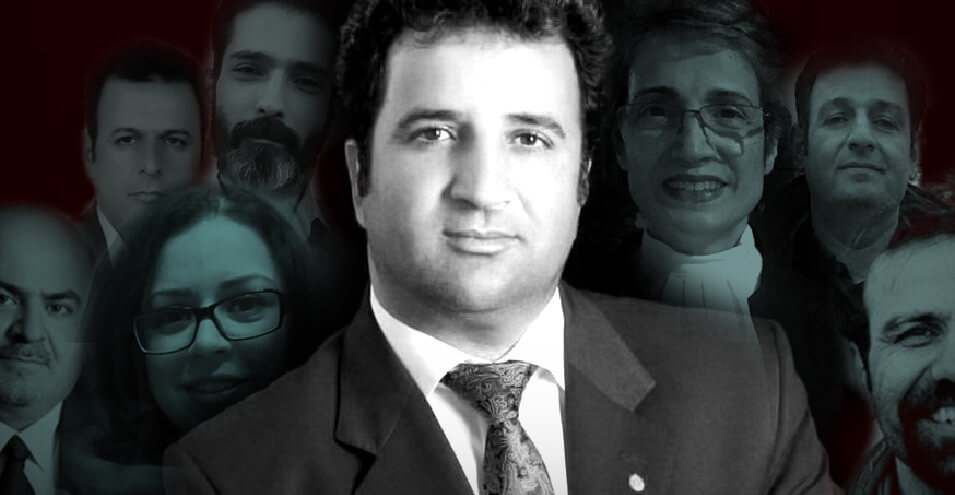
The independent Netherlands-based foundation Lawyers for Lawyers and the Campaign for Human Rights in Iran announced in a joint statement today that Mohammad Najafi, a lawyer in Iran who has been serving a 54-month sentence in prison since the fall of 2018, illegally and unjustly, solely for defending civil and political freedoms, should be released immediately.
"Mr. Najafi has faced a series of fabricated convictions to keep him behind bars because the authorities fear his strength and determination to speak the truth and defend basic human rights," said Hadi Ghaemi, director of the Campaign for Human Rights in Iran.
According to Hadi Ghaemi, "Lawyers are the last line of defense against tyrants who silence and suppress all dissent; when these defenders cannot do their job fully, the entire society becomes like a prisoner."
The Persian text of this joint statement is as follows:
Lawyers for Lawyers Foundation and the Campaign for Human Rights in Iran call on the authorities of the Islamic Republic to immediately and unconditionally release human rights lawyer Mr. Mohammad Najafi. Mohammad Najafi has been detained solely for his peaceful and lawful activities, and his legal prosecution has no legal validity or value.
According to Article 35 of the Iranian Constitution, people in all courts “have the right to choose their own lawyer,” and therefore, in all circumstances, it must be guaranteed that all lawyers in Iran are able to carry out their professional activities without any fear or intimidation. Fear that arises from reprisals, harassment, and the imposition of countless restrictions by judicial and security institutions.
We also call on the international community, including the UN High Commissioner for Human Rights, the UN Human Rights Council, the UN Special Rapporteurs on human rights in Iran, on human rights defenders and on the independence of judges and lawyers, as well as all UN Member States, to use all their power to call on the Iranian authorities to immediately and unconditionally release Mr. Najafi.
It is important to emphasize that, given Mr. Najafi's history of heart disease and other serious illnesses, and in accordance with Articles 502 and 522 of the Iranian Criminal Procedure Code, which state that if imprisonment aggravates the illness, the prisoner's sentence can be suspended or reduced to a fine.
We strongly condemn the long-term and ongoing harassment of Mr. Najafi by the judiciary. While Mohammad Najafi has been harassed and detained by the Iranian authorities for years for his peaceful and pro-democracy activities, in 2018 he investigated the suspicious death of Vahid Heydari, a detainee of street protests in the city of Arak. A protester who was arrested during the January 2017 protests died while in police custody.
Mohammad Najafi previously told the Campaign for Human Rights in Iran that “this young man was a protester who was arrested and then beaten and killed.”
Najafi was sentenced to three years in prison and 74 lashes for his efforts and reporting on the local prison authorities’ attempt to cover up the cause of Vahid Heydari’s death in August 2018, on charges of “disturbing public order” and “spreading lies.” His sentence was confirmed in October 2018, and Mohammad Najafi was transferred to Arak Central Prison to serve his sentence.
Mohammad Najafi was previously sentenced to 3 years in prison by Branch 2 of the Arak Revolutionary Court on charges of insulting the leadership. In mid-December 2018, Mr. Najafi was sentenced to 10 years in prison by Branch 1 of the Arak Revolutionary Court in the second part of this case on charges of “propaganda against the system,” “insulting the leadership,” and “aiding a hostile government through interviews with Voice of America, Radio Farda, and BBC Persian.” He was also sentenced to one year in prison for “disturbing public opinion” by publishing critical material about the Islamic Republic on social media.
In January 2019, Mr. Najafi was sentenced to two years in prison on charges of “spreading lies with the intention of disturbing public opinion” for publishing an open letter of protest he had written to the Supreme Leader of the Islamic Republic of Iran in September 2018. He was also sentenced to six months in prison for speaking at a memorial service for Sattar Beheshti, a blogger who died under torture in police custody. In June 2011, he was sentenced to prison on charges of “propaganda against the system” for calling for a boycott of the presidential election, calling for changes to the constitution, and the removal of Khamenei.
All of these convictions were clear examples of illegal violations of Mohammad Najafi's right to freedom of expression and aimed at preventing his legitimate activities as a lawyer.
Article 16 of the UN Basic Principles on the Role of Lawyers states that States must ensure that lawyers “are able to perform all their professional functions without intimidation, obstruction or interference.” The principles also emphasize that lawyers “shall not be subject to or threatened with judicial prosecution or administrative, economic or other sanctions for any act performed in accordance with recognized professional duties, standards and ethics.” They also stipulate that lawyers, like any other person, have the right to freedom of expression and, in particular, that lawyers have the right to participate in public debate on matters relating to the law, the administration of justice and the promotion and protection of human rights (Article 23 of the UN Basic Principles on the Role of Lawyers).
Under Iranian law, a prisoner with multiple convictions serves the heaviest sentence, which in Mr. Najafi's case was 10 years in prison, but with recent reductions in prison sentences ordered by the judiciary, his current prison term has been reduced to 54 months.
We know that Mohammad Najafi is not alone, and that human rights lawyers in Iran are increasingly under pressure from the government. The ongoing persecution of independent defense lawyers by the Iranian judiciary on trumped-up charges is central to the Islamic Republic authorities’ strategy to silence and suppress dissent in Iran. By imprisoning or silencing human rights lawyers, activists, dissidents, and other human rights defenders are effectively being charged with trumped-up charges and prosecuted without due process and heavy penalties.
Mohammad Najafi is another human rights lawyer who has been harassed, threatened, suspended or banned from working, arrested, and unjustly imprisoned by the authorities of the Islamic Republic of Iran in recent years. Indeed, it should be noted that there are now few Iranian lawyers left who are able and willing to handle and work on human rights cases.
Just a few of the lawyers who have been severely persecuted for defending civil rights and freedoms in Iran in recent years include: Nasrin Sotoudeh, Abdolfattah Soltani, Naser Zarafshan, Giti Pourfazel, Arash Kaykhosravi, Mostafa Nili, Farzaneh Zeilabi, Payam Darafshan, Amirsalar Davoudi, Mohammad Ali Dadkhah, Mohammad Reza Faghihi, Javad Alikordi, Mostafa Daneshjo, Hoda Amid, Mohammad Seifzadeh, Ramzan Haji Mashhadi, Farhad Mohammadi, and Mohammad Hadi Erfanian Kassab.
In addition, security pressures in recent years have led to the forced migration of some other lawyers, including Saeed Dehghan, Mohammad Moghimi, Ghasem Sholeh Saadi, Mazdak Etemadzadeh, and Hossein Ahmadi Niaz, from the country.
The courts in Iran are working hand in hand with intelligence agencies to prosecute and build cases against independent lawyers, extinguish any hope for legal defense, due process, and fundamental civil and political freedoms in Iran. We call on the international community to speak out strongly and with one voice against this illegal and unjust practice, and for member states to raise this issue – including the case of Mr. Mohammad Najafi – directly and repeatedly when meeting with their Iranian counterparts.
Source: Iran Human Rights Campaign