Sepideh Qolyan from Evin Prison: Spread the names of these women by word of mouth
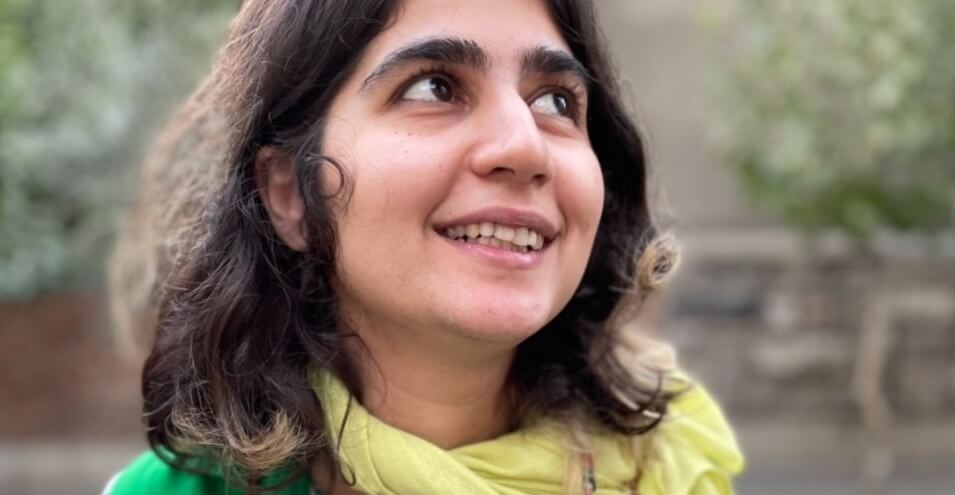
Sepideh Qolyan, who is imprisoned for her civic activities in support of workers, wrote a letter dated Bahman detailing her and a number of other imprisoned women, which has now reached Radio Farda.
Sepideh Gholian was sentenced to five years in prison in the Haft Tappeh protests case. Last March, Ms. Gholian was exiled to Bushehr Prison, and after a while, she wrote and published a report about the prison titled "A Place Near the End of the World," which addressed issues such as "the temporary concubinage of some needy women by male prisoners of the Mali Prison in coordination with the prison administrator."
In her new letter, Ms. Gholian, who is currently in Evin Prison, apologizes for the "deceptive camera of the prison organization" in her full text, and also describes her and a number of other female prisoners, asking people to spread the names of these women.
Full text of Sepideh Gholian's letter from the women's ward of Evin Prison
Before speaking:
Torture, courtroom corridors, solitary confinement, and long exiles from prison to prison are a summary of my life in recent years. The most painful moments of these years, however, are those when I became the cause of despair for my loved ones and fellow countrymen. The suffering of Bushehr was the pure truth, and I could not see and live in this suffering without speaking about it in some way; sometimes by negotiating with the prison guard, and sometimes by publishing a report on the situation of the “women” of Bushehr Central Prison.
But I apologize that along the way, due to the additional pressure that was put on my inmates in Bushehr Prison, I fell under the deceptive camera of the Prisons Organization and became a cause of disappointment. I hope that the disastrous situation in Bushehr Prison will never befall anyone.
The body of an exile is in pieces, and now pieces of me remain from Tehran to Ahvaz and Bushehr.
In Sepidar, I saw an Arab woman whose young son had been killed by the guards and who had denied her the right to attend the funeral. Now I only remember her cry: “Oh God, you are not our God!” A cry that was forgotten in Sepidar, could be heard from anyone else at any time.
During our last meeting in Sepidar, my mother had brought a bottle and some other items for the newborn child of Elaheh Dervishi. She said, “Sepida! Her child is born, imagine that Tahora and Mehra were born.” Becoming a mother in Sepidar, when you are exiled to a desert full of despair at the end of the world, means giving birth to a child and hope.
I stroked Elahe's stomach, exhausted by the slander and humiliation, which was filled with pain and swollen. She still did not know why such a heavy torment had befallen her at the age of 18. I had not yet seen Elahe's child, who was to be born in Arabic and be a criminal and condemned from the moment of birth, when my deportation letter arrived. Now I had to collect the pieces of my heart from the poplar and go to Bushehr with a world of longing.
I said goodbye to Makiya, who had to repeat the details of her sexual relationship with her husband to the interrogators and was my biological sister. Later, I heard the news of her death. When I left Sepidar, I became an exiled woman and have remained in exile until now.
In exile, the days were longer. In exile, my bones were crushed. They never let me return to my homeland, Sepidar. They never let me become one with Sepidar.
I have placed Haft Tappeh before my eyes, the Arab people and Khuzestan in my heart. When I was exiled to Bushehr, I met a woman named Mahin Boland-Karami. Mahin was from Kurdistan; like a mountain, but forgotten, sad and with many wounds on her body. Her head was at my feet until she died, in pain. They killed her, just because she had spoken the truth.
Silence was no longer permissible or possible. I told you about a shrouded child and a naked woman. About the suffering in Bushehr prison that was hard to believe, even for me, who was a witness. A woman called out from the crowd that it was time for us to find each other and hold hands. She was right. I, standing on the edge of a huge precipice, regained my life. You accepted my stories without question. You stood by us. We stood together and you didn’t believe the cameras and the lies.
The evidence and documents in the case were so clear that even in these courts of repression and bloodshed, I was acquitted of the charge of spreading lies about Bushehr. It would be better to say that each of us, who had found each other and held each other's hands, was acquitted.
From Evin:
Now I am a woman in love; very much in love. Amidst the smell of sawdust and sweets, amidst the review of the resistance of my loved ones in several prisons, I fall in love even more. Amidst the suffering of a young woman and my lover who is condemned to pack my bags again. Exile! The torture of going from prison to prison.
Today, when I am in love, passion, dance, and freedom have taken over my entire being. I want to write to you about the sufferings of a few other women. I hope you remember the women; not me, but the women. You will pass their names on from mouth to mouth. I hope that one day, together with their lovers, they will review their romances in their native language in the neighborhoods that belong to them. I hope that happiness will be ours. Let us dance and stand up in the four corners of Iran.
One: Maryam Hajihosseini has been in prison for more than two years. Maryam is one of those who, between the temptation to leave and the thirst to stay, preferred her homeland; rather, she could have a share in its development. She herself told the authorities that she was dissatisfied with the country's position in the world, and stayed behind to do something. But her response was to be arrested and accused of spying for Israel. Maryam was sentenced to death for corruption on earth.
For 412 days, a year and a few months, she has been in solitary confinement in a safe house at the foot of a mountain - according to the authorities themselves. In an unknown location. Far from her son Alireza. She has asked herself a thousand times why she hoped for the development of a country that is so bent on destroying those who care about her. After 412 days, she has been transferred to the women's ward of Evin Prison with the charge of corruption on her forehead and the death sentence on her forehead.
Now, as each official enters the women's ward of Evin Prison, he voices his only request for the thousandth time: Even if there is a single line of evidence indicating my espionage, please execute me quickly; I can't bear to put up with this scandal anymore, please execute me.
Two: Niloufar Bayani, a 30-year-old woman accused of spying for the Mossad, the CIA, and any other organization the IRGC can think of, has been in prison. She was a UN employee and a student at Columbia University. She has been held in solitary confinement for more than two years and is now in her fifth year of imprisonment. During this time, she has sometimes been taken to the parking lots of empty apartments on the outskirts of the city, sometimes to a villa in Lavasan. The interrogator has taken Niloufar around parking lots and empty villas to get her to confess that she is a spy. She has endured more than two years of solitary confinement and all kinds of torture and psychological pressure.
When you think about it, the four pillars of your body tremble, everything in you begins to die and die and die, what you did and didn't do, what you said and didn't say become one and invalid, whether it's a confession of espionage or a confession of murder. The seemingly living, big, and stern interrogator is recording your confession of murdering himself! Niloufar, who has spent all her time and life loving nature, is now here and can only greet the fish from afar.
Three: Nahid Taghavi, a dual citizen, came to Iran from Germany. She is a communist and yearns for justice and freedom. But she has been sentenced to 10 years and eight months in prison. Her child is waiting for her mother outside Iran. The mother does not have a visit, but she does not frown. When her phone call is returned, she is happy that she spoke to her daughter. Her daughter is worried about the prisoners. Worried about her mother's imprisonment. It is as if she is in Evin Prison.
Her mother turns to me and, with eyes shining with tears and joy, tells me that Maryam is no longer the Maryam she used to be. Her heart is in Evin. Her heart is with the people of Iran. Her heart is tied to Iran's freedom. Nahid endured months of interrogation and torture. She was given leave and then taken back, which is torture in itself. The fact that Nahid can hug her daughter, her Maryam, is a matter of the ever-increasing strain on Iran-Germany relations! Nahid contracted the coronavirus and was one of the few who was not granted leave. Nahid never cries unless her fellow prisoner cries.
Four : Zohreh Sarv, a royalist prisoner who was sentenced to seven years in prison without visits. Zohreh was in Qarchak Prison for two whole years. However, she was released within two months and was arrested again. A resilient and very compassionate and kind woman. Zohreh's sick mother has no one but her and is looking forward to her child's release.
Five: Shohreh (Leila) Qolikhani, a royalist prisoner who has been sentenced to four and a half years in solitary confinement. She has been deemed so lonely and helpless that her entire estate, the 21 million tomans mortgage on her house, has been seized. God knows how much this woman has lamented the loss of a few pennies that were her life savings. Only God knows.
Six : Gelareh Abbasi hasn't spoken for a long time. She just screams, shouts, and suffers from pain. Gelareh has rheumatism, arthritis, spinal stenosis, and five herniated discs. Add to this the sciatica and heart failure, and what's left of her but pain?
But I wish that were all. Gelareh is enduring this pain in the women's ward of Evin Prison. The pressures on royalist female prisoners are increasing day by day without anyone raising a voice. We ourselves must take responsibility for some of these pressures, we must question the silence of public opinion in the face of the double oppression of these prisoners and not allow disagreement with a person's political orientation to lead to ignoring or denying their rights.
Seven: Zahra Zehtabchi is the oldest female prisoner in Evin Prison. She was sentenced to 10 years in prison, of which she has served 9 years. During this time, she has only been sent on leave once, due to contracting COVID-19. When Zahra was arrested, her youngest daughter, Mina, was 11 years old. After her arrest, she was interrogated and held in solitary confinement for more than a year. During this time, her husband and Narges, her eldest daughter, were also arrested and pressured. Zahra’s father is one of the victims of the bloody massacre of political prisoners in the 1960s.
Eight : Sepideh Kashani has been sentenced to six years in prison. Like Niloufar, she has been accused of espionage and has been in solitary confinement for more than two years, under the most severe psychological pressure and torture. Sepideh and Hooman have been classmates, companions, colleagues, companions, companions, spouses, roommates, companions
Source: Radio Farda