Sixth Session of Hamid Nouri's Trial; Case in point: They took us to the slaughterhouse of our friends.
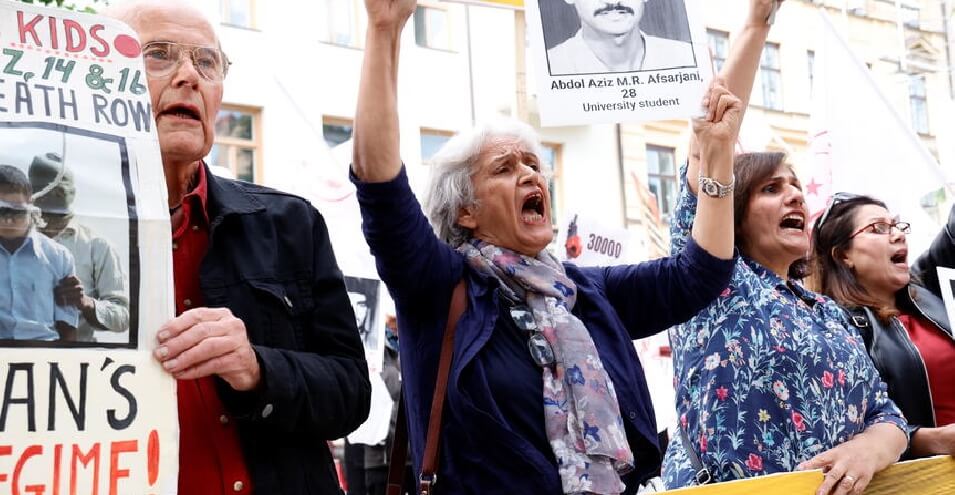
The sixth trial session of Hamid Nouri, accused of participating in the summer executions of 1988, was held on Monday, September 1, in Stockholm, Sweden.
Iraj Mosadaghi, a political prisoner in Gohardasht Prison, Karaj at the time of the executions and one of the plaintiffs in the case, was the first witness since the start of this trial to answer the prosecutor's questions about the reason for his arrest, interrogation, torture, and the holding of his trial in prison.
Mesdaghi is the author of several prison memoirs that are among the 65 written documents in the prosecutor's indictment.
During the court hearing, Iraj Mosadaghi discussed the location, sections, and conditions of the various prison buildings, the duties and roles of the Revolutionary Guards personnel and forces, and their presence in the prison at the time of the executions; including the condition of Hall No. 4 of Gohardasht Prison, which, according to him, was where prisoners of leftist groups were held at the time.
Mesdaghi said that hall number four had been emptied of leftist prisoners in the months of October and November 2018, because they had all been executed. To prove his point, he referred to the arrest and transfer of prostitutes and their children to this empty hall after the destruction of Tehran's Qale neighborhood.
He described an example of how detained prostitutes were beaten by prison guards for singing songs with their children.
Mesdaqi spoke about the Husseiniyeh prison and how, after the 1967 massacre, they were allowed to visit each other in person in Husseiniyeh on the occasion of Bahman 12 of that year. He said: "They took us to the place where our friends were killed to meet our families. I showed Hamid Nouri and Naserian to my mother and grandmother and said, 'These are the people who killed our children here.' I told my mother that many mothers are outside now and hanged their children here, and today you see me here. I made a promise to myself there that I would not forget this incident, and that is why I am here today. That is why I tried to bring Hamid Nouri to justice, and that is why I asked the Swedish judicial system to carry out justice."
Previously, Hamid Nouri's defense lawyers, as in the previous court session, analyzed some of the books and memoirs of survivors that had been presented as evidence in the prosecutor's indictment.
The defense lawyers also analyzed the list of names of the executed persons included in the indictment and claimed that it is not known where, by whom, and how these lists were written and prepared. Hamid Nouri's defense lawyer said that due to the vagueness and contradictions of the names of the individuals, Hamid Nouri will not accept the list of names of the executed persons and the books as evidence in this court.
Hamid Nouri's defense lawyer said his client claims that the executions never happened. The defense lawyer had also stated in a previous hearing that Nouri was on leave at the time of the executions.
Saeed Khatibzadeh, a spokesman for the Iranian Foreign Ministry, called Nouri's detention "illegal" and confirmed that Iran's ambassador to Sweden was following up on the matter. "We are using all our diplomatic tools to uphold Nouri's rights," he said.
Iranian Ambassador to Sweden Ahmad Masoumifar also said on Sunday, without mentioning Nouri by name, that after 20 days of trying, he had finally managed to meet with an Iranian citizen in a Swedish prison. He announced that he had called for an independent investigation into the violation of the prisoner's rights due to the use of violence against him.
According to the schedule, the next session of Hamid Nouri's court, the seventh session - Wednesday, September 25, will be dedicated to continuing to hear testimony and questions and answers from prosecutors and defense attorneys from Iraj Mesdaghi, as the first witness and plaintiff in the case.
According to the information contained in the indictment, Hamid Nouri, also known as Hamid Abbasi, was an assistant prosecutor and assistant to the then deputy prosecutor – Mohammad Moghiseh, alias Naserian – during the mass killing of political prisoners in Gohardasht Prison, Karaj, between August and September 1988. He is accused of intentionally taking the lives of many political prisoners, mostly members or supporters of the People’s Mojahedin Organization of Iran, as well as a number of members of leftist and other groups, in conjunction with and consulting with other defendants and perpetrators of the summer 1988 massacre.
According to Swedish law, the maximum penalty for Hamid Nouri if convicted would be life imprisonment.
This case is not only important in terms of human rights and humanitarian aspects, but the arrest and trial of Hamid Nouri in a court of another country is one of the most important political events in Iranian history, especially in the history of the Iranian justice movement.
Source: Voice of America