Head lice outbreak in Iran has terrified parents
Ehsan.S. FCNN News Agency: The news of the death of a seven-year-old child whose only sin was being infected with a parasite and who became a victim of the authorities' negligence and his mother's ignorance was the shocking headline in most of the country's media today.
This girl and her 10-year-old brother, who are still hospitalized in Babol Hospital, were put at risk due to severe poisoning with an agricultural pesticide.
The mother of these rural children had used poison to kill the lice that were feeding on her children's blood.
Babylonian officials simply ignored the incident. However, the media reported news that the spread of lice in every corner of our country has become a serious problem and has terrified families, because the spread of this parasite can lead to the transmission of diseases such as typhus and contagious fevers.
Examining the conditions in several county samples reflects these concerns.
We start with a city that has recently suffered a disaster. Currently, 74,000 students are studying in about 500 schools in Babol. In this city, only 70 health educators are taking care of the students. This means, in the most optimistic case, one educator for every 1,000 students. Because of this number, only 30 are in public schools and the rest serve in private schools. While the student population density is higher in public schools.
According to news reports, more than five percent of Babylon's 74,000 students are infected with lice.
In Borujerd, there are only 7 health teachers to serve a population of 50,000 students.
Of course, this shortage has a long history in the country and is not specific to one or two provinces.
In 2014, the then Director General of the Health and Wellness Office of the Ministry of Education stated that there should be one health educator in schools for every 750 students, and announced that in the most optimistic scenario, we are facing a shortage of 5,830 health educators in urban schools to provide services to students in the country's cities.
Tehran residents have also been infected.
This is despite the fact that the spread of this parasite in the country, unlike in the past, is not limited to polluted and unsanitary areas. In fact, students in the capital's urban areas have also been infected with lice. News reports indicate that schools in District 1 of Tehran have the highest rate of contamination.
The spread of this parasite has gripped our country's students in a situation where it is easily combatted and drug treatment is 90 percent effective.
Therefore, it seems that unintentional infection of children with this parasite is due to factors that need to be pathologically investigated.
Especially since even adults are not safe.
According to Leila Malek Jamshidi, an infectious diseases expert at the Ministry of Health, the number of lice infections in universities has now reached about 150,000 in the first six months of the year.
Health and wellness are not a priority.
According to FCNN, one of the factors behind the spread of this parasite is the lack of attention paid by education officials to hiring health instructors and providing health equipment in schools.
There is no doubt that lack of credit in such cases is the most justifiable excuse for the negligence of officials.
A comparison of one of the conventional credit priorities in the country demonstrates this justification and Iran's lack of money in the field of children's health.
According to FCNN, this year, 100 billion Tomans was allocated for the field of physical education and health, while two years ago, more than 6 trillion Tomans was spent on the country's cultural propaganda.
The Islamic Propaganda Organization, propaganda and cultural institutions in universities and schools, the Iranian Broadcasting Corporation, and institutions affiliated with seminaries are among the institutions that hold funds for Iran's cultural propaganda.
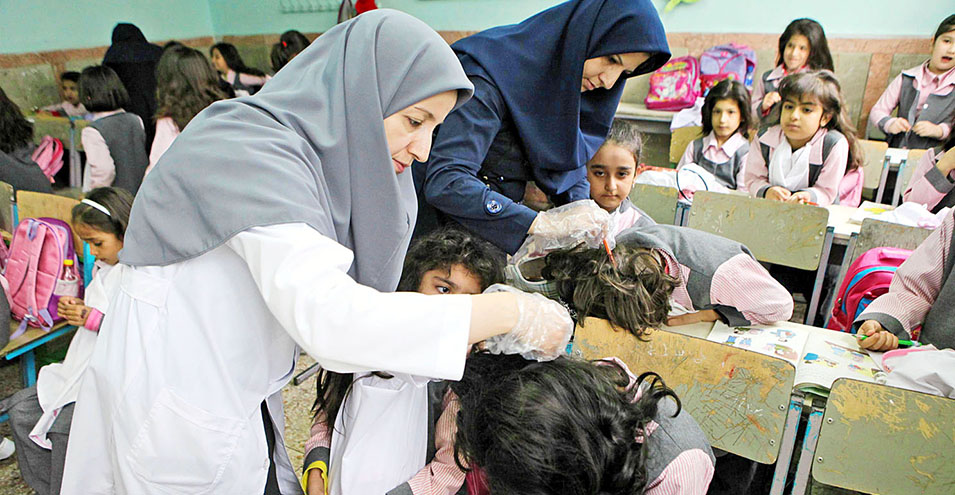
Scientific research indicates that with the onset of the cold season, the prevalence of lice in schools increases, and girls are more susceptible to this parasite. This is especially true because living in apartments and wearing headscarves provides a warm and humid environment for lice to grow. In addition, the use of shared gloves or combs by teachers to inspect hair is a factor in the transmission of the parasite, which is evidenced by this happening in schools.
The unfortunate thing is that the statistics of infected people in different provinces are confidential, while the concerns of parents and unprofessional news reports via virtual networks reflect the reality.
These home and non-professional reporters report that the outbreak of lice in the country is increasing year by year, and with the reopening of schools and the onset of cold weather, it is causing concern for families.
However, education does not have the necessary capacity to help families. Of course, parents are asked not to self-medicate. In other words, everyone should wait until the lice have a heart of their own and stop sucking the blood of Iranian children.
Lice are external, blood-sucking parasites of human societies that live on the head and body of humans and feed on blood.
The history of infection with this parasite dates back to prehistoric times, and since the early 20th century, lice have been known to transmit a number of infectious diseases, such as typhus, relapsing fever, and trench fever.