The Judiciary as a Machine of Repression, Threats of Flash Trials and "Merciless" Punishment
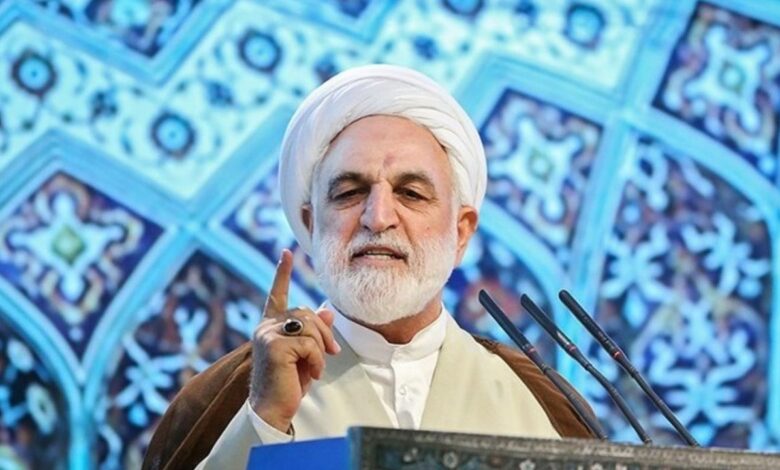
The Islamic Republic's judicial repression machine seeks to silence protests by promising speedy trials and "without mercy."
As a new wave of mass arrests, worrying reports of prison conditions, and mounting evidence of the killing of protesters are being published, the head of the Islamic Republic's judiciary has announced, in explicit and threatening language, the beginning of a new phase in the suppression of protests; a phase that has this time taken on a judicial face and has intensified warnings about the risk of mass executions.
Judiciary Chief Gholamhossein Mohseni Ejei announced on Sunday, January 25, that those arrested in the recent protests will be tried “as soon as possible.” He said of the protesters: “The people rightly expect the accused and the main elements of the riots and terrorist and violent acts to be tried as soon as possible.”
Mohseni Ejei further emphasized: "The judiciary is obligated to deal with those who have taken up arms, committed murder, or committed destruction and arson without the slightest leniency." From the perspective of human rights observers, these statements pave the way for issuing harsh sentences and hasty trials.
These positions are being raised in a situation where, according to reports from independent human rights organizations, thousands to tens of thousands of people have been arrested in various parts of Iran during the widespread protests in January. At the same time, reliable sources report that more than 30,000 people have been killed in the suppression of the protests; a statistic that has faced serious obstacles to independent verification due to the nationwide internet shutdown since January 8.
Amid the crackdown, images broadcast on state television showing the head of the judiciary personally interrogating some detainees have sparked widespread reactions. Human rights activists see these scenes as a clear sign of pressure to extract “forced confessions” and a prelude to show trials.
The combination of public threats from a senior judicial official, ignorance of the status of thousands of detainees, and the Islamic Republic's history of issuing death sentences after protests has raised concerns about widespread and secret executions, particularly for prisoners who lack access to independent counsel, contact with family, or a fair trial.
Observers say that the judiciary at this stage is not acting as an independent institution, but rather as a complementary arm of security repression; a tool to create judicial terror and break the wave of social protests.
Meanwhile, a new report by HRANA on the situation of women detained in Shiraz’s Adel Abad prison has revealed another dimension of the crisis. According to the report, at least 150 women (mostly students) have been arrested in connection with the nationwide protests and transferred to the prison’s political ward, which, according to informed sources, does not even have a capacity of 30 people.
According to these sources, phone calls between female prisoners have been completely cut off for the past two weeks and visits are only limited and conducted in cabins. Severe food shortages, lack of adequate drinking water, and lack of basic sanitation facilities have brought the situation to a critical stage; a standard meal that used to be given to one prisoner is now divided among four people.
Despite these reports, the Islamic Republic's security officials continue to deny using firearms against protesters. Colonel Mehdi Sharif Kazemi, commander of the special police unit, has claimed that the police forces did not use firearms against protesters at all and only used "non-lethal means."
But this claim is in clear contradiction to the available findings. Numerous videos have been released showing that the Islamic Republic's security forces fired live ammunition at protesters in at least 19 Iranian cities and six neighborhoods in Tehran in early January.
These developments show that the Islamic Republic has not only shown any signs of retreating from social protests, but is also seeking to consolidate organized repression by simultaneously activating security and judicial tools; repression that is accompanied by mass arrests, threats of hasty trials, increased pressure on prisoners, and blatant disregard for human rights, and could have irreparable consequences.