Iran ordered to pay $107 million in compensation to families of six victims of Ukrainian plane crash
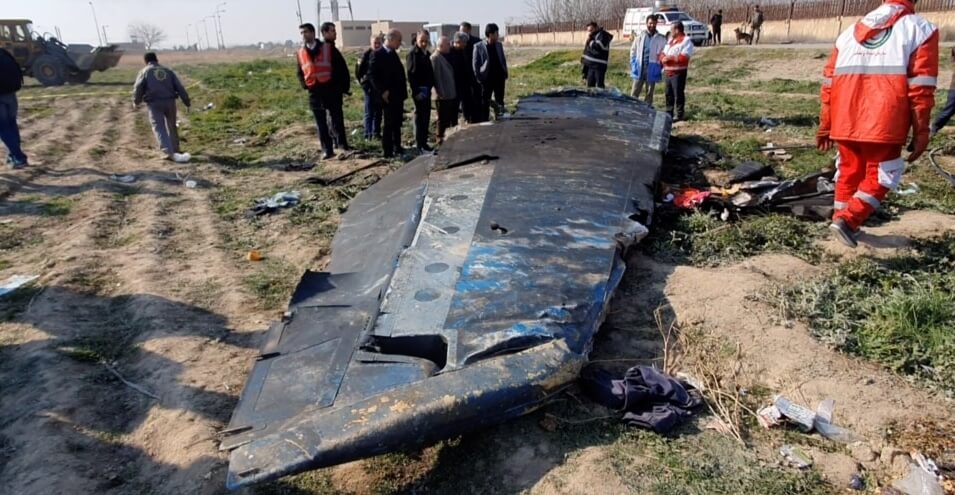
On the eve of the second anniversary of the targeting of Ukrainian Airlines Flight PS752 by IRGC missiles, the Ontario Superior Court of Canada ruled that the downing of the plane was a "deliberate and terrorist act."
On Monday, January 4, the court's president, Edward Belobaba, announced in a ruling that the plaintiffs had proven that the downing of the Ukrainian plane was an "act of terrorism."
The court was held based on a complaint by six survivors of the victims of Flight PS752 and sentenced the Islamic Republic of Iran to pay $107 million in compensation to these individuals.
According to the court ruling, a copy of which was obtained by Radio Farda, Mr. Belubaba announced that, based on the evidence presented by the plaintiffs and experts, the downing of the plane by the Revolutionary Guards' missiles was "deliberate."
The defendants in this case are the Leader of the Islamic Republic, Ali Khamenei, the Revolutionary Guard Corps, the General Staff of the Armed Forces, and some senior military officials such as Mohammad Bagheri, Chief of Staff of the Armed Forces, Hossein Salami, Commander of the IRGC, Amir Ali Hajizadeh, Commander of the IRGC Aerospace Force, and Seyyed Abdolrahim Mousavi, Commander of the Army.
According to the ruling, a report by the then Minister of Social Security of Canada also shows that Iran's claim that "human error" played a role in the downing of the flight is not true. The Canadian federal government is set to release its findings regarding the downing of the Ukrainian plane soon.
Ukraine International Airlines Flight PS752 was shot down by two anti-aircraft missiles fired by the Revolutionary Guards on the morning of January 8, 2019, shortly after taking off from Tehran International Airport, killing all 176 people on board, including 164 Iranians.
For several days, Islamic Republic of Iran officials denied that the plane was shot down by IRGC missiles, but after some foreign countries published images and evidence, they were forced to admit it.
The 138 victims of this incident were either dual Canadian citizens or permanent residents of the country.
The Islamic Republic of Iran did not appoint a representative to defend itself in the Ontario Supreme Court, and this ruling was issued in absentia.
Experts in the Ontario court have argued that given the advanced Russian Tor M1 anti-aircraft missile system, the radars and multi-layered systems, the need to coordinate and receive orders, and ultimately fire two missiles, the downing of the plane was a deliberate accident.
Meanwhile, Canada's CBC News reported, citing lawyers in the case, that the victims are now seeking to seize Iranian assets in Canada and other countries, especially Iranian tankers, in order to receive compensation.
Canada recently blacklisted the IRGC's Quds Force as a terrorist group, but the victims of Flight PS752 say that given the deliberate downing of the plane, the IRGC should also be placed on Canada's terrorist list.
Previously, Oleksiy Danilov, Secretary of the National Security and Defense Council of Ukraine, had said that the Revolutionary Guards "deliberately" shot down the passenger plane to "prevent an escalation of regional tensions between Iran and the United States."
In an interview with the Canadian newspaper The Globe and Mail, he said that he had discussed this issue with Ali Shamkhani, Secretary of Iran's Supreme National Security Council, during his trip to Tehran.
Canada's foreign minister had previously said that he did not believe the missile launch was due to "human error."
Canadian Prime Minister Justin Trudeau has also said that Iran's official portrayal of how the plane was shot down is "hypocritical, misleading and superficial" and deliberately ignores important factors.
The person responsible for the crash of Flight 752 in Ukraine has also told Radio Farda that his country is waiting for the government of the Islamic Republic to identify and punish those truly "responsible" for shooting down the plane and to announce the "real reasons" for the incident.
Agnes Callamard, Secretary-General of Amnesty International, also called the information released by Iran regarding how the passenger plane was shot down "misleading" and said that the explanations were designed to be "deeply confusing."
In addition to not providing a clear explanation for the downing of the Ukrainian passenger plane, the authorities of the Islamic Republic of Iran have also, according to numerous published reports, begun intimidating the families of the victims of Flight 752.
The Canadian Intelligence and Security Agency has announced that there are “credible reports” of harassment and intimidation of victims’ families and relatives in Canada. Human Rights Watch also announced on June 25 that since the downing of the Ukrainian airliner by the Revolutionary Guards, families of the victims of the flight have been systematically targeted by Iranian government officials.
According to a notification from the Tehran Military Prosecutor's Office, which was made available to the plaintiff's families in Iran 600 days after the plane was shot down, a restraining order has been issued for all the main and high-ranking defendants in the case, a move that has been widely protested.
Based on this ruling, the Tehran Military Prosecution has issued a ban on prosecution for key policymakers, including the Supreme National Security Council, the Islamic Revolutionary Guard Corps, the Integrated Defense Network, the Passive Defense System, the IRGC Aerospace Force, the Civil Aviation Organization, Hossein Salami (Commander-in-Chief of the IRGC), Amirali Hajizadeh (Commander-in-Chief of the IRGC Aerospace Force), and Ali Abedzadeh (then head of the Aviation Organization).
Source: Radio Farda