Vienna talks: IAEA Director General to visit Iran
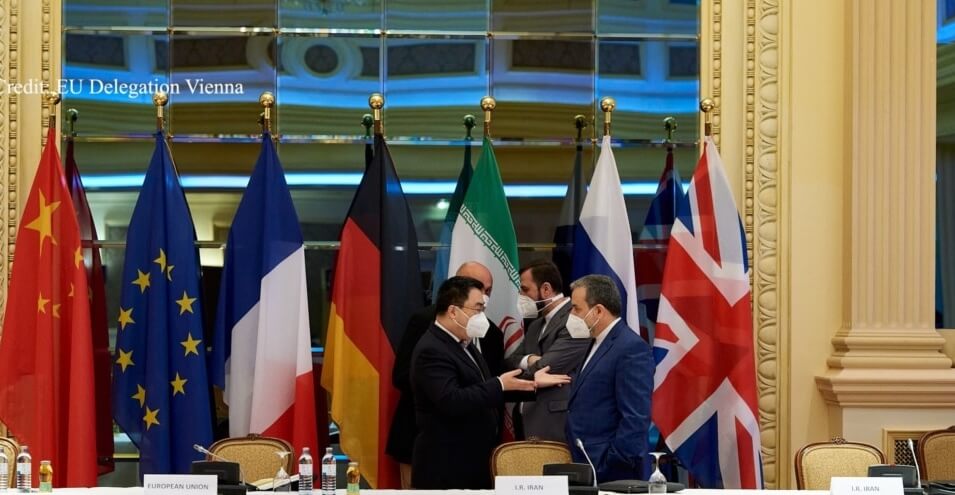
Eleven months after the start of negotiations to revive the JCPOA, news from Vienna indicates that talks on "remaining issues" between the parties to the nuclear agreement are continuing.
While the United States and European countries say that time is running out, the International Atomic Energy Agency's differences with Iran remain strong.
The "Noor News" website, close to Iran's Supreme National Security Council, in a report on Thursday, March 3, cited the ongoing safeguards issues between Iran and the IAEA as one of the main factors slowing down the Vienna negotiations.
The Islamic Republic's officials continue to throw the ball in the court of the United States and European countries.
Ali Shamkhani, Secretary of Iran's Supreme National Security Council, tweeted on Thursday, March 3, referring to the "maximum pressure" policy of the former US administration, saying that if a good agreement is not reached in the Vienna talks, "the current US administration will also feel defeated due to not using the opportunity for diplomacy in a timely manner."
This is despite the fact that US State Department spokesman Ned Price said three days ago that Washington is prepared to leave the talks in Vienna if Iran shows inconsistency in the progress of the talks.
However, Mikhail Ulyanov, Russia's representative in the Vienna talks, announced a "useful" conversation with Iran's chief negotiator, Ali Bagheri Kani.
He tweeted on Thursday, March 3, that the talks were on issues that need to be addressed to finalize the Vienna talks.
- Iran is close to building a nuclear bomb, senior diplomat tells Reuters
On Thursday, March 3, Reuters reported that Iran's enriched uranium reserves are reaching the level needed to build a nuclear bomb.
It has obtained a copy of a new report from the International Atomic Energy Agency showing that Iran's stockpile of 60 percent enriched uranium has doubled to more than 33 kilograms.
The report quoted a senior diplomat as saying that this amount of uranium, if further enriched, would be three-quarters of the amount needed to make a nuclear bomb.
Iran is enriching uranium to 60 percent, while the JCPOA nuclear agreement had set the uranium enrichment level at 3.67 percent.
The IAEA's recent report also indicates that Iran's uranium reserves have now reached more than three tons, while the JCPOA set a limit of 202 kilograms for uranium reserves with an enrichment of 3.67 percent.
The Wall Street Journal has also reported that Iran's uranium reserves, if enriched to 90 percent, are sufficient to make a nuclear bomb.
- IAEA Director General's trip to Tehran to negotiate on differences
Rafael Grossi, Director General of the International Atomic Energy Agency, is scheduled to visit Tehran on Saturday, March 4.
The discovery of uranium traces in some undeclared centers by Iran is one of the points of disagreement between the Agency and Tehran.
Iran has also blocked the Agency's access to information from cameras installed at its nuclear facilities for several months.
Saeed Khatibzadeh, spokesman for the Iranian Ministry of Foreign Affairs, said on March 29 that Tehran wants its case at the International Atomic Energy Agency to be closed.
Rafael Grossi says the agency will never close this case for political reasons and the only solution to the differences between Tehran and the agency is to negotiate on the issues.
At the same time, Iran's political negotiations with the JCPOA countries on "remaining issues" continue.
The negotiating parties have not elaborated on the details of these remaining issues, but Iran had previously demanded the lifting of all sanctions related to terrorism, its nuclear and missile programs, as well as the lifting of human rights sanctions.
Iran has also demanded that Western countries provide guarantees that the United States will not withdraw from the JCPOA again.
Negotiations to revive the JCPOA have been ongoing in Vienna for 10 months, with the participation of representatives of Iran, France, Britain, Germany, Russia, China, and the European Union, as well as the indirect presence of US representatives.
Source: Voice of America