Masih Alinejad: In the meeting with Pompeo, I was the suppressed voice of part of Iranian civil society
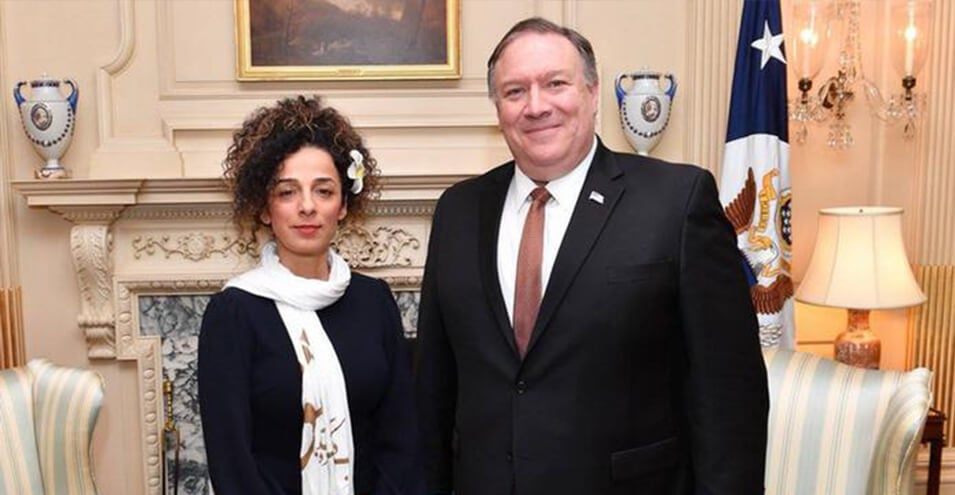
Masih Alinejad says that in his meeting with Pompeo, he was the voice of the Iranian people, whose credibility he was invited to this meeting. He asked Pompeo to recognize the protests of the Iranian people, as he did in Venezuela.
Masih Alinejad, a civil activist and journalist, met with US Secretary of State Mike Pompeo. He explained on his Instagram and Twitter pages that the meeting took place at the invitation of Mike Pompeo and that his goal was to gain the US government's support for the protests of the Iranian people.
On Wednesday, February 7, Iranian Attorney General Mohammad Jafar Montazeri reacted sharply to this meeting by using insulting terms towards Masih Alinejad.
The meeting has also sparked a lot of reactions on social media. Some have supported holding such a meeting and considered it to be beneficial to the people and opponents of the Islamic Republic, while others say that in the context of sanctions on Iran and when the United States is beating the drum of sanctions, this meeting was inappropriate and even harmful.
We shared these same criticisms in an interview with Masih Alinejad.
DW: Tell us a little more about the details of the meeting and the points raised in your conversation . What was your purpose in meeting with Pompeo?
Masih Alinejad: This meeting, as I was told, was the first meeting of this kind, at the request of the US Secretary of State, with a civil activist and journalist in his office. By accepting this invitation, I wanted to use this opportunity and be the voice of that part of the Iranian people on whose authority I was invited to this meeting. The voice of the people who are usually ignored in political negotiations where the interests of the powers are at stake. I wanted to bring this voice to the ears of high-ranking American officials.
In this meeting, I asked the US Secretary of State to support holding free elections under international supervision in Iran. I asked Mr. Pompeo not to use women's rights, minority rights, and human rights in Iran as a basis for reconciliation with the Islamic Republic and to try to convince European countries to always show sensitivity to the violation of human rights and civil rights in Iran. I also asked for visa restrictions for Iranians to be lifted and these restrictions should include the oppressors of the Iranian people, not ordinary people and civil activists. I also warned against any military action and the outbreak of war and the negative impact of general sanctions that cause more poverty in Iran.
You asked Pompeo to recognize the voices of the opposition. What exactly do you mean, and how can the United States recognize the voices of the opposition? Some see this as interfering in something that should be done only by the Iranian people . What is your response to this criticism?
Recognizing the voice of the opposition is similar to what most Western governments did in Venezuela. In Iran, we have an apartheid and dictatorial regime that does not allow free elections and suppresses its opponents in the most severe way. Of course, a coherent coalition of opponents of the Islamic Republic has not yet been formed, but the international community should be ready to support it if such a coalition is formed. The Islamic Republic does not represent the people of Iran, and this issue can be easily tested and verified by holding a free referendum.
In order to reduce the repression of civil society and to persuade the Islamic Republic to hold free elections, in addition to domestic pressure and civil and popular movements, international support is also needed. The Iranian regime is a repressive regime, and international pressure, along with civil movements, can facilitate and accelerate the process of transition to democracy in Iran.
On your Twitter, you have compared your meeting with Pompeo to the meeting between Zarif and John Kerry, and you have said that those who cheered for that meeting cannot criticize your meeting with Pompeo. Critics of your meeting say that the difference between you and Zarif is that he is a politician and you are a civil activist, and as a result, such actions do not fit into the framework of the civil activities of an activist . What is your response to this criticism?
I realize that my position as a journalist and social activist is different from that of a politician. But those who were not upset by the loss of Zarif and John Kerry should not logically be upset by my meeting with Mr. Pompeo. Just as Zarif is the official representative of the unpopular government of the Islamic Republic, I also represent a part of Iranian civil society; those who do not have a platform and have always been victims of agreements and compromises of politicians. Why should such a meeting be uncomfortable for some? The policies of the Islamic Republic towards human rights, civil rights and women's rights have always been consistent, and I have had the chance to be the suppressed voice of a part of Iranian civil society in this meeting. And all this was because these voices were so loud and clear that they reached the ears of senior American politicians. When a civil movement grows and expands, its boundaries with politics gradually disappear, and I am happy that today, as a civil activist, I am sitting in front of one of the most senior political officials in the United States. This means they can no longer ignore us, and this is a step before victory.
The Islamic Republic, through its official envoys, may be able to convince the world to turn a blind eye to human rights violations in Iran with heroic turns in international affairs, but now, in the position I have earned because of the trust of a section of the Iranian people, I can keep these closed eyes of the businessman open to the tragedies happening in the Islamic Republic. I hope I can. You should ask the person who does not like and blames such a thing why.
Continuing with the previous question, if you consider yourself a political activist, could you please tell me your political line?
Politically, I am a republican and I want a transition and change of regime from the Islamic Republic to a democratic and secular government. At this historical juncture, I think it is important to unite the opponents of the Islamic Republic because ultimately the type of government is chosen by the majority of the people.
Given Trump and Pompeo's recent positions, especially regarding sanctions on Iran, some Iranians consider him an anti-Iranian figure and for this reason they criticize you for accepting his invitation . What is your response to these criticisms?
My reason for accepting Pompeo's request for a meeting and discussion was to be the voice of a segment of the Iranian people and civil society, to convey their demands to American officials, and to present my criticisms and suggestions about their policies face to face.
Has your judgment of Pompeo and his policies changed before and after the meeting? Are you willing to continue these meetings and do you consider them fruitful?
I have no particular judgment about him, and it will be his performance after this meeting that will lead me to a judgment about him. His positions in this meeting seemed very positive and sympathetic to me, and I hope that this meeting will pave the way for beneficial changes for the benefit of the people and civil society of Iran. If I find the results of this meeting positive and beneficial for the people of Iran, I will definitely welcome future meetings; because, like millions of other Iranians, I do not want this government whose hands are stained with the blood of protesters, and I think we should ask the international community to recognize the voices of the opponents of a repressive government.
Source: DW