New Guardian Council Resolution: Violation of the Constitution and Deprivation of Citizens' Rights
The Guardian Council's new resolution on the 12 conditions for candidates to register for the Iranian presidential election has once again exposed the practice of this appointing body in violating the Iranian constitution. A practice that has been implemented by this powerful body in recent years and at various times, which shows more than anything else that the council that was tasked with "guarding" the constitution has actually turned into a council that defines its main task as guarding the "ruling system" and "Islamic law."
Although Guardian Council officials say that the council did not “legislate” by notifying the resolution to the Ministry of Interior, they have emphasized that the resolution is “enforceable.” However, implementing this resolution would violate Article 115 of the Constitution, a law that specifies the full and precise conditions for presidential candidates. The Constitution also does not provide the Guardian Council with any right to “approve” a resolution or “legislate.”
The recent resolution of the Guardian Council is, on the one hand, a clear example of the deprivation of the nation's fundamental rights from the laws stipulated in the Iranian Constitution, and on the other hand, it represents the "guardianship" of this powerful, appointed institution of the established government in Iran.
Although the facts in recent decades indicate the lack of free elections in Iran and the right of the Iranian people to determine their own destiny is clearly being violated, the current practice in this institution, both in the area of monitoring elections in Iran and in the Council's interpretation of the country's laws, indicates the Guardian Council's serious determination to completely destroy the meaning of "republic" in Iran's political system.
Guardian Council: Legislator or Interpreter of the Constitution?
What has sparked many reactions in recent days, after the announcement of the Guardian Council's new resolution regarding the presidential election, is the Guardian Council's violation of the constitution through "legislation." According to the nine articles related to the Guardian Council in the Iranian Constitution, this council does not have legislative authority and should only review the resolutions of the parliament and interpret the constitution.
Although Guardian Council officials say that this binding resolution is not a "law," many critics believe that this new Guardian Council announcement violates the constitution; in other words, if this announcement is an "interpretation of the law," then the interpretation of ordinary laws, according to Article 73 of the Constitution, is within the jurisdiction of the Islamic Consultative Assembly.
This issue ultimately prompted the Presidential Legal Office to declare in a letter dated Monday, May 10, in its interpretation of the Guardian Council resolution, "The establishment of standard criteria or legislation based on Article 71 of the Constitution is solely the responsibility of the Parliament, and after the law is passed by the Parliament, it is communicated to the President for implementation." The letter was prepared and published in line with Hassan Rouhani's order to the Ministry of Interior not to implement the Guardian Council resolution.
According to the interpretation of the Presidential Legal Office, the Ministry of Interior must carry out its executive duties regarding the presidential elections based on existing laws and relevant regulations and laws.
Given that the recent action of the Guardian Council is in complete contradiction with the personal freedoms of individuals or, if implemented, deprives them of their constitutional rights, this issue is apparently capable of criminal prosecution, given the provisions of Article 570 of the Islamic Penal Code; although in practice and based on precedent, practical action in this regard seems highly unlikely. This legal article emphasizes: “Any official or agent affiliated with government institutions and apparatuses who, contrary to the law, deprives the personal freedom of individuals of the nation or deprives them of their rights stipulated in the Constitution of the Islamic Republic of Iran shall be sentenced to imprisonment of two months to three years, in addition to dismissal from service and deprivation of one to five years from government jobs.”
Several of the 12 conditions for presidential candidates in the recent Guardian Council resolution have recently been added to these conditions; including determining the age of candidates (40 to 75 years old), the requirement to have an educational degree (master's degree), a set of work records in government, judicial and military agencies, and no criminal record (with an emphasis on not being close to the Green Movement).
Guardian Council lawyers consider the issuance of this resolution to be in line with Article 110, Section 9 of the Constitution, where the Guardian Council is responsible for verifying the qualifications of presidential candidates. Supporters of this resolution, referring to Article 10, Section 5 of the General Election Policies, which was issued by the Leader of the Islamic Republic in 2016, consider the determination of the qualifications of candidates to be entirely the responsibility of the Guardian Council.
The statements of Guardian Council officials and some forces close to the government approving and requiring the implementation of this resolution, and of course further stonewalling, including the announcement of a review of the election programs of presidential candidates and the authority and possibility of disqualifying candidates at any stage of the election, further demonstrate the systematic process of destroying people's participation in determining their own destiny and, in a sense, the collapse of the concept of "republic" in the Iranian political system.
Guardian Council: Guardian of the "Constitution" or Protector of "Islam and the System"?
In the draft constitution of Iran, the name of the Guardian Council was mentioned with the clause "Constitution". Chapter 10 of this draft constitution, which was about the Guardian Council, referred to this council as the "Guardian Council of the Constitution". However, during the revision of the constitution in 1989, one of the issues raised was the discussion of amending the "Guardian Council of the Constitution" and removing the clause "Constitution" from the name of this council. This issue was resolved with the unanimous vote of the members of the Constitutional Revision Council, and the suffix "Constitution" was removed from the title of the Guardian Council.
The justification of the members of the Constitutional Review Council for removing the suffix "Constitution" from the name of the Guardian Council, as reflected in the minutes of the Constitutional Review Council's deliberations, was that the Guardian Council is not only the "observer and guardian" of the Constitution, but that this council is also the guardian of "Shariah."
However, the behavior of the Guardian Council in recent years is evidence that this appointed body is more concerned with protecting Sharia and, of course, the positions of the ruling regime, than with protecting the constitution.
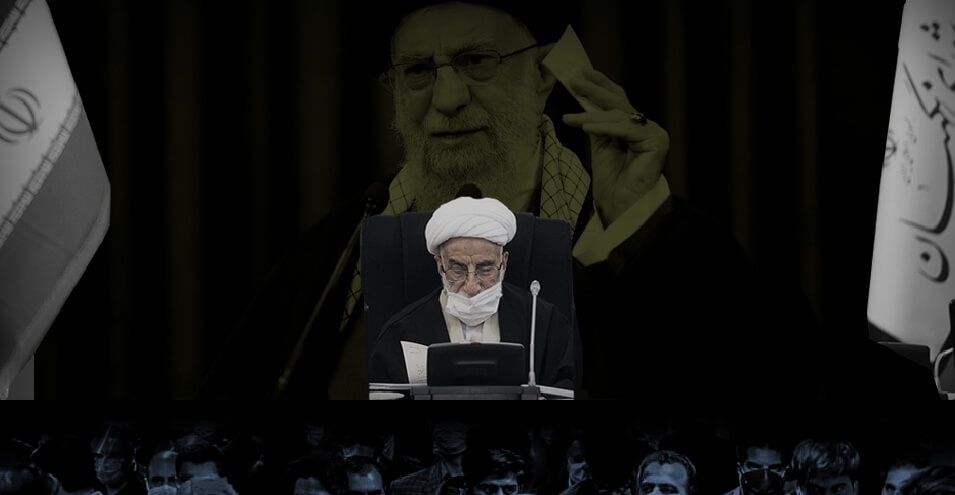
The Guardian Council consists of six jurists and six jurists, six of whom are dismissed and appointed by the Supreme Leader of the Islamic Republic of Iran, and the other six are jurists who are selected by the head of the judiciary (who is himself appointed by the Supreme Leader) and introduced to the Islamic Consultative Assembly for a vote of confidence. The Secretary of the Guardian Council is the highest official position of the council. The current Secretary of the Council is Ahmad Jannati, 95, who has held this position since 1992. Ahmad Jannati had called the recent resolution of the Guardian Council and its emphasis on the age requirement for candidates an effective and useful measure.
The Guardian Council's practice of taking actions contrary to constitutional principles had also been observed in previous years; Minoo Khaleghi was a candidate for the 10th Islamic Consultative Assembly in the city of Isfahan. After winning the election and entering the assembly, the Guardian Council, in an unprecedented move, rejected her eligibility, preventing Minoo Khaleghi from taking a seat in the Islamic Consultative Assembly.
The Guardian Council is undoubtedly the most powerful appointing body in the country at present, and its recent actions further clarify its decisive role in major decision-making and even legislation in the country; an institution that is never held accountable for its actions that are contrary to the country's constitution.
Source: Human Rights Campaign