Deputy Minister of Justice: They give their child to a spouse for one million tomans
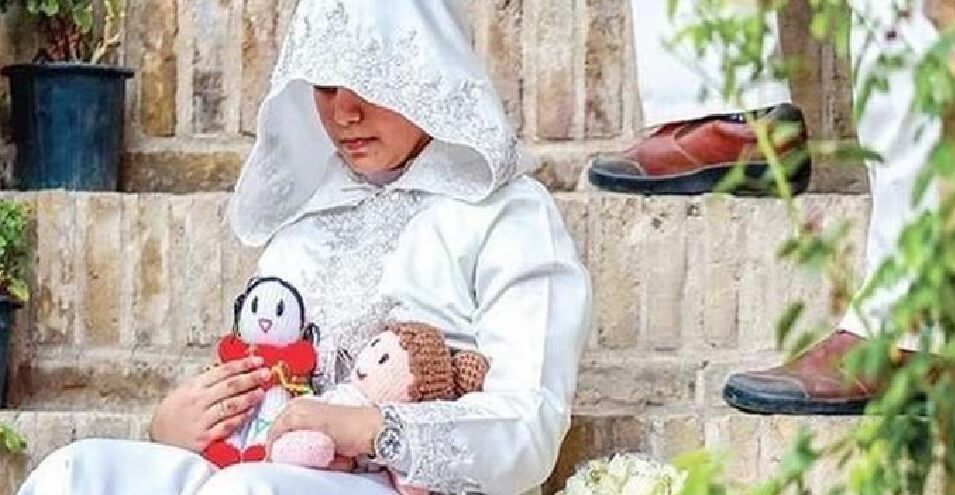
The Deputy Minister of Justice for Human Rights said that Iran is being questioned in international forums regarding the incidence of child marriage. He said that official statistics only reflect registered marriages and said that the actual rate of child marriage is much higher than the official rate.
Mahmoud Abbasi, associate professor at Shahid Beheshti University in Tehran and deputy minister of justice for human rights, called the two main reasons for child marriage “cultural poverty” and “economic poverty” in an interview with ISNA news agency on Sunday, September 28. He said that due to “black economic poverty,” there are families that give their children to be married even for one million tomans.
Emphasizing that in criminology, when a crime or social anomaly occurs, the officially announced rate is at least one-third of the actual rate, Abbasi added that the same is true in the field of child marriage.
The Secretary of the National Authority for the Convention on the Rights of the Child considered official statistics to only reflect registered marriages and said that some families, without official registration, marry their daughters off to private parties before the age of 13. After the age of 13, citing that this marriage is completely religious, they go to court to obtain marriage permission, effectively putting the court in charge of issuing a marriage decree.
Abbasi called the reason for not registering another portion of these marriages "concern about the consequences of the work, being found guilty, and fear of being blamed."
Child marriage is not abolished despite criminalization
In another part of the ISNA interview, the Deputy Minister of Justice for Human Rights referred to a question that was asked of him during his trip as the head of the Iranian delegation to the UN Committee on the Rights of the Child to present the Islamic Republic's five-year report to the organization. He said that during this trip, as Iran's representative, he was criticized for the "status effect" of early marriages, because despite the criminalization and punishment of perpetrators, including parents and the registry office, marriages remain in force.
He continued his remarks on this matter by calling on jurists to become active in this field, saying that they should "prevent the occurrence of child marriage by examining issues, expressing opinions, and providing solutions."
Abbasi also confirmed that some courts do not comply with the child's best interests when issuing marriage decrees, and said that to prevent arbitrary decision-making in this area, courses have been held for judges, families, and forensic specialists, but there is still a long way to go to achieve the desired result. He also referred to the fact that forensic medicine in some provinces determines puberty based solely on physical maturity, calling this criterion insufficient.
What happened to the plan to ban child marriage?
According to Article 1041 of the Civil Code, “The marriage of a girl before reaching the full age of 13 solar years and a boy before reaching the full age of 15 solar years is subject to the permission of a guardian, provided that it is in the best interests of the child, as determined by a competent court.” Many experts are calling for an increase in the minimum age for marriage to combat the phenomenon of forced child marriage.
In an effort to achieve this goal (prohibiting the marriage of girls under 16 and boys under 18), in 2018, efforts were made in the Tenth Parliament to address this issue with the "Prohibition of Child Marriage" bill, which was met with opposition from critics and, under the pretext of further investigation, did not reach any conclusion.
According to reports from the two provinces of Golestan and Khorasan Razavi and the Statistical Center of Iran, the number of marriages of girls aged 10 to 14 in the first quarter of last year was 7,323, which increased by 23 percent to 9,058 in the summer of 2019. This is the only recorded statistic. Many child marriages are not registered.
Some opponents of the ban on child marriage believe that the ban on child marriage is contrary to the country's general population policies and also contrary to Islamic law.
Source: DW