Iranians show their power at the Munich gathering, the heart of Europe
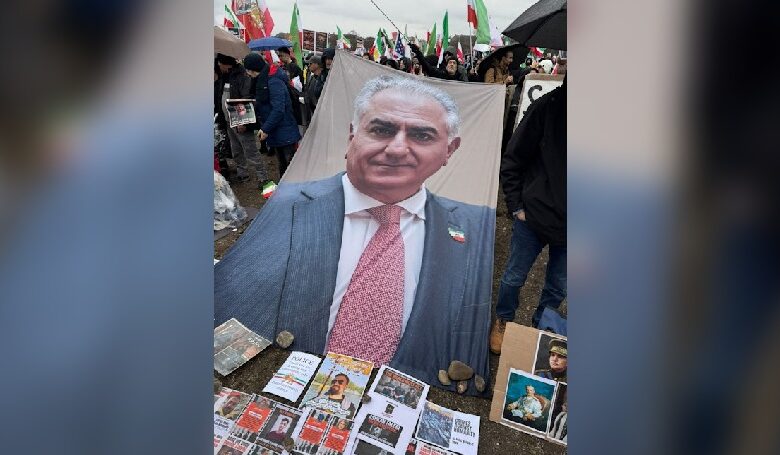
The gathering of Iranians in Munich and participation in the call of Prince Pahlavi is a story of Iranian solidarity and clear messages about the future of Iran.
The massive gathering of Iranians in Munich, which was held following Reza Pahlavi's call, became one of the largest gatherings of Iranians abroad in recent years; an event that received widespread repercussions not only in terms of the number of participants, but also in terms of political and international messages.
The son of the last king of Iran, who attended the gathering with his wife, addressed the crowd in a sincere tone at the beginning of his speech: “As our own children say, you exploded. This is one of the largest gatherings of Iranians abroad that we have ever seen.” This sentence was quickly reposted among the attendees and on social media, becoming a symbol of the passionate atmosphere of that day.
He continued, addressing the people inside the country, adding: "Know that you are not alone and know that all over the world, united Iranians have brought your voice to the world." A message that was shaped around the solidarity of Iranians inside and outside the country and was emphasized repeatedly during the speech.
In another part of his speech, Reza Pahlavi considered the current struggle a turning point in the path of political developments in Iran and, referring to the slogan "This is not the last battle..." chanted by protesters in Iran, said: "After nearly half a century, after decades of the world's appeasement with this oppressive system and several people's freedom movements that we were unable to achieve a final result, we have now reached a stage where, as you say, this is the last battle."
He also rejected narratives about the lack of consensus among the opponents of the Islamic Republic, stating: "The enemies are trying to claim that people do not have a consensus. This is a pure lie. You proved this."
Referring to the activities of Iranians abroad, he said: "Compatriots outside Iran, today you see this horizon of victory closer than ever. In all four corners of the world, Iranians have been on stage in their own way over the past few months to bring the voices of their compatriots to the world."
A significant part of the speech was delivered in English and addressed to citizens of other countries. Reza Pahlavi said in this part: "We know that we are not alone and I thank you for being with us. The Iranian people would like to see your solidarity, unlike this occupying regime that has held us hostage for 47 years."
He added: "We are fighting for freedom, justice, democracy and human rights. I am here to ensure that in the future, we will have a secular and democratic Iran."
At the end of his speech, he emphasized to the audience that they should have confidence, not hope, in the future of Iran, saying: “No force in the world can stand up to a united nation, and this time it is Iran’s turn.” He also added: “We will continue this struggle until the end, this system is weaker than ever and is collapsing. We have a duty to never let what happened in recent weeks be forgotten.”
Reza Pahlavi also paid tribute to the families who lost their loved ones, saying that there was not a day that went by without tears being shed for the victims. He concluded his speech with these words: “Victory is ours, and light triumphs over darkness.”
The rally was also attended by senior Republican US Senator Lindsey Graham, who drew media attention with his blunt remarks. He shouted to the crowd: "Help is on the way."
Describing a different approach to US foreign policy, the influential senator emphasized that the path to Iran's return to its former greatness lies in dialogue with the people, not negotiations with the current government. "The path to Iran's greatness lies in dialogue with the people of this country, not negotiations with the ayatollahs," he emphasized.
Graham described the world without the Islamic Republic as a better and safer place, saying that it was “time for the current rulers to go.” He also repeatedly reiterated his administration’s determination to support change in Iran, saying, “President Trump has said help is on the way,” and added that the voices of the protesters had reached Donald Trump.
In conclusion, he praised the protesters' resilience and said, "Your sacrifice amazes me. You made history."
On the other side of these developments, Abbas Araqchi, by publishing articles on the social network X, severely criticized the positions of European countries. Referring to the Munich Security Conference, he wrote: “It is regrettable that we see that the usually serious Munich Security Conference turns into a circus when Iran is involved.”
He described Europe's path as very dire, adding: "The current Europe has become paralyzed and irrelevant, and no trace of it can be seen in the ongoing talks about Iran's nuclear program."
Araqchi also pointed to regional diplomatic developments and stated: "Instead, our friends in the region are acting much more effectively and usefully than the three marginalized European countries."
The Munich rally can be seen as the scene of the intersection of three different narratives:
- The opposition's narrative, which sees it as a sign of cohesion and the imminence of change;
- A narrative of some Western politicians who emphasize support for the "Iranian people";
- Tehran's official narrative describes these events as a political show with no real impact.
What is certain is that the gathering of Iranians in Munich showed that the issue of Iran is still on the agenda of some Western politicians and international public opinion. In a situation where domestic developments, economic pressures, and nuclear disputes continue, this gathering once again showed that the Iranian equation is not defined only within the borders and that the voices of Iranians abroad are also influential in shaping the political atmosphere.