Iranian Human Rights Organization warns: The risk of extrajudicial execution and killing of detained protesters is serious
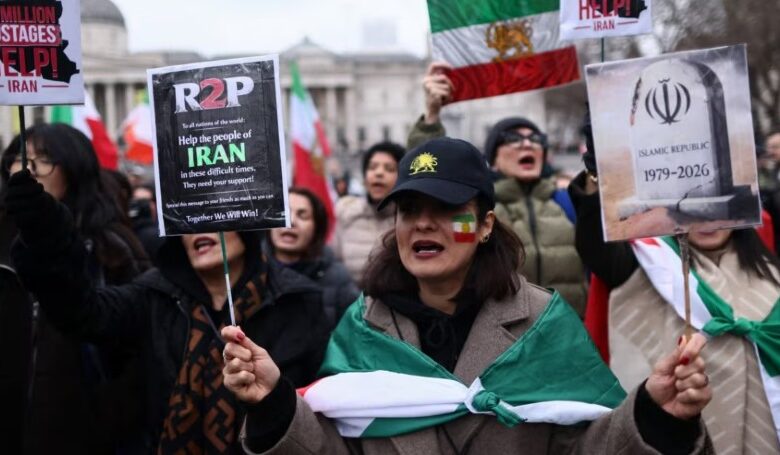
The Iranian Human Rights Organization warned of the risk of "extrajudicial" executions and killings of protesters, given the long history of issuing death sentences based on forced confessions in the Islamic Republic.
In a report published on Wednesday, February 5, the organization wrote that in addition to the Islamic Republic's history of executions, this risk is serious given the Iranian government's widespread and systematic use of lethal force with the clear intent to kill during this round of protests, especially after the nationwide internet shutdown.
The Iranian Human Rights Organization has estimated that, following the bloody crackdown on the January protests, “more than 40,000 people” are currently being held in detention centers, prisons, and unofficial or secret centers controlled by the Islamic Revolutionary Guard Corps and the Ministry of Intelligence.
The organization wrote that the situation of those detained in connection with the protests is an "emergency situation that requires immediate attention and action from the international community."
The complete disregard for the principles of fair trial and the history of hasty and secret executions during the Islamic Republic era are other reasons cited by the Iranian Human Rights Organization for its warning in this regard.
The report emphasized that many detainees are held in a state of “complete incommunicado detention,” “without access to family or lawyers, and completely outside of any effective judicial oversight.”
Currently, with public orders from senior officials of the Islamic Republic, including the head of the judiciary, to hold "expedited trials" and impose "severe punishments," and systematically label protesters with labels such as "terrorist," "foreign agent," and "enemy," many defendants have been convicted of charges that, according to the laws of the Islamic Republic, can lead to the issuance of a death sentence.
Since the first week of the protests, state media have broadcast hundreds of forced confessions obtained under pressure, torture, and threats from detainees and their families.
The Iranian Human Rights Organization says that it has also received credible but so far unconfirmed reports that a number of detainees have been executed "secretly" in several prisons.
Radio Farda is unable to independently confirm or deny these reports, and the Iranian Human Rights Organization has also stated that "these reports are currently under investigation."
Mahmoud Amirimoghadam, director of the Iranian Human Rights Organization, said in this regard: "By establishing a reign of terror, the Islamic Republic is trying to prevent the formation of new waves of protests and continue the survival of an unstable and shaky system. Execution is the most effective tool of this government to create fear and terror in society."
He added, "We are deeply concerned that the widespread killing of protesters in the streets is now continuing inside prisons and detention centers."
The director of the Iranian Human Rights Organization added that "thousands of protesters are detained, defenseless and in inhumane conditions, exposed to torture, enforced disappearance, and the immediate risk of execution or murder after show trials."
Identifying three threats and pointing out examples
According to information collected by the Iranian Human Rights Organization, "hundreds of people" are facing death sentences and charges leading to the death penalty in connection with the nationwide protests.
On February 27, 1404, the Islamic Republic announced the holding of the first public trial of protesters. This comes at a time when families and relatives of protesters have been reporting undisclosed cases of individuals facing the death penalty.
According to the report, given the lack of transparency in the judicial system, the number of protesters who have been charged or convicted so far is likely to be "far higher" than the reported number.
The Iranian Human Rights Organization has currently identified three main and related threats that protesters detained face. These threats include:
- Injured protesters who are at risk of death due to deliberate denial of medical treatment or as a result of torture in detention;
- The organization has received numerous reports of secret executions without any judicial process, which are still under investigation;
- And third, an increasing number of protesters will be sentenced to death after grossly unfair judicial processes, and those responsible for executing these sentences will likely make them public in an attempt to intimidate society.
The organization, warning about secret extrajudicial executions, has also pointed to examples of this danger for a number of protesters during the recent round of nationwide protests in Iran.
The Iranian Human Rights Organization has written, among other things, that relatives of Ali Rahbar, a 33-year-old fitness instructor, announced on February 23, 1404, that he was secretly executed in Mashhad Central Prison (Vakilabad).
A day later, the Mizan News Agency, affiliated with the judiciary, claimed: "Such a person was not detained in the prisons of Khorasan Razavi province, and therefore no death sentence has been issued or executed for him."
However, according to the Iranian Human Rights Organization, Ali Rahbar's name is listed as number 1285 on the official list of those killed by the presidential office, which was published on February 13, 1404.
Based on the explanations provided, this list was prepared by the country's Forensic Medicine Organization and then compared with information from the Civil Registration Organization.
The Iranian Human Rights Organization has repeatedly emphasized in its report that it has received unconfirmed but "credible" reports of secret executions of a number of protesters in three prisons; these reports are currently under further investigation.
The risk of execution and charges leading to the death penalty
In addition to citing examples, the Iranian Human Rights Organization wrote that dozens of protesters have also faced charges that could lead to the death penalty. The organization emphasized, however, that it has not yet been able to independently verify these reports.
However, the report notes that, according to a statement published by the judiciary-affiliated Mizan News Agency on February 4, cases related to the protests and what has been called "recent terrorist incidents" are "still being processed by judicial authorities and the verdicts in these cases have not yet reached the final stages."
This is despite the fact that the organization says that in numerous cases, families or detainees have been informed verbally about the issuance of death sentences, without any written or judicial documentation being provided in this regard.
In addition, many families have been threatened into silence to prevent public attention from being drawn to the cases of their loved ones.
The Iranian Human Rights Organization has named 38 protesters who are at risk of charges leading to the death penalty, including a woman.
The organization also presented a number of cases of detainees who are at immediate risk of summary trials and execution, individuals whose forced confessions to “killing security forces” have been broadcast in advance by state media. This pattern has repeatedly been a precursor to executions in Iran in the past.
The organization noted that under the laws of the Islamic Republic of Iran, murder cases are normally under the jurisdiction of criminal courts. However, in protest-related cases, authorities have increasingly transferred the case to the revolutionary courts by changing the charges and introducing alleged murders as crimes against national security, including moharebeh and corruption on earth.
The Iranian Human Rights Organization had previously documented such a practice during the nationwide "Women for Freedom" protests.
The organization also emphasized that when a case is secured, defendants lose the right to choose a lawyer.
Article 48 of Iran’s Criminal Procedure Code allows defendants to request a lawyer of their choice during the preliminary investigation stage. However, a note added to this article in 2015 limits this right for defendants accused of “crimes against internal or external security” to a list of government-approved lawyers during the preliminary stage.
Previously, Hadi Sharifzadeh, a lawyer in Fars Province, also reported on the "very heavy atmosphere" prevailing among the families of the detainees, saying that in-person visits and numerous messages to lawyers have increased, but independent lawyers are not able to enter these cases, and this has added to the anxiety of the families.
The report by the Iranian Human Rights Organization also mentions the intensification of repression against defense lawyers, and states that, according to the Shargh newspaper, at least nine lawyers have been arrested in various cities in Iran since the start of the nationwide protests.
Source: Radio Farda