72nd trial session of Hamid Nouri; Judge rejects proposal to add "genocide" charge

The 72nd hearing of the case of Hamid Nouri, accused of participating in the execution of political prisoners in Gohardasht Prison in the summer of 1988, was held in Stockholm, Sweden, on Wednesday, March 18, 2021.
The second session of the second round of the defendant's defense focused on the explanation of the facts of the case by Hamid Nouri's defense team. Daniel Marcus and Thomas Sørdqvist, Nouri's defense attorneys, continued their key strategy in this session as well. By supplementing previous documents, they tried to highlight the discrepancies between the testimonies of some witnesses in court and their testimonies recorded in reports by other international and human rights organizations, such as the Abdolrahman Boroumand Foundation and Justice for Iran. All of this testimonies were given in the years before Hamid Nouri's arrest in Sweden.
Hamid Nouri's defense lawyers went into detail about the accounts of individuals such as Esmat Talebi, Mokhtar Shallalvand, Vida Rostami, and Laleh Bazargan, and explained to the court members the differences in the time, place, and type of execution of the prisoners.
Hamid Nouri's defense lawyers questioned the authenticity of the testimonies of individuals such as Asghar Mehdizadeh, Mohammad Khodabandeh Lu, Hossein Maleki, and Manouchehr Ishaqi, and emphasized that Abbasi's name was added to these individuals' accounts not in the past but after his arrest. Other names of witnesses presented in today's hearing by the defendant's lawyers include Hossein Farsi, Mohammad Khodabandeh Lu, Hossein Maleki, Rahman Derkeshideh, and Amir Hooshang Atyabi.
Hamid Nouri's defense lawyers also explained that Mehdi Aslani, one of the witnesses in the case, testified that Hamid Abbasi called him and several other prisoners on September 28, 2018, and took them to the death squad. Nouri's lawyer said, however, that Mehdi Aslani, in explaining the same memory in his book "The Crow and the Red Rose," referred to a guard and Nasserian instead of Abbasi.
During the explanations and presentation of new evidence by the defendant's defense attorneys, the prosecutor objected several times. He said that these points should be included in the defendant's defense attorneys' final defense and that today is only for presenting evidence, not analyzing its content.
Another part of Hamid Nouri's defense hearing today was dedicated to the defendant's defense lawyers continuing their questioning of Rahman Derkeshideh, a political prisoner who survived executions and one of the witnesses in the case.
Rahman Derkeshideh participated in the trial for the second time via video from the Netherlands. During the first stage of his interrogation, he testified in court that the defendant's neighborhood child and neighbor and his family were in Tehran.
Rahman Derkeshideh pointed out several times in this hearing that the questions asked by the defendant's defense attorneys were repetitive. He repeated his testimony and confirmed that in 1986, he was blindfolded and interrogated by a person in the courtroom who, despite his efforts to remain anonymous, was identified by the witness through his questions. He was none other than the witness's old neighborhood boy, Hamid Nouri!
The hearing ended with an important announcement by Judge Thomas Sander. He announced that in the court’s opinion, Hamid Nouri’s case is not related to genocide. He said that there is no evidence to issue a genocide verdict from a legal perspective in this case, so Kenneth Lewis’s request is denied. Kenneth Lewis had previously requested that the genocide charge be added to Hamid Nouri’s other charges, citing Judge Jeffrey Robertson’s report. The judge announced that the court’s ruling dismissing the “genocide” charge is final and there is no right of appeal.
Hamid Nouri has been on trial in a Swedish court for seven months on two charges of war crimes and premeditated murder. He faces life imprisonment if convicted.
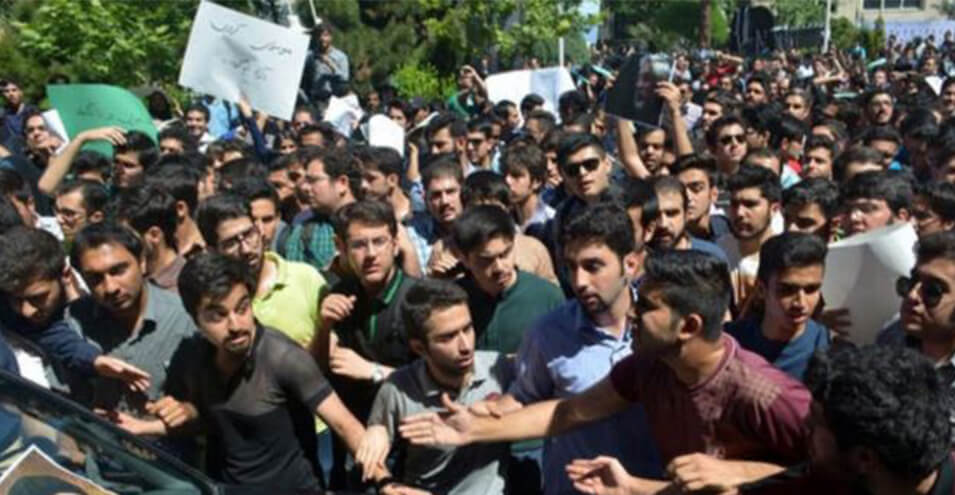
It is worth mentioning that this court session was accompanied by many incidents. Mohammad Reza Nili, Consul General of the Islamic Republic of Iran's Embassy in Stockholm, along with his colleague Alaeddin Arhan Mirmohammadi, reacted to the chants of "Death to the Islamic Republic," "Curse on Khomeini," and "Get lost, mercenary," from the attendees and demonstrators in front of the court building.
Mohammad Reza Nili asked the Swedish police to silence the protesters at the courthouse, but was met with a negative response.
Mohammad Reza Nili had previously insulted Stockholm-based artist Gisso Shakeri by using a vulgar and sexist phrase in front of the audience in the courtroom. Gisso Shakeri had asked Mr. Nili to explain why he was filming her.
The next court session will be held on Thursday, March 19, 2021, with the testimony of Judge Jeffrey Robertson. Mr. Jeffrey Robertson’s report is one of the most important pieces of written evidence for the prosecution in the indictment against Hamid Nouri. This report was commissioned by the Abdorrahman Boroumand Foundation and prepared by Judge Robertson after the Islamic Republic government’s efforts to destroy the Khavaran mass graves. The report, which took a year and a half to compile and prepare, includes interviews and various information related to the executions of political prisoners in the summer of 2018.