New wave of "dust mass" arrives; "dust surge" sweeps across western Iran
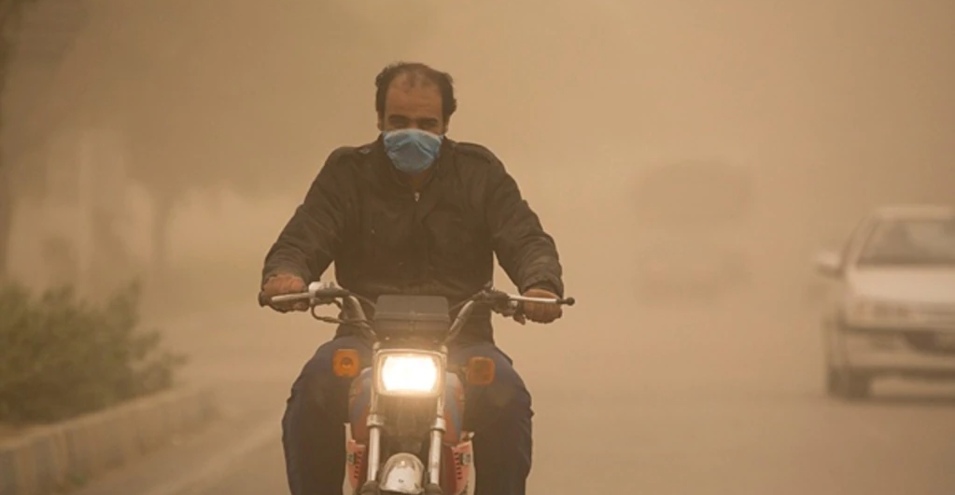
The Iranian Meteorological Organization has issued a warning notice, noting a "6 to 8 degree drop in temperature" in the coastal provinces of the Caspian Sea and warning of the possibility of "flash floods and local flooding in 11 provinces." It has also announced that "dust and dust are expected to rise and visibility will decrease, along with "decreased air quality," are expected in the western part of Iran.
The Meteorological Organization, which is run under the supervision of the Islamic Republic government, has also announced that based on "analysis of synoptic maps and foresight," today, with the "formation of a dust cloud over Iraq" and its penetration into "provinces located in the western strip," dust is expected to rise and visibility will decrease, along with "decreased air quality" for residents of these areas.
Less than two weeks ago, a "whole wave" of dust swept across various provinces of the country, causing many citizens to experience respiratory and lung problems.
Habib Haybar, deputy director of medical treatment at Ahvaz Jundishapur University of Medical Sciences, told reporters on June 27 that from the beginning of this year until that date, "12,116 patients" with "respiratory symptoms" following the dust phenomenon have referred to Khuzestan medical centers and "received treatment."
On April 18, in the midst of the first wave of severe dust and the threshold of its second wave, Ali Salajqeh, head of the Iranian Environmental Protection Organization and deputy to Ebrahim Raisi, stated at a meeting of the "National Headquarters for Policy-Making and Coordination of Dust Management" that "fine dust is one of the 11 main hazards facing the country" and claimed: "The enemy is planning to create public dissatisfaction with the occurrence of fine dust."
While some senior officials in the Islamic Republic government believe that "environmental problems" and "dust spreading" in the country are caused by "enemy actions," many experts in this field had previously warned that "continuing the current passive process" and "lacking precise scientific and operational planning" in dealing with it could cause extensive "environmental and human damage" for the country.
Meanwhile, Masoud Mansour, head of the Iranian Forests, Rangelands and Watershed Management Organization, also announced on June 1 that the "challenge of fine dust," which has repeatedly affected the "southern, western, eastern and central regions of the country," has also reached "northern cities" and has become one of the country's "main challenges."
At the same time, the Tehran Provincial Meteorological Department has also predicted today, June 6, that the "western and southern parts" of the province will be affected by "temporary dust rises" and the possibility of "decreased air quality" during the "evening and night hours of Monday."
In recent years, Islamic Republic officials have merely promised to “follow up on the situation.” On April 11, Abdul Jalal Iri, spokesman for the Civil Engineering Commission of the Islamic Consultative Assembly, said that the explanations of “officials” for “controlling air pollution” and dealing with the “fine dust phenomenon” were not convincing and that “a meeting with the presence of ministers of relevant agencies and the head of the Meteorological Organization” as the “in charge of implementing the Clean Air Law” was to be held; the results of these meetings have only been an increase in dust waves and the spread of fine dust in the country.
Source: Voice of America