US State Department Explains: The Real Reasons Behind Iran Regime's Effort to Lift Sanctions
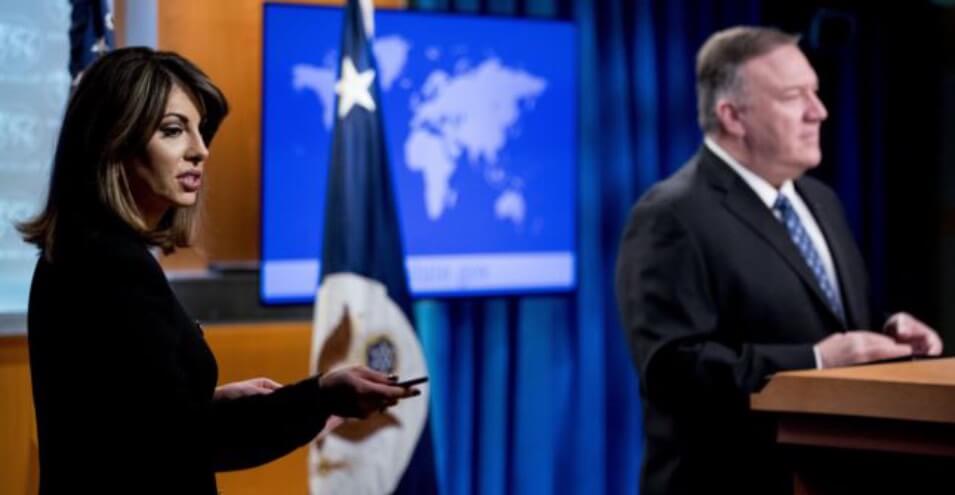
On the evening of Monday, April 6, the US State Department Spokesperson's Office released a statement, referring to the Islamic Republic regime's influence campaign and its recent activities to lift sanctions, and explaining the reasons for the necessity of maintaining and continuing the sanctions imposed on Iran.
The opening statement reprinted President Trump’s remarks to the press on April 2, 2020. President Trump said: “I think the [people] of Iran love America. I think they love being free. … They love our values. … If they want help fighting the [coronavirus] virus, we have the best medical professionals in the world. We would be willing to send [these doctors] to [Iran].”
The statement reads: “The Iranian [regime]’s covert and silent foreign influence campaign to lift sanctions is not aimed at the well-being and well-being of the Iranian people, but rather at providing money for its terrorist activities.”
The statement then details the spending the Islamic Republic has spent on terrorist activities and goals over the past few years, saying: “While Iran’s healthcare system suffers from severe budget shortfalls, the regime has spent more than $16 billion since 2012 to finance its terrorist proxies abroad. This led to the resignation of Iran’s health minister in January 2019 in protest at the successive cuts to the health sector budget.”
The statement continues by noting that "sanctions do not prevent aid from reaching Iran," and emphasizes that the United States has considered broad authorizations for the sale of food, agricultural products, medicine, and medical equipment from the United States to Iran.
The US State Department continued this statement, referring to recent statements by Iranian President Hassan Rouhani regarding the "failure of US sanctions to prevent [the Iranian regime's] efforts to combat the coronavirus," and emphasized that official Iranian documents and records show that Iranian pharmaceutical and health service companies have been able to import coronavirus testing kits into the country since January.
The article also mentions issues such as the Iranian regime's rejection of US humanitarian aid and medical equipment offers, as well as the expulsion of a Doctors Without Borders team from Iran, while the Islamic Republic's continued calls for sanctions to be lifted, and states: "It is clear that their priority is not access to medicine, but access to cash."
The Foreign Ministry further referred to the inadvertent disclosure of this issue by Hassan Rouhani in a government meeting held in late March, writing that in that meeting, while praising the coordinated efforts of the Iranian Foreign Ministry to influence public opinion and say "no" to sanctions, Rouhani said that "the goal of our efforts is to return the money confiscated in other countries [to Iran]."
The statement also mentions the creation of a website by the Iranian government in early March with the aim of coordinating Iranian government propaganda about the coronavirus and efforts to end US sanctions, as well as the promotion of the website's content by Iranian diplomatic missions with the aim of encouraging public opinion in other countries to confront US sanctions.
The US State Department also emphasizes that the Iranian regime has enough money to deal with the coronavirus pandemic in that country, saying that instead of agreeing to the request of Iranian parliamentarians and the president to withdraw from the National Development Fund of Iran, Khamenei has doubled the Basij budget and increased the budget of the Revolutionary Guard by 33 percent, and that "for years, the Iranian regime has prioritized proxy forces over the Iranian people."
The Foreign Ministry's statement continues, referring to other cases such as the killing of 1,500 Iranians during the protests of last November by regime forces, the looting and disappearance of more than $1 billion in funds that should have been spent on providing health services and medical equipment for the Iranian people, the Iranian regime's pseudo-humanitarian organizations and companies that were actually sending hundreds of millions of dollars to Hezbollah and Hamas through the IRGC and Quds Force, and many other cases of the Iranian regime's incompetence and inaccuracies, and states: "The Iranian people are the first to reject this regime's excuses."
The statement notes that graffiti on the outskirts of Tehran with slogans such as “The real coronavirus is the Islamic Republic” can be seen, adding: “When Khamenei accused the United States of using the coronavirus as a biological weapon, the most popular Twitter hashtags in Iran were KhameneiVirus and IslamicRepublicVirus.”
The statement concludes: “The United States will continue to support the needs and aspirations of the Iranian people – who are the longest-suffering victims of the Iranian regime.”