Aftershocks of CFT Approval: From Death Threats to Parliament Shutdown
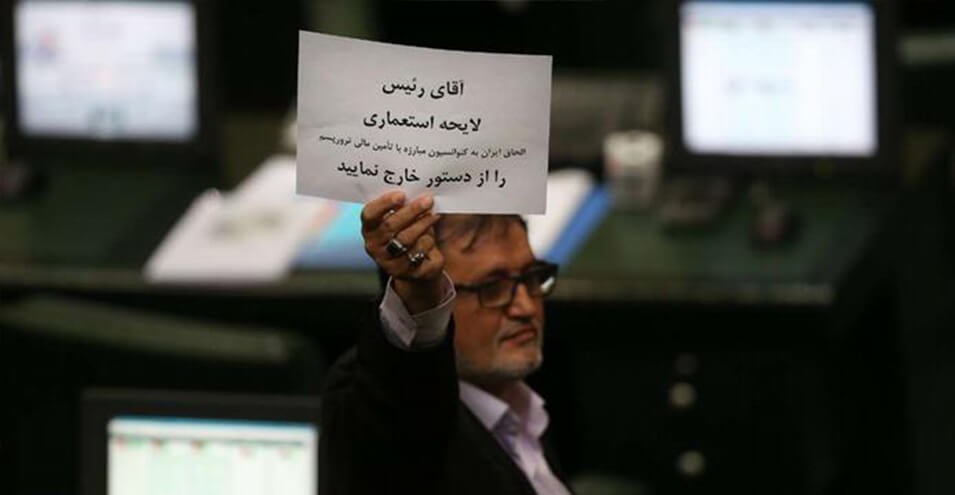
Opponents of Iran's accession to the Convention on the Suppression of the Financing of Terrorism have not remained silent even after its ratification in the parliament. The threats continue. Some representatives have received death threats. Some text messages also warn of "the parliament being shut down."
The approval of Iran’s accession to the Convention on the Suppression of the Financing of Terrorism in the Iranian Parliament has provoked mixed reactions among supporters and opponents of the bill. The opponents, who had begun their attacks and even sent threatening text messages to the MPs from the beginning, did not stop even after the approval of the bill on Iran’s accession to the CFT and continued their attacks. Some MPs even announced on Monday, October 8, that they had received “death threats” or “ballots” to the Parliament.
Opponents of Iran's accession to the Convention on the Suppression of the Financing of Terrorism, primarily hard-line fundamentalists, should now place all their hopes in the Guardian Council. However, given the stance taken yesterday by the office of the Leader of the Islamic Republic regarding the bill, which was read by Ali Larijani, the Speaker of the Parliament, it has become difficult to predict the Guardian Council's reaction.
The office of the Leader of the Islamic Republic quoted Ali Khamenei as saying: "What I said in the meeting with the representatives regarding the four bills and the conventions was related to the principle of the conventions and not to the specific convention. Therefore, I have no objection to reviewing these bills in the parliament so that they can follow their legal path."
This is despite the fact that on June 20, the Leader of the Islamic Republic announced his clear opposition to the bill to join the Convention on the Suppression of the Financing of Terrorism and asked parliamentarians to pass other laws in this area.
Guardian Council's position: It's still early.
The Guardian Council’s first reaction also indicated the appointive body’s hesitation about approving the “CFT.” Abbasali Kadkhodaei, the Guardian Council’s spokesman, said yesterday: “It is still too early to announce an opinion. The parliament has approved it, but it has not yet come to us. It must first be sent to the Guardian Council so that, God willing, we can announce our opinion. For now, I have no opinion until it comes to the Guardian Council.”
Kadkhodaei also said that there was no “opportunity” to consider two other bills related to the FATF (Financial Action Task Force), namely the bill to join the Palermo Convention and the amendment to the Anti-Money Laundering Law, and that these bills would also be “on the agenda this week” of the Guardian Council. The Guardian Council spokesman also wrote on Twitter that the body’s consideration of the “CFT” bill would be “like other approvals” and in accordance with “constitutional and Sharia standards.”
“A shining example of democracy” for government supporters
It is clear that the government also fears opposition from the Guardian Council. Hesameddin Ashena, an advisor to the Iranian president, wrote on his Twitter account, noting that “the stable members of the parliament have fulfilled their duties,” adding that “the remaining steps remain, and the stable members of other institutions will probably also fulfill their duties well.” “The stable members of other institutions” is a not-so-hidden reference to the Guardian Council or, under certain circumstances, the Expediency Discernment Council, which, according to Hassan Rouhani’s advisor, must “fulfill their duties well.”
Mahmoud Vaezi, the head of the presidential office, also expressed his “gratitude” to the parliament, calling the approval of the CFT bill in the Iranian legislature “a powerful display of unity, democracy, and political dynamism,” and said that the representatives “ultimately voted for what was in the best interests of the national interests and the sacred system of the Islamic Republic.”
Hamid Aboutalebi, the deputy political director of the presidential office, yesterday welcomed Iran's ratification of the Convention on Combating the Financing of Terrorism, writing on Twitter, among other things: "The representatives of the parliament showed that the country's national security and the interests of the Iranian people are the priority of their decisions and will overcome the challenges ahead with wisdom and firmness."
Hamid Baeidinejad, Iran's ambassador to the UK, also called the process of approving the CFT bill in the Islamic Consultative Assembly a "brilliant manifestation of democracy" and wrote in a tweet: "With this resolution, our country's four legal obligations to the FATF financial and banking standards have been approved and completed by the Assembly."
"Black Day" for Parliament Hardliners
But the reactions also had another side. The day of the approval of the bill for Iran’s accession to the Convention on the Suppression of the Financing of Terrorism was a difficult day for its staunch opponents. Nader Ghazipour, a member of the provincial parliamentary faction, called the day of the approval of the CFT bill a “black day” for the Islamic Consultative Assembly and said in a speech during the open session on Sunday: “Military officials stated the dangerous harms of this bill, but the government spoke against them and insisted on FATF approval, and ultimately a shameful treaty like Paris, Golestan, and Turkmenchay II was approved in the Assembly. The nation had 120 negative votes.”
Ghazipour's statements indicate the extent and depth of opposition among hardliners in Iran to the passage of the four FATF-related bills. Of course, the opposition is not limited to public rhetoric. Members of parliament also reported receiving "threatening text messages," and on Sunday, Ali Larijani confirmed the sending of these text messages during a discussion of the bill, saying, "The parliament is too mature to change its mind with a few text messages."
Yesterday, as the CFT bill began to be considered in the parliament, a group of opponents of its approval gathered in front of the Iranian parliament building and demanded that the representatives vote against the bill. However, it seems that the approval of the bill has not put an end to the threats.
Threat to “shut down the parliament”
Parvaneh Salahshouri, a member of the Tehran Parliament, revealed her death threat on her Twitter account on Monday, writing: "Until yesterday, it was obscenity. Since last night, death threats have been received from opponents of the passage of the bill to combat money laundering and terrorism. Those close to me know that I received thirty extra years of life from God and I am not afraid of threats. I proudly say that I voted against the supporters of terror in Iran and the world. By the way, I am not going to the pool. Think of another way."
Tayyaba Siavashi, another reformist MP, also shared a threatening message she received on Sunday evening on Twitter. The message read: “By God, if you vote yes to these bills, we will shut down the parliament.” Siavashi wrote: “They are planning to shut down the parliament! Where do these strange text messages and organizations come from? These threats seem to continue until late at night and are not going to end.”
Mohammad Reza Badamchi, a member of the Omid parliamentary faction, told the state-run IRNA news agency, referring to the fact that “they want to scare the representatives,” adding: “Threatening text messages have been sent to representatives about the CFT bill for a long time. We thought these text messages would end after the bill was reviewed and approved, but these text messages are still continuing and have taken on the aspect of a curse.”
According to Badamchi: "Until yesterday, those who send these text messages were saying, 'Do this and don't do that.' Since yesterday and after the passage of this bill, the tone of their text messages has changed and they are saying, 'Wow, what a mess you are in.'"
In response to yesterday's rally in front of the parliament, this reformist MP also said that "people are being encouraged to come in front of the parliament and shout. We have heard that these people were brought in front of the parliament by bus from a specific geographical route and neighborhoods. These actions are truly unworthy of the educated nation of Iran."
The use of “chemical weapons in cyberspace”
On Monday, Iran's Minister of Communications and Information Technology, Mohammad Javad Azari Jahromi, referring to text messages related to the approval of Iran's bill to join the CFT, said: "We must be more careful so that some insiders do not harm public trust by abusing chemical weapons in cyberspace."
The Iranian Minister of Communications added: “Some people insulted the chairman of the Islamic Consultative Assembly in cyberspace last night, and this is a clear example of the use of chemical weapons by insiders.” Azari Jahromi emphasized: “Some people do not know that the use of chemical weapons by insiders has a more destructive effect in damaging public trust. What does it mean for some people dressed as insiders to call the authorities of the system hypocritical, other than using chemical weapons against insiders?”
Mohammad Ali Vakili, a member of the parliament's presidium, said today that the threatening text messages sent to representatives "first begin with insults and threats to Ali Larijani, the speaker of the parliament, and then threaten and insult other representatives."
Alireza Rahimi, a member of the presidium of the Majlis, yesterday referred to the "threatening" text messages sent to representatives, stating that most of them originated in the provinces of Khorasan and Isfahan, and said: "In fact, the opposition, including those wearing the shroud and some students, have brought in-depth expert discussions to the streets on various occasions, and in this regard, they have also taken over a platform on the Iranian Broadcasting Corporation."
The deputy for political, security and social affairs of the Khorasan Razavi governorate has also said that anti-FATF text messages were sent to representatives from a Hussainiyyah on Chamran Street in Mashhad. According to Mohammad Rahim Norouzian, a person named Kh.M., who was a former member of the Mashhad City Council, was the “main person in charge” of sending the text messages, who openly announced this issue and it was not a secret. In the list of members of the Mashhad City Council, a person named Khalil Movahedi, a student of Tous, was a member of the fourth term (2013-2017).
At the same time, the deputy head of the Independents’ parliamentary faction in the parliament had also accused the Islamic Republic of Iran Broadcasting of “cooperating” with a “minimal group” against the FATF. Referring to the broadcast of the “anti-FATF documentary report” on Iran Television, whose director is appointed by the Supreme Leader of the Islamic Republic, Gholamali Jafarzadeh Aymanabadi said: “The Iranian Broadcasting Corporation should be a place of conflicting opinions and, in the true sense of the word, “national,” but unfortunately, we sometimes witness that due to some political activities, the direction of the Iranian Broadcasting Corporation is such that it seems to want to force public opinion in a certain direction.”
Zarif's "Ramazkalam" narrated by Karimi Ghoddousi
Javad Karimi Ghoddousi, a hard-line fundamentalist and one of the staunchest opponents of approving bills related to the FATF, is among those who strongly reacted to the Iranian Foreign Minister's statements in parliament yesterday, implicitly considering the approval of the CFT bill as a kind of retreat that could lead to a revision of the Islamic Republic's regional and missile programs.
Mohammad Javad Zarif, who attended the open session of the parliament to defend the passage of the CFT bill, said, among other things: "Neither I nor Mr. President guarantee that joining the Convention on the Suppression of the Financing of Terrorism will solve the country's problems. But we guarantee that by not joining this bill, the United States will find important excuses to increase our problems."
Explaining Zarif's "code of speech," Karimi Ghoddoosi wrote in a series of tweets: "Based on his and the president's policy; after accepting all these agreements and not resolving the problems again, if you ask them again, Mr. Minister, what should this nation do after the JCPOA and FATF to resolve the problems?! They will definitely answer: give up missiles and not support the resistance movement."
Meanwhile, former Iranian President Mahmoud Ahmadinejad, who has been marginalized for some time, has also implicitly opposed the passage of the CFT bill. Ahmadinejad wrote on his Twitter account: “No international agreement should be signed without the vote and approval of the Iranian people.”
The importance of the four bills for Iran
In order to avoid the risk of complete blockage of bank transfer routes with the arrival of US sanctions, the Islamic Consultative Assembly put four bills on its agenda: a bill for Iran's accession to the Convention against Transnational Organized Crime, known as the "Palermo Convention", a bill for Iran's accession to the Convention on the Suppression of the Financing of Terrorism (CFT), a bill to amend the Anti-Money Laundering Law, and a bill to amend the Anti-Terrorism Financing Law.
In addition to the bill for Iran's accession to the CFT, the parliament has also approved three other bills. Of course, these bills, except for the bill amending the law on combating the financing of terrorism, have encountered obstacles from the Guardian Council.
Less than a month ago, the Expediency Discernment Council had declared one of the bills related to the FATF, namely the bill to amend the Anti-Money Laundering Law, contrary to the "general policies of the resistance economy, encouraging investment, food security, and economic security," and had rejected it, citing the "risks" arising from the approval of such a bill.
However, many supporters of the approval of the four bills consider the Expediency Discernment Council's opinions to be "advisory" and consider the Supreme National Security Council, not the Expediency Discernment Council, to be the authority to consider such "vital" bills. Iran's negotiating team, which is engaged in talks with the European Union to "preserve the JCPOA," had previously conveyed its message to the parliament regarding the necessity of approving the four bills related to combating money laundering and the financing of terrorism.
The approval of the four bills, including joining the Convention on Combating the Financing of Terrorism, is essential to breaking the international banking restrictions on Iran. This path cannot be paved without the Islamic Republic’s cooperation with the FATF, which operates under that convention. Among the recommendations of the intergovernmental organization, the Financial Action Task Force, is the establishment of “international standards” to combat money laundering and terrorist financing. The group, which monitors Iran’s activities and the country’s progress in combating money laundering and combating terrorist financing, gave the Islamic Republic another three months in early July to implement the organization’s conditions and prepare the ground for its complete removal from the “black list.”
Source: DW