Hamid Nouri's 53rd trial session; Witness: I cried every day in prison when I was 13
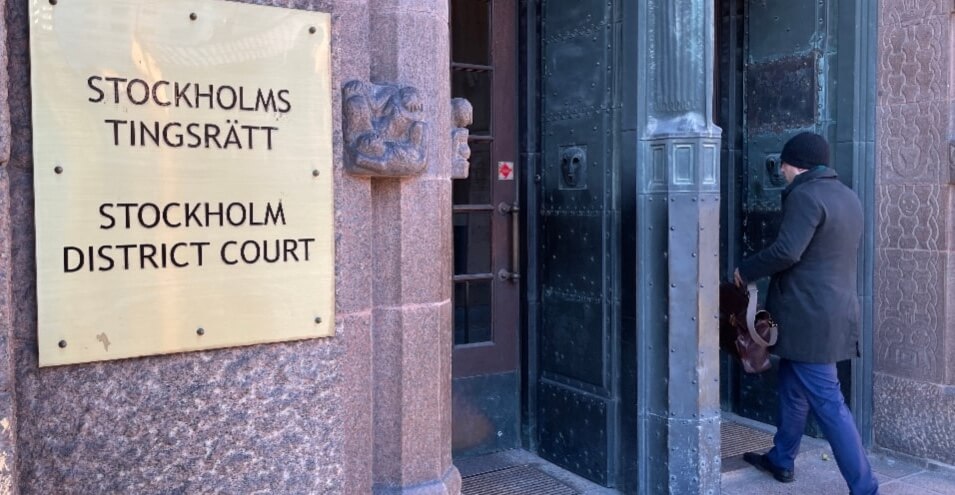
Another extraordinary session of the trial of Hamid Nouri, accused of war crimes and participation in the massacre of political prisoners in the summer of 1988, on Wednesday, December 14, 2011, was dedicated to the testimony of Manouchehr Ishaqi in Stockholm, Sweden. Due to the length of Hamid Nouri's defense sessions, Manouchehr Ishaqi's testimony had been postponed from December 11 to today's extraordinary session.
On July 16, 1988, just twenty days before his fourteenth birthday, Manouchehr Ishaqi was arrested for supporting the People's Mojahedin Organization (PMOI), tortured upon arrival, and transferred to solitary confinement. The witness said that it was not like the solitary confinement in which Hamid Nouri was placed, and that "this cell is like a five-star hotel in front of them."
This comparison caused the judge to object. He asked the witness not to make the comparison.
Manouchehr Eshaghi further explained that three days after his arrest, he and eight others were brought before Gilani and Lajvardi, the Sharia judge and prosecutor, respectively, in court. Eshaghi witnessed the execution squad and the killing of the eight and others who had been transported by minibus to the back of Ward 325.
Manouchehr Eshaghi said he was thrown into a room on the lower floor where he had been tortured before. Because of this, Manouchehr Eshaghi was constantly witnessing the shouting, crying, and torture of others. Manouchehr Eshaghi was later transferred to a hall where about ninety prisoners aged thirteen to sixteen were held. Thirteen months later, he was granted a reduced sentence in court due to his “young age” and received a ten-year prison sentence.
Manouchehr Eshaghi was transferred to Gohardasht Prison in 1986. He said that he had seen Hamid Abbasi many times in Gohardasht and Evin prisons. He added that once, after the executions, he was sent to solitary confinement by Hamid Nouri for more than two months and was repeatedly threatened with execution by guards and IRGC members. He said: “I was not a hero or anything like that. I was a 13-year-old teenager who cried every day.”
The witness, while confirming the existence of a death tunnel and gas chamber in the prison, testified that he survived the execution by writing a letter of disgust towards the MEK and making a commitment. Manouchehr Eshaghi testified that after the executions, Naserian, with Hamid Nouri standing next to him, told the prisoners who survived the execution that if it were up to him, he would have executed the others as well.
After the executions, Manouchehr Eshaghi was transferred to Evin Prison in late February or early March. Eshaghi was released again after writing a letter of disgust against the People's Mojahedin Organization (MEK) "in a dramatic manner" and was returned to Evin Prison two or three days later. Manouchehr Eshaghi was released from Evin Prison in 1991.
Manouchehr Eshaghi said that before their release, they were taken to the office of Hamid Nouri, where a person who introduced himself as "Zamani" and an official from the Ministry of Intelligence threatened them, saying that if they contacted "groups" or engaged in political activities, this time neither their family nor their bodies would be found.
Manouchehr Eshaghi suffers from post-traumatic stress disorder and has been receiving treatment from the Red Cross Committee on Torture for four years. In 2009, he also participated as a witness in the Abdolrahman Boroumand Foundation's investigation in France.
At the end of today's court session, the judge asked the witness – like other witnesses – if he wanted any compensation for his appearance in court or for any losses he had suffered. The witness said: "I don't expect anything like that at all. I had lost my life. I was happy to be here and testify."
It should be noted that Shahed's two brothers – Mohsen and Mehdi – were also imprisoned with him in the 1960s and previously participated as witnesses in Hamid Nouri's trial. Shahed's two uncles were also executed in 1968 and 1967.
The next court session will be held on Thursday, December 15, with the testimony of Mehrzad Dashtbani at the Stockholm courthouse.
Source: Voice of America