Gilani residents still under siege by snow; officials admit lack of preparation
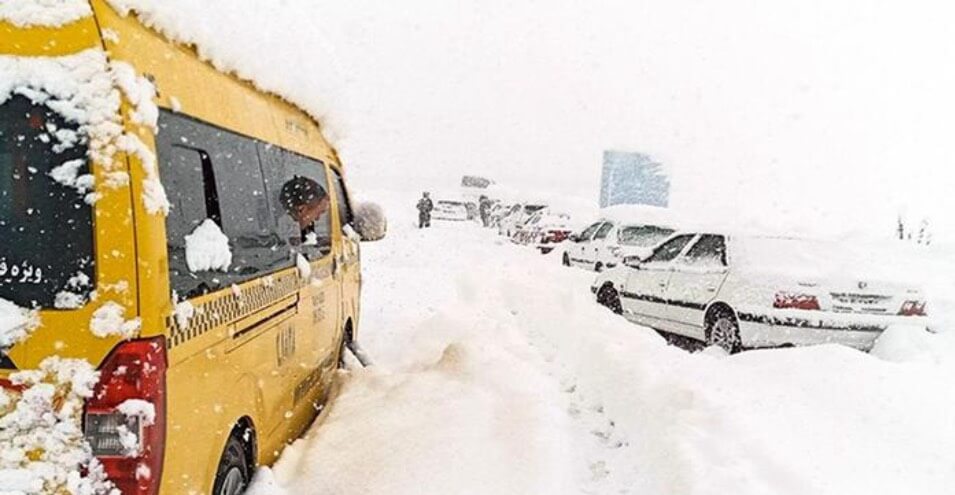
Five days after heavy snowfall in Gilan province, people are besieged by problems caused by water and electricity outages and blocked communication routes. The governor of Gilan said that the level of preparedness was not sufficient. The finger of blame is pointed at the crisis management.
Gilan province has been covered in snow for five days, with snow reaching more than one meter in some urban areas and more than two meters in the outskirts of cities and villages. The day before the snowfall, the Gilan Provincial Meteorological Department had announced in a statement that a cold and rainy system would arrive, leading to snowfall of up to 80 centimeters. The department had also asked the Crisis Management Headquarters to “make the necessary preparations to deal with and anticipate any potential crisis.”
Gilan Governor: Preparations were not sufficient
During a visit to Gilan, Iranian Vice President Mohammad Bagher Nobakht announced that the amount of snowfall in the province was “slightly more” than the Meteorological Organization had predicted. But this “slightly more” coincided with the celebration of the anniversary of the 1979 Revolution, paralyzing the daily lives of people throughout Gilan province.
The executive and crisis management agencies of Gilan province were also not very successful in providing aid and rescue. Arsalan Zare, the governor of Gilan, said that despite all the efforts of the relief and crisis management forces, preparations for this crisis were not sufficient.
The situation today, Thursday, February 13, in Gilan province has not changed much from the previous days. The electricity supply to about 206,000 households in some areas of Gilan is still cut off, and people in cities cannot access drinking water due to the cutting and destruction of the main water supply arteries. Seven thousand,600 rural households also do not have access to drinking water.
In an interview with the state-run Gilan Central Broadcasting Company, Zare, the governor of Gilan, announced that the amount of rain and snow in the province was 27 times the national average and said that this critical situation has disrupted 85 percent of power lines and networks.
Lahijan, Soumeh Sara, Rudbar, Astaneh, Fouman, Rudsar, and Langrud are among the cities that, according to reports, “have been most affected by the heavy snow and life has become unbearable.”
Human casualties of a snowstorm
The problem in Gilan province is not just traffic in cities and access to public amenities. So far, seven people have died in the cities of Rudbar and Rasht due to falls from heights or avalanches. According to the governor of Gilan, 78 people have also been injured due to trauma from falls.
According to IRNA, three people missing in the avalanche in the Rudbar River were found by rescuers from the Iranian Red Crescent Society. Among the three, an elderly woman was alive and was taken to the hospital. However, a young woman and her child died in the incident and their bodies were pulled out of the snow.
Traffic on the roads; difficult and slippery
Traffic conditions on main roads in Gilan province are still reported to be “difficult and slippery.” The latest reports show that after three days of heavy snowfall, only “35 percent of rural roads have been reopened.” ISNA reported that officials have promised that this percentage will reach 55 percent by the end of today, Thursday, May 5.
Reopening rural roads; second priority
The road network in Gilan province is 10,000 kilometers long, and according to Mohammad Reza Nazkkar, Director General of Gilan Roads, due to limited facilities and low manpower, reopening the road is prioritized in times of crisis.
According to him, the first priority is to reopen main roads and arteries, and for rural roads, local facilities should be used.
Claiming that the Crisis Management Organization is prepared to resolve the problems, Vice President Nobakht said that “the reason for the 70 percent blockage of communication roads” in the outskirts of Rasht is the high volume of vehicles entering Rasht from Qazvin and the lack of winter equipment. He stated that “almost all secondary roads in Gilan province are under snow,” and announced that “most” of them will reopen by the end of today, Thursday.
On foot to Rasht
Over the past 24 hours, nearly 1,350 passengers have been trapped in snow and ice on the Imamzadeh Hashem-Rasht road. Many of them, due to the inability of road rescue forces, chose to walk the 30-kilometer distance to Rasht on foot since dawn on Wednesday to save themselves. Some of these people have posted videos about this on social media. Meanwhile, 500 of the passengers who were stranded on the road have found necessary accommodation.
Snow, newspapers and politics
Heavy snowfall in Gilan Province became an excuse for some media outlets in Iran to write notes and reports about the "unpredictability of officials in the face of predictable incidents."
Conservative media outlets such as Jawan and Watan Emrooz have not considered the surprise of officials in Hassan Rouhani's government to be a new issue. Watan Emrooz, in a headline titled "The Head of Intelligence Under the Snow," took a strong stance against the government's lack of preparedness during foreseeable crises.
In contrast, Iranian newspapers, Ebtekar, Etelaat, and even Kayhan, have published reports on the critical conditions in Gilan and aid efforts, at least on their front pages.
Some media outlets, such as Sazandegi, Etemad, and Sharq, have not mentioned the heavy snowfall on their front pages.
Some newspapers have also looked at the snowfall from a different angle. Majid Rezaian, a journalist at the Arman Melli newspaper, while pointing out the necessity of providing information in times of crisis, considered it unwise to limit journalists' access to accurate and official sources of information, and said that reporting on the ground by journalists helps the relief effort.
Aftab Yazd also wrote in a note how one can criticize crisis management when the Meteorological Organization does not specifically say what will happen in which regions and what crisis crisis management should prepare for.
Snowfall has stopped in most parts of Gilan today, while people are thinking of ways to deal with the frost and access their daily necessities.
Source: DW