Pope Leo XIV and Archbishop of Canterbury Meet at Vatican, a New Step for Christian Unity
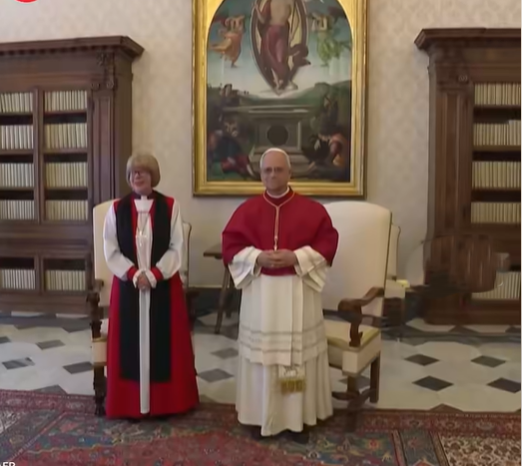
The meeting between Pope Leo XIV and the Archbishop of Canterbury at the Vatican once again revived hopes for the rapprochement of churches and the strengthening of a shared Christian message in today’s tense world.
In a rare and meaningful event, Pope Leo XIV and Sara Mullaly, leaders of two major branches of Christianity, met with each other at the Vatican on Monday, April 27, corresponding to Ordibehesht 7. This is considered the first formal meeting between these two leaders since Mullaly took office as the highest official of the Church of England, an event that has been referred to as a historic encounter.
The meeting took place in a warm atmosphere accompanied by the exchange of gifts and joint prayer, an action that, in the view of many observers, is a practical sign of the desire to strengthen convergence between the Catholic Church and the Anglican Church.
During this dialogue, the Archbishop of Canterbury, alluding to the complex and tense conditions of the world, supported the Pope’s positions in defending peace and said: “The world needed such a message at this time. This message reminded us that despite all suffering, humans aspire to a fulfilled life, and countless individuals strive every day to achieve this common good.”
These peace-seeking positions previously had widespread repercussions in the international arena and even provoked reactions from figures such as Donald Trump.
For his part, Pope Leo XIV, alluding to the path taken in relations between churches, while expressing hope for the future, also referred to some recent difficulties and said: “We must not allow these ongoing challenges to prevent us from taking advantage of opportunities to deliver Christ’s message to the world.”
Mullaly, continuing her remarks, emphasized the importance of spiritual compassion among Christians and added: “We receive from one another gifts that we alone are not capable of creating: the depth of prayer, courage in bearing witness to faith, perseverance in suffering, and faithfulness in service.”
These statements reflect an approach that, rather than focusing on historical differences, emphasizes shared capacities to serve the world.
The roots of the schism between the Catholic Church and the Church of England date back to the sixteenth century, when Henry VIII, following his disagreement with Pope Clement VII, paved the way for the independence of the Church of England in 1534. This separation is considered one of the most important turning points in the history of Western Christianity.
Despite centuries of deep disagreement, in recent decades theological dialogues and formal meetings have created opportunities for gradual rapprochement between these two Christian traditions. However, differences still remain, including on matters such as the appointment of women to the priesthood and laws concerning clerical celibacy.
Sara Mullaly’s appointment in March as Archbishop of Canterbury is considered an important development in the contemporary history of Anglicanism. This choice, particularly in some conservative branches in Africa and Asia, was met with different reactions and sparked new debates about the role of women in church leadership.
Before her trip to the Vatican, in a media interview with ITV, she emphasized: “There is a long-standing relationship and fellowship between the Anglican Church and the Roman Catholic Church, and we will continue to strengthen this bond.”
This meeting takes place as part of ongoing interactions between Christian leaders. Previously, Charles III, as the Supreme Governor of the Church of England, made an official visit to the Vatican and participated in a joint ceremony with the Pope in the Sistine Chapel, an event recognized as the first joint prayer between a Pope and a British monarch since the time of Henry VIII.
Overall, the recent meeting between the Pope and the Archbishop of Canterbury can be seen as a clear sign of the continued efforts to bring Christians together in a world that is in greater need than ever of messages of hope, peace, and cooperation.