Disguise in Feathers: Exposing Revolutionary Guard Operations Under the Guise of Peshmerga in Iranian Kurdistan
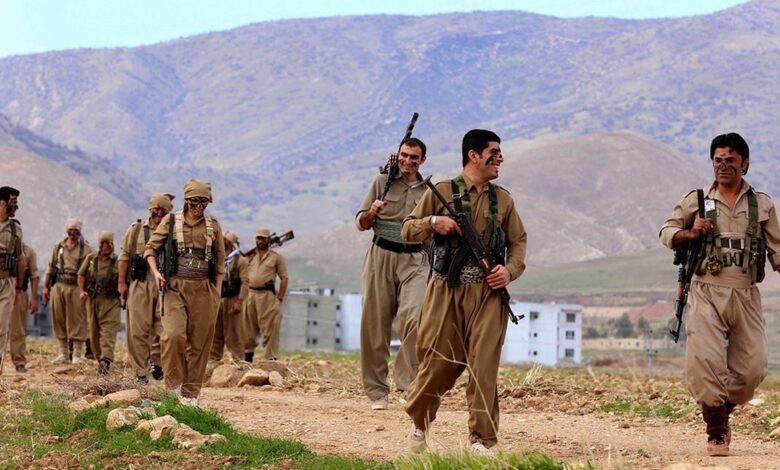
Disguise in feathers is not merely a theoretical narrative, but rather confirmed by reports and field evidence demonstrating how the Revolutionary Guards Corps forces operate under the cover of “Kurdish Peshmerga” in the city of Kamyaran, acting against citizens and Kurdish groups.
On Tuesday, March 3, corresponding to Esfand 12, a new report from the human rights organization “Hengaw” reveals that a group of individuals dressed in disguise resembling the organizational clothing of peshmerga from Kurdish parties traveled along a route leading to the village of “Turih-Riz” near Kamyaran city, in several Saipa vehicles. This movement took place not in secrecy, but deliberately on the open road to be seen; however, Hengaw’s investigations indicate that these individuals were in fact members of the Islamic Revolution’s Revolutionary Guards Corps who appeared disguised as peshmerga in this region.
Hengaw’s investigations warn that such operations may not be limited to Kamyaran and could be repeated in other cities of Kurdistan. This warning advises citizens of the region to be “cautious” about how they interact with these individuals, as their appearance may be deceptive and contrary to their true identity.
This report, while an independent update on a specific incident, should be assessed within the broader context of tensions and crackdowns in Kurdish-inhabited regions of Iran. In recent months, numerous reports have been published about arrests, forced disappearances, and security encounters with Kurdish citizens, including in Kamyaran, Sanandaj, Mahabad, and other cities; some of these arrests have been accompanied by torture or violent interrogations without the presentation of judicial warrants, raising serious human rights concerns.
Alongside this security situation, the military operations of the Revolutionary Guards Corps have also intensified in Kurdish-inhabited areas. Just last week, it was reported that forces under the command of the Revolutionary Guards detained at least eleven senior members of the Kurdistan Free Life Party (PJAK) in Kermanshah Province, an action that according to Iranian officials’ claims was carried out “to prevent sabotage operations,” but human rights critics view it as political opposition suppression.
Simultaneously, Hengaw and other human rights organizations have reported an escalation of pressures on activists, ordinary people, and ethnic groups; from mass arrests to disappearances of individuals last seen during recent protests in Kamyaran.
This type of covert and quasi-military operation, particularly in areas such as Kurdistan, recalls patterns from the past of tensions and clashes between Iran’s security forces and Kurdish groups, tensions with a long history that have repeatedly led to armed confrontations, widespread arrests, and deep mistrust.
Human rights experts and activists believe that using the clothing and uniforms of local groups to conduct security operations is not only contrary to principles of transparency and international law, but can also increase tensions, undermine public trust, and intensify violence in society.
Given these developments, the international community and independent organizations must conduct a more thorough investigation of military and security activities in Iranian Kurdistan, including the use of misleading disguises and the disappearance of citizens, to prevent further human rights violations.