USS Abraham Lincoln’s Radar Silence: An Alarming Sign of Escalating US-Iran Military Tensions
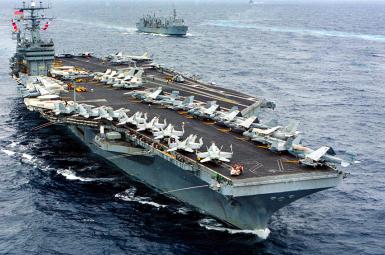
The radar silence of USS Abraham Lincoln and simultaneous US military movements in the Middle East have transformed this radio blackout into one of the most serious indicators of escalating military tensions between the United States and Iran.
Reports based on maritime surveillance data show that the USS Abraham Lincoln carrier strike group has disabled its Automatic Identification System (AIS) as it approaches Middle Eastern waters—a measure known in military terminology as “electronic silence” or entering a semi-stealth mode, and is typically considered a precursor to deployment in advanced operational or security conditions.
Military analysts have warned that turning off position transponders on a carrier, especially amid regional tensions, often signals a shift from demonstration deterrence to operational readiness. The disappearance of USS Abraham Lincoln from public ship-tracking maps has rapidly heightened alert levels regarding the possibility of direct confrontation between the United States and Iran.
Concurrent with this development, reports indicate unusual increases in flights by US Air Force tanker aircraft toward the Middle East—a pattern that typically aligns with preparation for extensive aerial operations in US military doctrine. According to these reports, three to four such aircraft have moved toward Al Udeid Air Base in Qatar, while others have landed at bases in Europe.
The Wall Street Journal has also reported that Patriot and THAAD air defense systems have been transferred to the Middle East—a measure generally associated with concerns about missile attacks or Iranian retaliation.
While these military movements continue, the US Embassy has announced that operations at Al Udeid Air Base have returned to normal status. The embassy has also advised American citizens and personnel to continue carefully following security protocols. Al Udeid, which houses approximately 10,000 US military personnel, is considered the largest US base in the Middle East, and any changes to its status are closely monitored by regional observers.
The news outlet “The New Arab” described this decision as a sign of reduced threat levels, reporting that the measure was taken following a partial withdrawal of US forces last week amid escalating tensions.
On the political level, rhetoric has intensified sharply. US President Donald Trump said in an interview with News Nation on Tuesday, January 20: “Very decisive orders have been issued, and if Iran launches any attack, it will be wiped off the ground.”
In response, Iranian Foreign Minister Abbas Araghchi warned in an op-ed in the Wall Street Journal that if Iran is attacked again, Tehran will respond with full force.
In his message, he wrote: “Unlike the restraint Iran demonstrated in June 2025, should we be attacked again, our powerful armed forces will have no doubt in employing their full capacity. This is not a threat, but a reality that I feel compelled to state clearly, for as a diplomat and a veteran soldier, I find war deeply abhorrent.”
Araghchi further added: “Any full-scale confrontation would undoubtedly be catastrophic and far longer than the imaginary timelines Israel and its proxies are feeding to the White House. Such a conflict would engulf the entire region and affect the lives of ordinary people around the world.”
Concurrent with these positions, US Central Command (CENTCOM) announced that F-15E fighter jets have arrived in Jordan, and the USS Abraham Lincoln carrier strike group, along with destroyers, F-35 fighters, and electronic warfare aircraft, is moving toward the region.
These developments occur as Araghchi has been barred from attending the World Economic Forum in Davos due to the killing of protesters in Iran, with domestic unrest remaining a focal point of tension between Tehran and Washington. Videos, despite widespread internet shutdowns in Iran, show security forces firing directly at unarmed protesters—images that Iranian officials have not addressed.
Meanwhile, reports have emerged of Iranian drone and missile attacks on one of the bases of an Iranian Kurdish group in Iraq, which, if confirmed, would mark Iran’s first cross-border military operation since protests began. Additionally, restrictions have been imposed on the movement of US diplomatic personnel in Kuwait and Qatar to military bases.
Based on these reports, Arab diplomats in the Persian Gulf region have asked the US government to refrain from any direct attack on Iran. Last week, Iran also signaled preventive readiness against possible military scenarios by closing its airspace.
While the silencing of USS Abraham Lincoln’s radar, by itself, does not necessarily mean imminent war, when combined with aerial movements, the transfer of air defense systems, severe verbal hostilities, and Iran’s unstable domestic situation, it paints a troubling picture of a region standing on the brink of a costly decision—one whose consequences could extend far beyond the Middle East, affecting the lives of millions of defenseless people.