Rasht in Fire and Blood; A Crackdown That Transcends Historical Memory
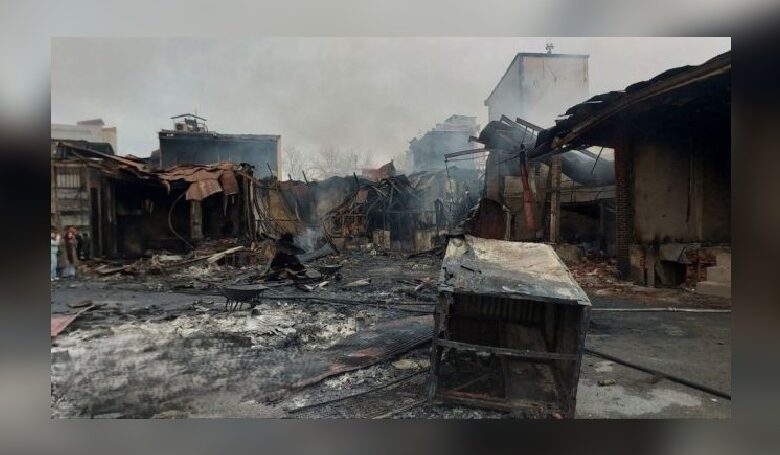
Eyewitnesses in Rasht reported the bloodiest and most violent crackdown in the city, which represents an unprecedented suppression during the December 2025 protests.
According to eyewitnesses and based on limited images released, what occurred on the nights of December 18 and 19, 2025 in Rasht went beyond a typical street crackdown and is now remembered as one of the “bloodiest” events in the contemporary history of this city.
The capital of Gilan Province effectively transformed into a scene of unrestrained violence on those two nights; a place where sections of the city’s old bazaar and several banks were consumed by fire, and a very large number of citizens lost their lives.
Despite the passage of time, the true extent of what happened in Rasht remains shrouded in obscurity. Eyewitnesses, including individuals who managed to transmit information from within the country at serious risk and those who have since left Iran to recount their experiences, insist that to understand the scale of this tragedy, more documents, images, and videos must be released. According to them, the intensity and scope of events was unprecedented and essentially indescribable in words.
In this regard, the accounts of three eyewitnesses to the Rasht events who spoke with BBC Persian present a chilling picture of those nights. To protect the security of these individuals, the accounts have been published in paraphrased form, a fact that itself testifies to the atmosphere of terror and fear gripping the country.
The Rasht crackdown is only part of a larger picture. In the third week of nationwide internet shutdowns in Iran, images have leaked showing the situation in various cities following the massacre of protesters. Among these images are videos from Beheshti Zahra, Tehran’s largest cemetery, on December 21, 2025; where large crowds of families gathered to bury their loved ones. These images, without requiring explanation, reveal the depth of the human tragedy unfolding in the country.
Human rights organizations, citing field data and informal reports, have warned that since the beginning of December 2025 protests, thousands have been killed or wounded. The Human Rights News Agency (HRANA) announced that by February 4, it has verified 5,149 protester deaths and is simultaneously investigating around 17,000 additional fatalities. These organizations emphasize that given severe censorship, communication blackouts, and pressure on families, the final count of victims could be several times higher than currently reported figures.
The widespread suppression of protests, prolonged internet shutdowns, prevention of independent reporting, and pressure on witnesses and families of victims are familiar patterns in how Iran’s government responds to public protests; however, what occurred in December 2025, according to many observers, represents a crossing of boundaries that is considered unprecedented even compared to previous crackdowns.
Rasht, a city long known as a symbol of social and cultural vitality in northern Iran, is now tied to a name that recalls fire, blood, and imposed silence; a silence that can only be broken through the revelation of truth and meticulous documentation of these events.
The widespread and prolonged internet shutdown during the December 2025 protests cannot be viewed merely as a security or technical measure; it was an inseparable part of the suppression mechanism. At this juncture, the internet was not only a means of communication, but the only way to record, document, and save lives. Depriving citizens of access to it meant blocking the path of outcry, testimony, and assistance.
When security forces violently attacked protesters, the internet shutdown effectively transformed cities into isolated islands; islands where massacre could continue without public oversight and without fear of accountability. The lack of communication disrupted the ability to contact families, media, doctors, and even emergency services, and according to accounts, many of the injured died because medical assistance did not reach them.
The internet shutdown was also a tool for distorting reality. In the absence of images and real-time reports, the government’s official narrative had space to label victims as “rioters” and conceal the true extent of violence. This is while experience from previous protests in Iran has shown that wherever the internet remained operational, visual evidence has been able to challenge official narratives and prevent widespread denial.
From a human rights perspective, internet shutdown during protests is an instance of collective punishment and a clear violation of the right to access information. International organizations have repeatedly warned that such measures not only violate freedom of expression but also facilitate more serious violations such as extrajudicial killing, forced disappearance, and torture.
What happened in Rasht and other Iranian cities showed that internet shutdown is no longer merely an “emergency response” but has become a structural tool in managing suppression; a tool that imposes silence, targets collective memory, and limits accountability from the very beginning.
Until these events are independently investigated and their perpetrators held accountable, the risk of such tragedies recurring remains; tragedies that occur in the darkness of internet shutdowns and can only be illuminated again through insistence on truth.