Zahedan’s Bloody Friday, A Tragedy That Cannot Heal With Peace Talks and 10-Year Sentence
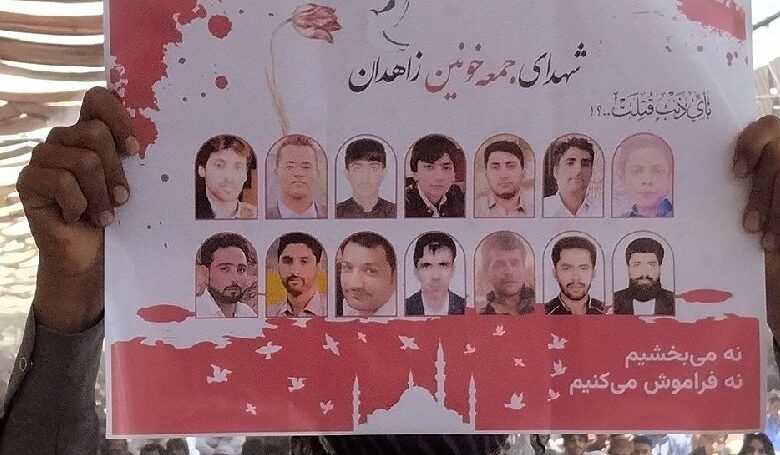
On the third anniversary of Zahedan’s Bloody Friday, even peace talks and a 10-year sentence have failed to heal this tragedy.
A peace and reconciliation meeting was held with an apology from the governor of Sistan and Baluchestan to the families of victims of Mecca Mosque during “Zahedan’s Bloody Friday,” but the 10-year prison sentence for those responsible for the shooting and the reduction of the tragedy to an “incident” continues to provoke anger and grievances among the families.
Three years have passed since “Zahedan’s Bloody Friday” on September 30, 2022, when worshippers at Mecca Mosque came out to the street after prayers and were met with gunfire. Dozens were killed and many wounded that day; an event that still lives in the collective memory of the people of Sistan and Baluchestan.
Recently, the judiciary announced that the accused in this case have been sentenced to the “severest legal punishment,” namely 10 years in prison. A ruling that not only failed to gain public acceptance, but drew serious criticism from the families of the martyrs and political activists. Moein-al-Din Saidi, a former parliament representative, says on this matter: “Accepting only ten years as the sentence for murderers has been heavy for the people. September 30, 2022 was the greatest tragedy that Sistan and Baluchestan province has experienced since the time of the Medes.”
With the advent of the fourteenth government, Mansour Bijaar, governor of Sistan and Baluchestan, held a peace and reconciliation meeting with the families of victims at Mecca Mosque and formally apologized on behalf of the government. “Safar Islami,” an advisor to the governor on social affairs, described this action as a salve for part of the people’s wounds and emphasized that “the killing was acknowledged, the perpetrators were convicted, and the families by their presence at the meeting showed a kind of implicit consent.”
Nevertheless, Saidi believes that using the term “incident” for this tragedy is a diminishment of the matter and an ignoring of its dimensions. He stressed: “In the early days, even the very fact itself was not acknowledged by some officials, and people were branded with separatism. This is while the people of Baluchestan consider themselves Iranians more than anything and are loyal to the territorial integrity of the country.”
According to local officials, compensation for victims has been paid and the Martyrs Foundation has followed up on many cases, but these measures have not been able to repair the depth of the rift created between the people and the government. Saidi says: “September 30 was definitely a disconnect between the people and the government. This disconnect was turning into a fault line. Efforts must be made to fully repair it.”
Now, although the peace and reconciliation meeting and the governor’s apology are evaluated as positive steps, the families’ grievances remain: Why was the main perpetrator not identified? Why was only a 10-year prison sentence issued? And why was such a great tragedy reduced to an “incident”?
Zahedan’s Bloody Friday is a wound that has not yet healed, a wound that cannot be closed by compensation payments and peace meetings alone, but requires transparency, true justice, and accountability at the highest levels of governance.